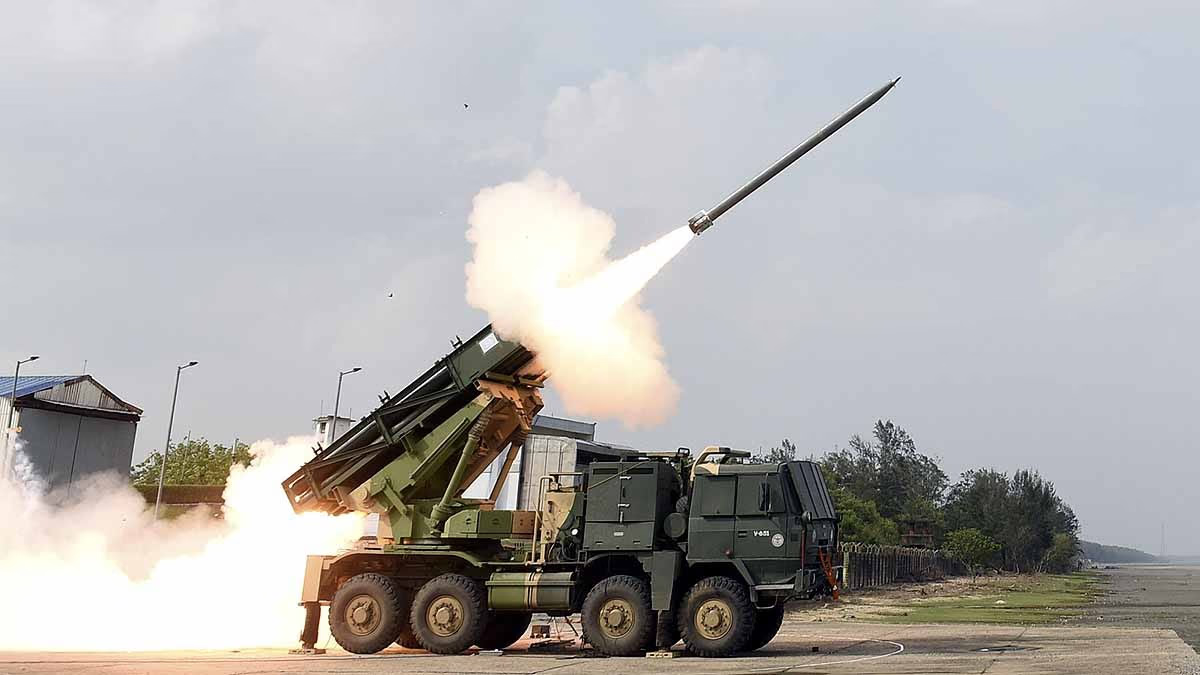
Operation Sindoor – this name will be etched in golden letters in India's military history. On the night of May 7, the Indian Army executed 24 precise strikes on terrorist camps in Pakistan. The indigenous Pinaka Multi-Barrel Rocket Launcher (MBRL) obliterated supply lines, bunkers, and staging areas 120 km away within minutes.
According to DRDO Chairman, Dr. Samir V. Kamat, this attack was a stellar example of 'Deterrence by Punishment' – compelling Pakistan to rethink by meting out punishment. Now imagine, when the new 300 km range Pinaka Mk4 bliver anywhere enters the forces by 2030, what fate will await the enemy?
You can also read:
Operation Sindoor began on April 22, 2025, with a terror attack in Pahalgam that claimed 26 innocent lives. India held Pakistan accountable, though Pakistan denied involvement. On the night of May 7-8, India targeted 9 terrorist bases — 5 in Pakistan-occupied Kashmir and 4 in Pakistan's Punjab province.
The Role of Pinaka:
The Mk-3 variant (120 km range) collaborated with BrahMos missiles, Rafale jets (equipped with SPICE-2000 and HAMMER bombs), and Smerch to execute 24 strikes. A battery (6 launchers) discharged 72 rockets in 44 seconds, decimating an area measuring 1,000 x 800 meters.
Satellite images confirmed the destruction of camps in Muridke, Sialkot, and Jacobabad. Over 100 terrorists were killed, including those accused of IC-814 hijacking and the Pulwama blast.
Also of Interest:
Pakistan's Response and India's Shield:
Pakistan retaliated with drone and missile strikes (targeting Srinagar, Jammu, and Pathankot). However, India's S-400, integrated counter-drone grid, and Pinaka nullified these attempts. The army released videos declaring our forces as an unyielding wall of fire. There was no significant damage; rather, India suspended the Indus Water Treaty.
This operation surpassed the Uri Strike (2016) and Balakot (2019) in depth, precision, and risk. According to the Royal United Services Institute (RUSI), it bolstered India's 'Calibrated Force' strategy.
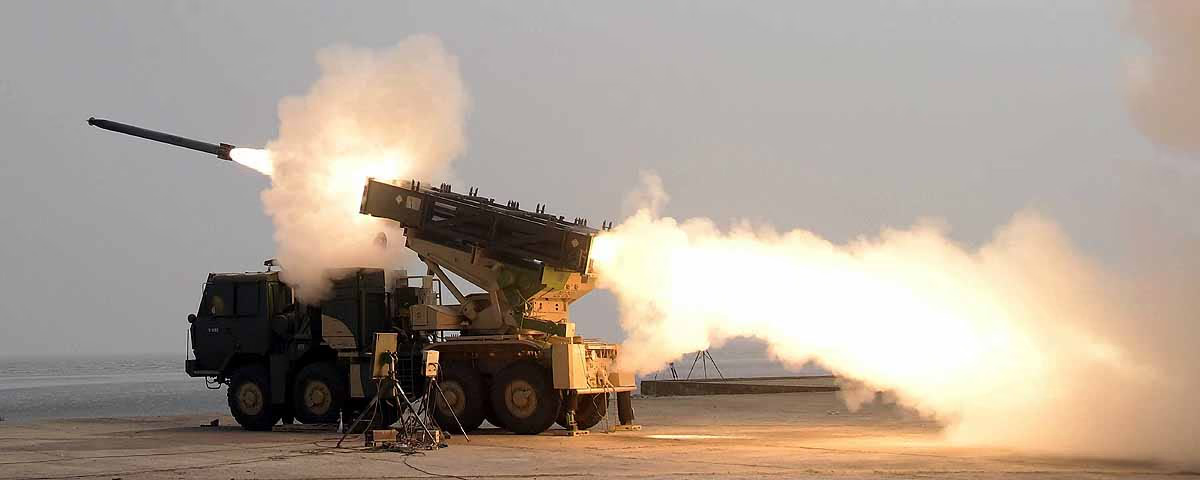
Source: aajtak
The Journey of Pinaka: From 38 km to 300 km Flight
Named after Lord Shiva's bow, Pinaka was developed by DRDO in 1986 to replace Russian Grad-Smerch. It was first used in the Kargil War (1999) to destroy Pakistani bunkers. Today, 4 regiments (72+ launchers) are deployed, with 22 regiments planned by 2030.
Pinaka rockets run on solid fuel, lending them a ballistic missile-like speed. The Mk4...
Follows a Quasi-Ballistic Trajectory: Taking a high parabolic flight (100+ km altitudes) before plunging rapidly, evading enemy air defenses like Pakistan's HQ-9.
Features Evasive Maneuvers: Employing throttable propulsion for mid-course direction changes, evading radar detection, enhancing the hit rate by 70%.
Boasts Triple Guidance: Incorporating GPS (satellite), INS (Inertial Navigation – compass and accelerometer), and active radar (locks at terminal phase). Even if GPS is jammed, the CEP is within 2 meters, allowing a single rocket to destroy a bridge or radar site with pinpoint precision.
Executes Rapid Fire: Launching 12 rockets in 20 seconds — a regiment (18 launchers) can fire 216 rockets to obliterate an airbase 300 km away. Payload options include cluster munitions or loitering drones.
Offers Cost Efficiency: A single Mk4 rocket costs 4-5 crore INR, compared to a BrahMos missile at 15-20 crore INR, offering quadruple destruction at 25% of the cost.
Scientifically, it bridges artillery and tactical ballistic missiles. According to RAND simulations, the Mk4 will triple India's deep-strike capability.
China's Border (Ladakh-Arunachal): Targets Tibet's airfields or missile sites within 300 km. Excels in high-altitude operations.
Pakistan LOC: Direct hits on Islamabad or Karachi logistics. Conducts deeper strikes like Sindoor, but five times more penetrative.
Coastal Defense: Capable of sinking the enemy's navy from the Andaman islands at a distance of 300 km. An anti-ship variant is feasible.
Global Export: France is actively negotiating — India's first MBRL export. Extra production post-22 regiments to feed exports.
Induction Timeline: Mk-3 by 2028, Mk-4 by 2030. Part of a 5-year DRDO plan for artillery modernization.
Production: Initial 10 regiments (180 launchers). Private companies (Tata, L&T) hold a 50% share.
Army Confidence: Pinaka variants wreaked havoc in Sindoor, terrorizing Pakistan. The 300 km variant could deter any daring assaults. India is wielding a formidable new weapon.