In the city of dreams lies a peculiar charm where even hardship is auctioned. They say the drains of Mumbai glisten like gold where poverty is no longer just a condition but a 'sellable' item. It is a paradox where local shortcomings are cloaked under 'exposure' and 'education' and put on display. Buyers of this showcase are not just tourists from distant lands but also the elite of Malabar Hill and Pedder Road, for whom poverty has become a 'tourist destination.'
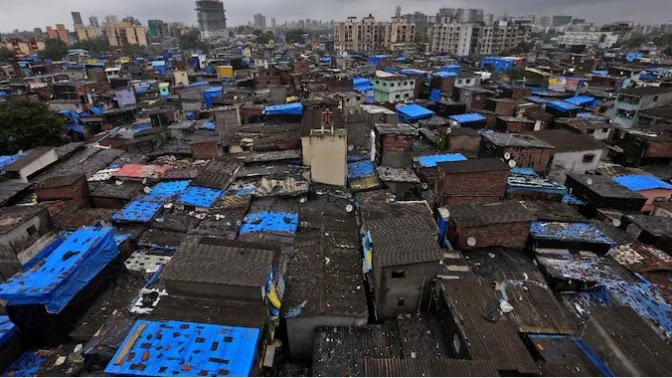
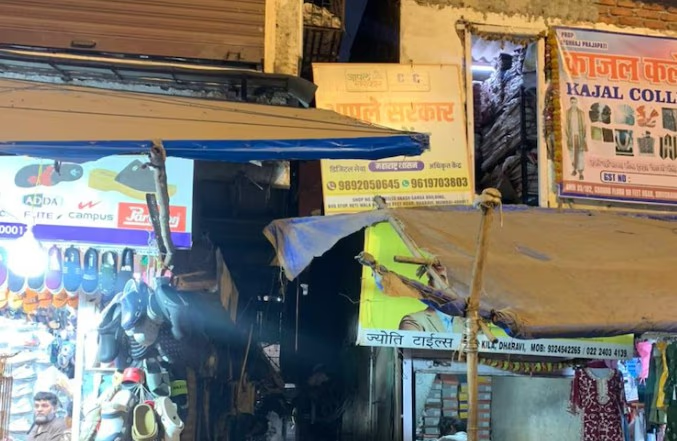
Dharavi, one of the largest slums in the world, is where this spectacle is most apparent. During a recent visit to this settlement at the heart of Mumbai, one of the most shocking sights was the sale of poverty to the elite, at the astounding price of 15,000 rupees for just two hours.
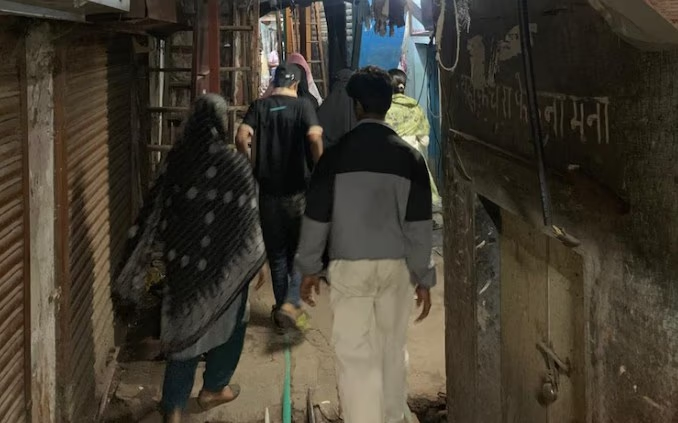
While interviewing a plumber, Raju Hanumanta, and his neighbor Shanappa, an idli seller, in the narrow lanes of Dharavi, a group of foreigners appeared, led by a 'guide,' in a place where one would least expect their presence.
Also worth reading:
The Hidden Side of Mumbai...
There are many alleys in Dharavi where even the regular Mumbaikar hesitates to go. These lanes connect to a darker side of Mumbai once linked to crime lords like Varadarajan Mudaliar. His henchmen are no longer involved in extortion or mayhem but have shifted to what are now considered legitimate businesses like real estate, land dealings, and drugs. S. Hussain Zaidi, an author and former investigative journalist who knows these shadowy parts of Mumbai inside out, states that while methods have changed, the nature remains unchanged.
Nonetheless, that parallel economy is another story. Here, we discuss the 'business of poverty.'
Poverty, especially in India, sells like hotcakes. Dharavi's billion-dollar economy holds an element we had not considered. The foreign group was led by a local, Omkar Dhamale. When asked how much he charged for this 'slum tour,' his answer was, '15,000 rupees per person.' With five foreigners, he was about to make 75,000 rupees for just a two-hour walk through the slums.
Source: aajtak
Poverty Tourism: An Ongoing Phenomenon
This is not a new trend. 'India Today Magazine' reported on the growing 'poverty tourism' across India in 2006. The game has changed; now, Dharavi residents themselves manage these tours, charging a fee comparable to a corporate salary. Foreign visitors to Mumbai often venture only as far as Dharavi's leather market street, missing its deeper reaches. These narrow, three-foot-wide alleys hold corners unseen by the world, attracting even those Mumbaikars who have never dared tread there.
Indians pay different rates for these slum tours—ranging from 1,500 to 7,000 rupees, prices generally half of what is charged to foreign tourists. Many label these tours as 'voyeurism,' watching others’ hardships or private lives out of curiosity. But for local resident Dhamale, who grew up in Dharavi and studied till the 12th grade, there’s no harm in earning from their locality. He asserts, "White people have never seen a slum before, they get to see my home, and I earn money; why not show them?"
Read More:
The real problem arises when wealthy individuals make money by providing biased glimpses of poverty to other rich folks. As you step into the lanes of Dharavi, you realize the reality of a life full of struggle, where every person fights to retain their identity. When you see guides like Omkar Dhamale leading foreigners there, eager to witness poverty, you come face-to-face with Mumbai's complex and bizarre truth.
Dharavi presents a dual spectacle that goes beyond appearances. Bharat Gothoskar, founder of 'Khaki Tours,' initially opposed the idea of escorting tourists to Dharavi. He told India Today Digital, "For the first three to four years, we did not do this." To him, it was akin to 'poverty tourism,' a situation resembling a scene in 'Munnabhai MBBS' where a Japanese tourist seeks 'poor and hungry people' in Mumbai.
How Is Poverty Being 'Sold'?
However, he explained this trend didn't spring up overnight. 'Reality Tours,' launched in 2005 by European social worker Chris Way and Krishna Pujari, provided a blueprint for organized tours in Dharavi. This initiative was meant to enable local students to earn enough to fund their education. Gothoskar said a significant part of their profits contributed back to the community. Over time, what began as an organized effort morphed into something else entirely. He added, "Now, slum tourism in Dharavi has become a 'cottage industry.' Today, anyone who can manage a bit of English can present themselves as a guide and 'sell poverty.'"
Gothoskar's perspective shifted after participating in one of these tours himself. He argued, "As I see it, it's not just about poverty. It’s about industry, migration, religion, and geography as much as it is about lack."
Many homes now have air conditioners, astonishing both locals and foreigners. Gothoskar remarks, 'It’s true that space is cramped here, but it's located at the city's heart. For residents, it’s a practical deal providing easier commutes than distant suburbs like Virar or Badlapur.' Gothoskar emphasizes his company avoids sensationalizing Dharavi. 'We work with locals, but our approach is unique. We focus on informal housing, recycling, and the settlement's layout and discussions.'
Source: aajtak
While some tours delve into intricacies and local perspectives, others, like Dhamale’s case, simply lead wanderers through the alleys without insight. When asked if Dhamale sought permission from locals for snapping foreign visitors' pictures, he shrugged, 'They’re our folks... it’s all good.'"
Yet that wasn't entirely true. When 'India Today Digital' asked Raju Hanumanta, his wife, and Shanappa for pictures, they refused outright. This is because mentioning Dharavi often evokes associations with struggle and poverty, and they feared another journalist came to showcase only that. They didn't want to be permanently identified with these negative memories of slum life.
The line between providing information and infringing on personal lives is a fine one, protested by residents. Some areas have banned tourists entirely for snapping unpermitted interior photos.
Gothoskar stresses, "We always insist on seeking permission before taking photos." In Kumbharwada, elderly women often refuse to be photographed. Visitors are politely told to click pictures of the pots, not the potters.
Gothoskar believes it's a guide's responsibility to educate tourists that the tour is for understanding, not for incessant photographing or 'poverty-watching.' He further explained, "The waste recycling system, where collectors pay for waste without government aid, is more astonishing to foreign guests than cramped homes but needs contextual clarification."
He adds, "A local resident tells one aspect of the story, while a trained guide compares it to slums in Brazil or other cities worldwide, providing depth." These 'slum tours' in Dharavi also highlight the culture of hard work and industrial spirit thriving there.
Gothoskar said, "Whether redevelopment will alter this spirit remains uncertain. Livelihood modes will change. Even young guides employing these tours might need to reinvent themselves." When India Today Digital asked Raju Hanumanta and his wife about their feelings toward outsiders and guides intruding unannounced, Hanumanta replied, "It supports their livelihood. What else can I say?" His wife nodded in agreement.