The recent events in Venezuela have left the world astounded. Rarely do we see an existing president being taken from their residence, with the situation sparking intense social media reactions in India. People argue that if Venezuela possessed nuclear weapons, America might not have dared such an action.
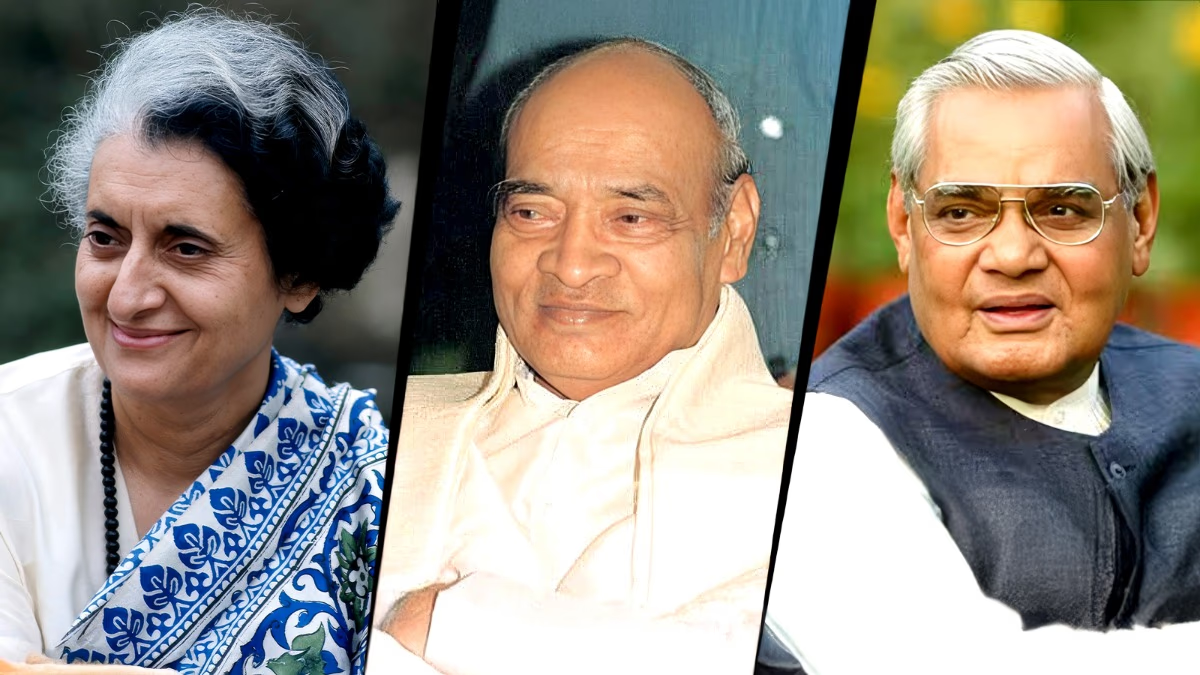
The passionate online discussions have also led to a wave of gratitude towards former Indian Prime Ministers Indira Gandhi, Narasimha Rao, and Atal Bihari Vajpayee, for transforming India into a nuclear power, securing the nation's sovereignty through nuclear strength.
A user highlighted Indira Gandhi's Smiling Buddha nuclear test, stating that without it, even the land of the Buddha might have faced the humiliation experienced by Venezuela.
It’s worth noting that Smiling Buddha was India's first successful nuclear test, conducted by Indira Gandhi's government on May 18, 1974, in the Pokhran desert of Rajasthan. Held on Buddha Purnima, it was codenamed 'Smiling Buddha' to symbolize peaceful intentions.
This landmark test established India as a nuclear power. The aftermath saw the United States imposing several sanctions on India, yet the country stood firm.
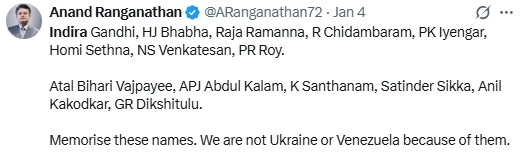
Renowned debater Anand Ranganathan responded on X to events in Ukraine, crediting Indira Gandhi, H.J. Bhabha, Raja Ramanna, R. Chidambaram, P.K. Iyengar, Homi Sethna, N.S. Venkatesan, and P.R. Roy for avoiding a fate similar to Ukraine or Venezuela.
Source: aajtak
User 'Ironman' shared, "After witnessing Venezuela's plight, my respect for Indira Gandhi has grown. Even when America was at our doorstep threatening an attack, she showed no fear."

Source: aajtak
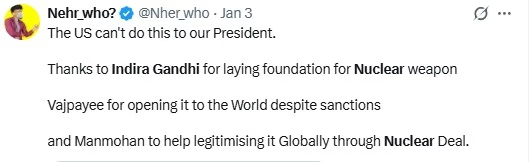
Another user commented on the Venezuelan incident, thanking Indira Gandhi for laying the nuclear foundation, Vajpayee for exposing the nuclear program to the world despite sanctions, and Manmohan Singh for furthering its global recognition.
Source: aajtak
It’s important to remember that Pokhran-2, India's second nuclear test, was conducted under Atal Bihari Vajpayee's government on May 11 and 13, 1998, involving five underground blasts known as Operation Shakti, comprising both fusion (hydrogen bomb) and fission bombs.
This operation declared India a complete nuclear power. While the U.S. and Pakistan condemned it and imposed sanctions, India persevered.
User 'Rajiv' stated, "The USA threatened us, attempting everything to prevent us from becoming a nuclear nation. Yet, Indira Gandhi defied all threats and made us one in 1974. Today, as I see the U.S. attacking other nations, I appreciate the importance of being nuclear-armed."
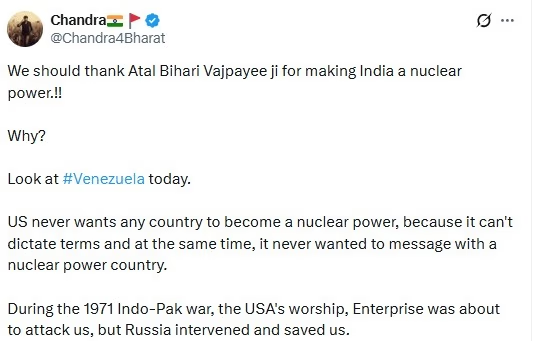
User 'Chandra' wrote, "We owe our thanks to Atal Bihari Vajpayee for making India a nuclear power. Why? Look at Venezuela today. America never wants any country to become nuclear-powered, as it can't impose its will and doesn't want to conflict with a nuclear nation."
During the 1971 India-Pakistan war, the American warship 'Enterprise' threatened us. Still, Russia intervened to assist us.
Source: aajtak
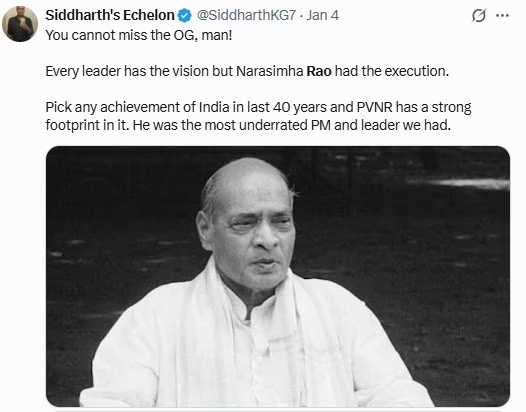
In remembering the nuclear development, a user highlighted Narasimha Rao's contribution, noting that, although every leader has vision, Rao had the ability to implement it. In the past four decades of India’s achievements, P.V. Narasimha Rao has had significant involvement.
Source: aajtak
Narasimha Rao was indeed a crucial figure in empowering India as a nuclear nation. In 1995, he ordered preparations for a nuclear test at Pokhran, but it was aborted due to American intelligence. Rao advised scientists to be ready, pushing the program forward so the subsequent government could conduct the tests.
Notably, in 1998, when Vajpayee returned to power through a coalition government, former Prime Minister Rao met him shortly after the swearing-in ceremony. Rao indicated to Vajpayee, "The materials are ready, you can proceed," implying that all preparations for the nuclear test were in place. Atal Bihari Vajpayee promptly approved Pokhran-II upon assuming office in 1998.