Last Saturday, the U.S. military launched an attack on Venezuela, arresting President Nicolas Maduro, causing a major upheaval. Various nations are criticizing America's action. Meanwhile, Washington accuses Venezuelan leadership of enabling drug shipments into the U.S., necessitating this action. However, data shows other countries serve as primary drug suppliers to the U.S., not Venezuela.
Late last year, U.S. forces attacked along Venezuela's maritime borders, sinking numerous boats, claimed to be used for drug trafficking. This led to the arrest of Venezuelan leader Nicolas Maduro, who is now in a New York detention center sparking political turmoil back home.
The dire threat drugs pose to America is evident in data. The country, infamous for its drug issues, now sees around 100,000 annual deaths due to drug overdoses, primarily from synthetic drugs. This stark reality isn't an accusation but a warning from the U.S. Centers for Disease Control and Prevention. Drug overdose deaths now surpass those from road accidents.
While Venezuela was subject to extreme action based on severe accusations, no publicized drug shipment trace directly to Venezuela exists. There's no established link between Venezuelan drug trade and the overdose epidemic. According to the United Nations Office on Drugs and Crime, fentanyl, the primary illegal drug causing numerous deaths, originates from Mexico.

Source: aajtak
On September 19th, the Trump administration sank its first boat at sea, claiming each vessel was packed with fentanyl, describing boat-sinking as saving twenty-five thousand lives. Despite lack of evidence, more boats were sunk, culminating in Maduro's arrest.
Now, concerning cocaine, Venezuela lags behind Mexico, Panama, and Colombia as per UNODC. Most drug shipments take maritime routes, with some traversing by land. The primary drug trafficking route from Venezuela to the U.S. is aerial, well-guarded against drug entry.
In reality, Venezuela isn't a major drug producer like Colombia. Cocaine is produced in Colombia, Peru, and Bolivia. Venezuela's role is acknowledged as transit, facilitating drugs' journey to the U.S. and Europe. Allegations have surfaced about military and political collusion in facilitating drug shipments, but proven culpability lacks.
Source: aajtak
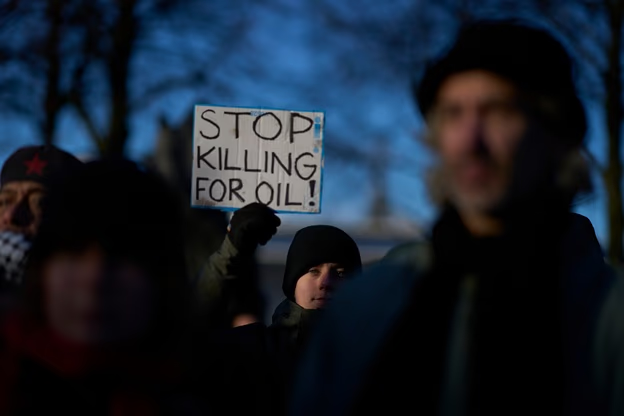
Venezuela owns substantial oil reserves, long coveted by America. With Maduro's arrest and an economic meltdown, America sees an opportunity to install a favorable government. Trump has been forthright about his intentions, stating U.S. forces will remain until Venezuelan stability returns. Post-arrest, drug discourse died down, with no raids unveiling trafficking.
Despite being labeled as significant drug suppliers, Colombia and Mexico don't face direct American military actions like Venezuela. Colombia cooperates with America's drug war, receiving billions through Plan Colombia to fight drug cartels and guerrilla organizations, treating them as allies, not adversaries.
The case of Mexico is even more delicate, given its proximity to and integration with the U.S. economy. Direct military action in Mexico could instigate instability, impacting the U.S. border directly. Millions might flee violence and chaos to America, prompting a balance-maintaining strategy with Mexico.