After the U.S. attack on Venezuela, leading to the arrest of President Nicolas Maduro, President Donald Trump finds himself in a web of legal and political questions. The international backlash against this action is scathing, and divisions within the Trump administration have come into the open. U.S. Secretary of State Marco Rubio's recent remarks have added controversy to the operation.
Rubio distanced himself from Trump's claim that the U.S. would "run" Venezuela until the power transition is completed. Rubio clarified that America is not running Venezuela but merely shaping its future direction. As he stated, "We are directing where things will go next. We hold the leverage."
Read also:
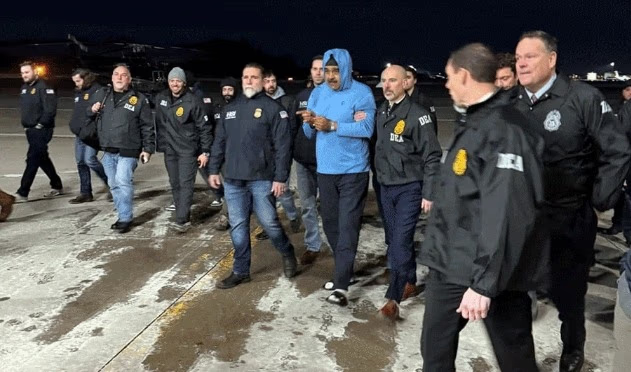
The primary question is whether this action was a military invasion and if it required U.S. Congress approval. Rubio insisted this was no invasion or prolonged military campaign, thereby negating the need for Congressional consent. He termed it a "law enforcement operation," intended to arrest a wanted drug trafficker, although this rationale clashes with previous statements from the Trump administration.
Source: aajtak
An Attack on Venezuelan Soil Would Be Considered 'War'
According to American media reports, White House Chief of Staff Susie Wiles declared in November that any assault on Venezuelan soil would be deemed an act of war necessitating Congressional approval. Back then, Trump administration officials privately acknowledged to lawmakers that they lacked a legal standing for a ground assault in Venezuela.
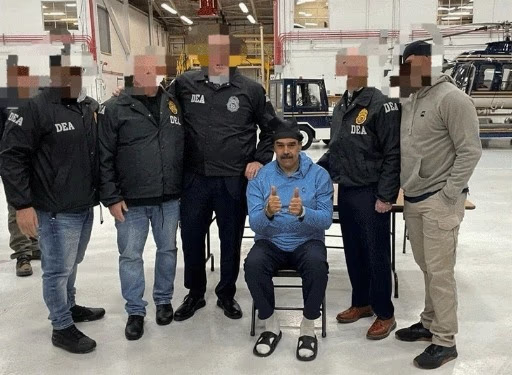
Nevertheless, just two months later, the U.S. executed what it had once deemed unfeasible and unlawful. Trump referred to it as a "full-scale attack against Venezuela." Under the operation, Maduro and his wife Cilia Flores were taken to New York, facing charges related to drug trafficking, terrorism, and illegal arms dealings, and are currently detained at the Brooklyn Metropolitan Detention Center.
Statements from J.D. Vance, Pete Hegseth, and Rubio
The legal framework for the operation continues to evolve. Republican Senator Mike Lee mentioned that Rubio had told him the assault was crucial for the safety of U.S. personnel executing an arrest warrant. Later, Vice President J.D. Vance, Defense Secretary Pete Hegseth, and Rubio reiterated the same justification.
Source: aajtak
However, critics argue that many individuals facing charges in the U.S. do not prompt military assaults on sovereign countries. This raises serious questions about international law, the U.S. Constitution, and the role of Congress.
The U.S. operation on Saturday, branded as a "law enforcement operation" by the Trump administration, has contradicted its own rhetoric. Trump's statements, suggesting U.S. involvement in running Venezuela, especially concerning its oil industry, contradict claims of merely enforcing law.
Read also:
These developments indicate it's not just about arresting Maduro, but potentially about control over governance and natural resources, drawing international law and U.S. Constitutional scrutiny.
Experts Weigh in on Maduro's Arrest
Experts believe that even with a strong legal rationale, justifying such an action is challenging. While the U.S. previously used military force for regime change in Iraq, sanctioned by Congress in 2002, post-9/11 terror conflicts were also backed by Congress. However, the Venezuelan scenario lacks such consensus.
Source: aajtak
Though comparisons to Iraq are frequent, some see parallels with the 1989 Panama operation, when the U.S. apprehended President Manuel Noriega for drug trafficking. The operation was described as limited, but eventually, the U.S. Justice Department recognized that the FBI wasn't authorized for such actions.
Notably, American laws previously disallowed forcibly bringing foreign nationals to the U.S., but in 1989, the government revised its legal stance, resurfacing the debate with the current Venezuelan situation.