A deceased man's files have sent shockwaves across the lives of countless powerful individuals around the world. There is always the fear of when and whose name or picture might emerge from these notorious Epstein Files, causing widespread panic among the influential.
The heart of these files lies in their connection to a man accused of exploiting minors, implicating a range of powerful, wealthy, and renowned people globally. Remarkably, the mention of these files unexpectedly found its way into the premises of the country's highest judiciary, the Supreme Court, this Monday.
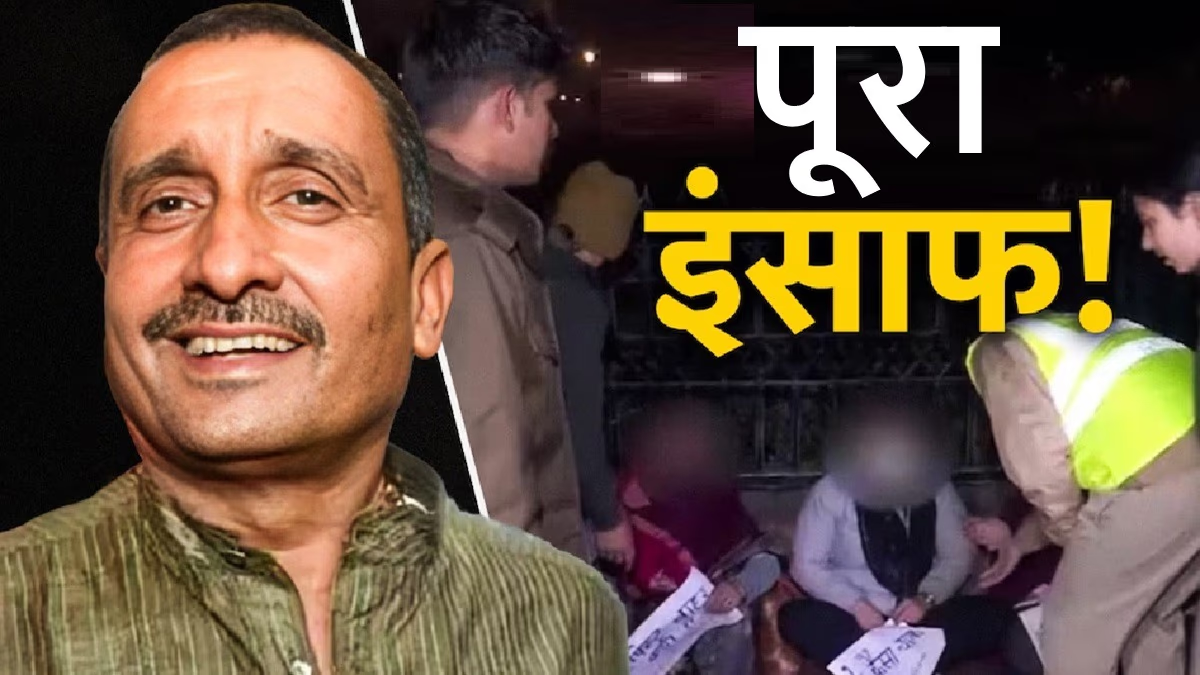
Kuldeep Singh Sengar, a convicted criminal, never actually met Epstein. But eight years ago, in 2017, as a sitting MLA from the ruling party in Uttar Pradesh, he committed atrocities against a minor, leading to his comparison to the 'Indian Epstein' in the Supreme Court this Monday afternoon.
For five consecutive days, a decision by the Delhi High Court raised eyebrows and disturbed both commoners and legal experts: how could someone convicted of rape, sentenced to life imprisonment, be ordered released on bail? The nation's highest court, too, remained perplexed over this decision. Consequently, the Supreme Court intervened, challenging the Delhi High Court's order and ensuring Sengar would remain incarcerated for now.
Previously, on December 23, the Delhi High Court granted bail to Sengar, stating he had already served over seven years in prison. The Court's justification hinged on a technical assertion that Sengar didn't fall under the POCSO Act's category of a 'public servant,' an interpretation that puzzled many, as Sengar was indeed a member of a ruling party at the time.
Read More: Kuldeep Sengar's First Statement After the SC Shock, Expressing Grief Over His Family's Ordeals
The CBI challenged this interpretation in the Supreme Court, arguing that the POCSO Act's provisions very much include figures like legislators or parliamentarians, who fall within the broad definition of public servants.
Moreover, the CBI argued that such individuals, using their power, privilege, or influence, have a greater responsibility and hence deserve more stringent punishment under the POCSO Act if found guilty of crimes against minors.
In line with the CBI's argument, the Supreme Court observed lapses in the Delhi High Court's comprehension of the POCSO Act. Under this Act, crimes against minors attract a minimum of seven years to life imprisonment, but offenses committed by 'public servants' demand even harsher penalties.
Sengar's defense contended that he should face a minimum penalty, arguing against his public servant status. Yet, the Patiala House Court had previously recognized him as such while delivering its life sentence.
Overturning the Delhi High Court's decision, the Supreme Court stayed Sengar's bail. Chief Justice Surya Kant, along with Justices JK Maheshwari and Augustine George Masih, rendered the verdict, emphasizing the uniqueness of Sengar's case due to his concurrent incarceration for a homicide conviction.
Read More: Unnao Rape Case: Supreme Court Halts Bail; A Setback for Kuldeep Sengar
In response, the victim's family expressed gratitude to the court yet voiced concerns about their safety. For now, the new year dawns with the dashed hope of release for the 'Indian Epstein' Kuldeep Singh Sengar, amidst the earlier contentious decision by the Delhi High Court that briefly nullified his life sentence alongside ten more years for his previous conviction.