During the 1971 India-Pakistan war, around two hundred thousand RSS volunteers were involved in various relief and assistance efforts. At that time, much of the responsibility was handled by Balasaheb Deoras, as Guru Golwalkar started to feel weary. Although Dr. Praful Desai constantly checked on him in Nagpur, the requisite rest evaded Golwalkar, who rarely declined any RSS engagements.
Conscious of his condition, in January 1972, Golwalkar was on a tour in Uttar Pradesh. Continuous travel had left him exhausted. During a journey from Aligarh to Meerut, he humorously pointed out to his companions the relentless demands of his schedule, stating, "Notice how I’m driven every moment." Even during his Goa visit, he admitted feeling fatigued. Between July 25 and August 18, a reluctant rest was taken in Indore at Pandit Ram Narayan Shastri’s residence, followed by a sojourn to Rajasthan until late September. By October 4, fever struck yet he attended programs in Ajmer, moving on to Jodhpur and then Jaipur.
In Jaipur, Guru Golwalkar fell gravely ill with a temperature of 103 degrees. Despite his health, he resisted canceling a pre-scheduled meeting. Only when his voice failed, was a cancellation unavoidable, with the fever spiking to 105 degrees. Concerned doctors chastised his assistants for risking his health. For the first time, Golwalkar admitted loss of control over his body, a sentiment he shared with fellow volunteers while sipping tea the next morning. He declared, "It's the first time I am losing control of myself, never happened before." Once well again, he disregarded rest and returned to work.
Cancer Surgery in 1970
The health effects from tireless work became evident as Golwalkar turned sixty. In May 1970, a chest lump indicated cancer, yet he chose to delay treatment until after his May and June tours. On July 1, he underwent surgery by Dr. Praful Desai at Tata Cancer Hospital. Previously unfamiliar with RSS activities, Dr. Desai was impressed by Golwalkar’s calm endurance during surgery, reflecting, "I wondered at 65 how Guruji handled the intense, lengthy surgery with a smile unwavering." By the next day, Golwalkar was up and moving.
Upon being asked about his post-operative life expectancy, Golwalkar jested, "Ah, splendid! It means I have substantial time left. Much work awaits!" Dr. Desai maintained consistent checkups, soon allowing Golwalkar to resume his bustling routine of writing, traveling, and meeting volunteers.
Preparing for an Inevitable Transition
Realizing his traveling capacity waning, Golwalkar pondered over the future. Biographer C.P. Bhishikar notes, "Adhering to Hindu tradition, Guruji chose to converse with key workers for a final time," leading to an All-India study camp held in Thane, Maharashtra. Senior RSS officers and prominent volunteers from various fields gathered from October 28 to November 3. The camp was deeply moved by Guruji’s failing health.
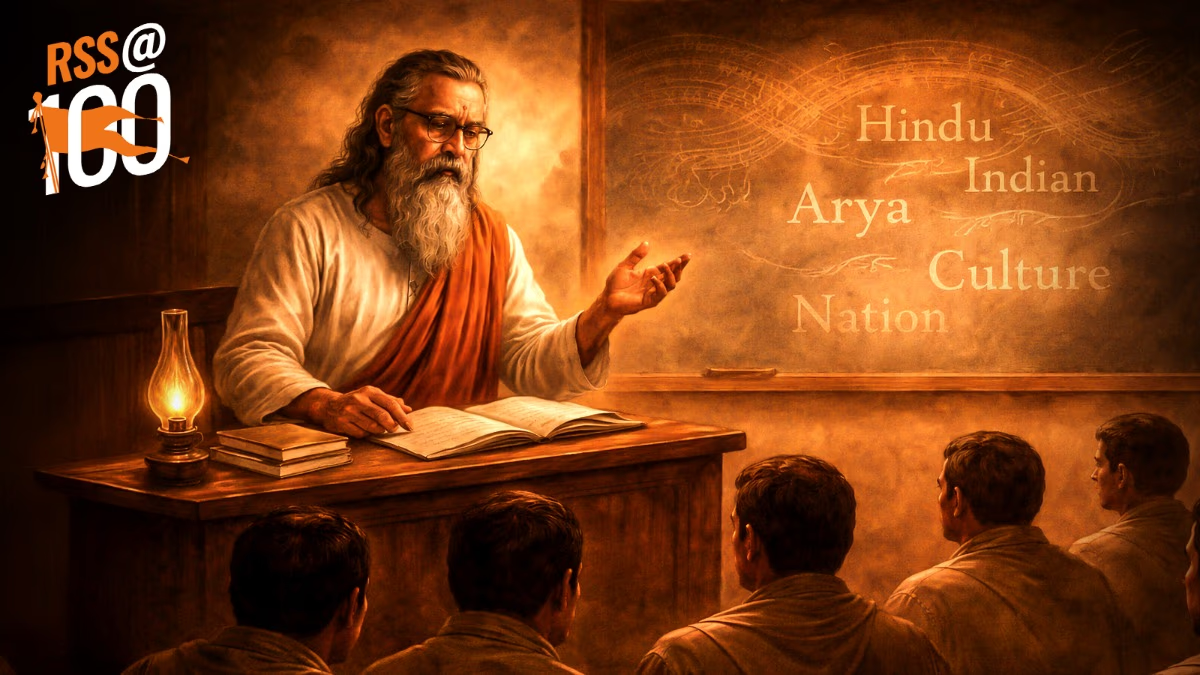
Hosted at Tad Gyan Vidyapith of Pandurang Shastri Athavale, it seemed as if a guru imparted his final teachings before renouncing the mortal form. With profound insight, Guruji articulated eternal Hindu cultural foundations through modern parallels and contexts.
The Significance of 'Hindu'
The foremost camp discussion questioned, "Why continuously emphasis 'Hindu' rather than adopting broader 'Indian'?" Dismissing recurrent accusations of RSS’s sectarianism required resolution. Golwalkar responded, "Attempts are made to misinterpret 'Hindu,' spreading misconceptions of RSS’s purported anti-Muslim, anti-Christian, anti-Jain, or anti-Harijan stance. However, such claims lack substance. A well-studied evaluation of our faith, culture, and history offsets these baseless allegations."
Lasting Imprints of the RSS Centennial Series
Further, he explained, "Our Hindu ideology flourished for millennia here, predating Christianity and Islam. Thus, labeling Hindu as Muslim-opposing holds no stand. Sikhism, Buddhism, Jainism seamlessly merge within the vast 'Hindu' concept. To reject the Hindu identity is akin to dismembering oneself, a self-destructive act. The Hindu vision has always been inclusively positive." Very likely, this was his final intellectual session, wherein compelling arguments dismantled the RSS’s alleged communal accusations, affirming pride in India’s eternal heritage. The dialogue demystified confusing terms—Hindu, Indian, Arya, Sanatani—planted by antagonistic elements to confuse volunteers, eliminating doubts among present camp volunteers.
Volunteers' Hope for Guruji's Address to End
Even post-Thane camp, Golwalkar persisted in travels. On February 4, 1973, he delivered an hour-long public address in fluent English while standing in Bangalore. Despite a vast audience of devotees and ordinary citizens unaware of his nearing departure, on March 25, he addressed key workers nationwide at the All India Representative Assembly in Nagpur for the last time. Volunteers, recognizing his difficulty, silently wished for his early cessation, yet he spoke for 40 minutes. Emphasizing, "Our foremost effort should be to earn global respect for our nation," he concluded, "Whatever circumstances arise, pursue our path convinced 'Hindu' will universally gain recognition." His concluding speech echoed, "Only triumph awaits."
Unable to Attend the Final Camp
In May, Nagpur hosted the third-year RSS training camp, which Golwalkar couldn’t attend. Accommodating his pressing desire, state volunteers were invited in rotations to meet him at the RSS office from May 16 to 25. Ultimately, the meetings couldn't extend further. Subsequently, visits from volunteers across regions and notable individuals from varied spheres attested to concern over his health. On June 3, visiting Rashtriya Swayamsevak Samiti director Mausi Kelkar received the poignant remark, "I am fully prepared."
On June 4 evening, when staff brought oil for massage, the flask laid empty to which Golwalkar joked, "That’s settled! Who massages tomorrow?" He bathed and meditatively sat at his usual seat on June 5, passing away at 9:30 PM that evening.
His Three Final Letters and Successor Named
Golwalkar's remains were laid before Nagpur's Mahal office on June 6. An emotional crowd gathered to listen to the reading of three sealed letters he’d penned. The first letter, read by Maharashtra's Sanghchalak Babasaheb Bhide, appointed Balasaheb Deoras as the next Sanghchalak. Deoras read two remaining letters. The second signified the appropriateness of constructing monuments only for RSS founders like Dr. Hedgewar. The third letter humbly sought forgiveness from any he’d inadvertently wronged during his lifetime, also referencing saint Tukaram’s Abhang (poem).
“O Holy Men! My final plea. Relay it to God that I remain remembered. They know all, what more to express. Tukaram articulates, head bowed at Their feet, I wish constantly to reside under Their grace.”
Cremated upon a sandalwood pyre near Dr. Hedgewar’s samadhi in Nagpur’s Reshambagh, a saffron flag was raised, followed by solemn RSS prayers. Chanting “Bharat Mata ki Jai,” dispersed volunteers returned home heavy-hearted. Now, Reshambagh houses two RSS heads’ tombs. Dr. Hedgewar's statue presides atop the Smriti Mandir, with Guru Golwalkar's symbol as a revered emblem.