Finance Minister Nirmala Sitharaman presented her ninth federal budget in Parliament on Sunday, with a strong emphasis on reinforcing Indian exports against American tariffs, infrastructure growth, and boosting manufacturing. Unfortunately, expectations for middle-class tax relief were not met. The 2026-27 budget proposes a total expenditure of 52.65 lakh crore rupees, including a record capital expenditure of 12.22 lakh crore rupees.
The budget's greatest strength lies in fiscal discipline. The finance minister has set a target to keep the fiscal deficit at 4.3% of GDP for the next fiscal year, less than the current year's 4.4%. This is a continuance of achieving the goal to bring it below 4.5% as promised in 2021-22. The debt-to-GDP ratio has also reduced to 55.6%.
The government has made it clear that expenditure will be prudent, reducing debt and deficit gradually, but simultaneously focusing on roads, cities, small industries, health, and employment. Presenting the budget, Finance Minister Nirmala Sitharaman emphasized that the government aims to meet common people's needs and strengthen the economy. Announcements include seven high-speed rail corridors and three Ayurvedic AIIMS (institutes).
Also Read:
No Relief for the Middle Class
Hopes for the common man and the middle class were dashed. People expected increases in the income tax slab exemption or standard deduction limit, but nothing was mentioned. However, certain lifestyle items will become cheaper: clothes, leather items, synthetic footwear, cancer-sugar 17 drugs duty-free, bidis, lithium-ion cells, mobile batteries, and solar glass will be cheaper, as well as mixed gas CNG, EVs, microwave ovens, aircraft fuel, and foreign travel will be less costly.
On the flip side, sectors where customs duty has been increased, making items more expensive include alcohol, scrap, and minerals.
The increase in STT for youth and professionals investing rapidly in the stock market is a setback. It's bad news for stock market investors, as the securities transaction tax (STT) on stock option and futures trading has been increased from 0.02% to 0.05%. This had an immediate effect on the market, causing investors to lose 8 lakh crore rupees. Taxes on alcohol, luxury items (like watches), and scrap have risen, making these items costly, and fines for misreporting income have been doubled to 100%.
Also Read:
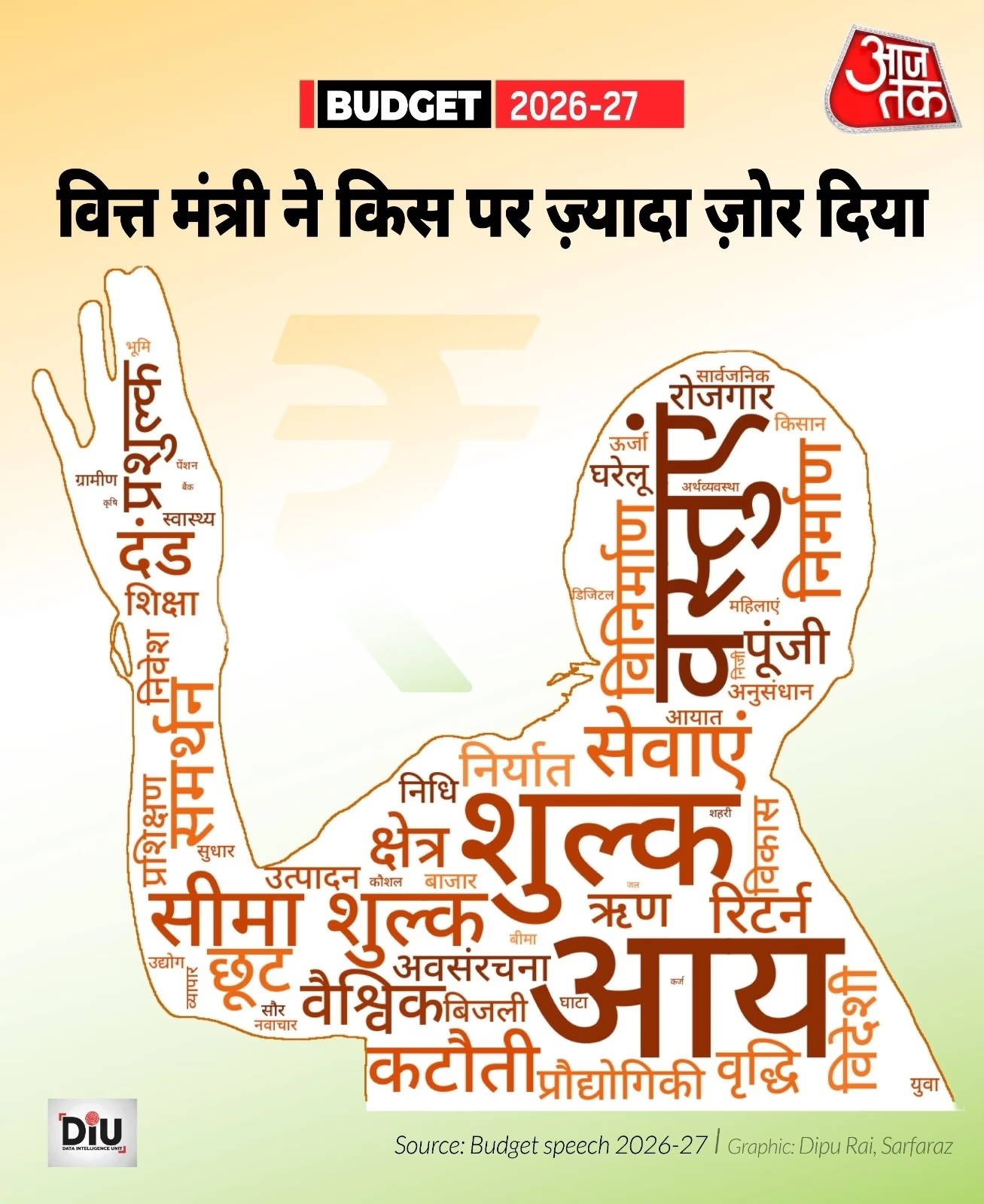
Source: aajtak
Industry Gets a Major Boost
The budget has clearly given top priority to the industry. Efforts to strengthen domestic manufacturing as a counter to the global tariff war are visible. In her budget speech, Finance Minister Sitharaman announced substantial funding for promoting micro and small industries. The government's goal is to prepare champion MSMEs. 10,000 crore rupees have been allocated for the MSMEs growth fund, aimed at helping small industries modernize and gain access to international markets while facing global trade disruptions. An additional 2,000 crore rupees have been added to the Self-Reliant India Fund.
Also Read:
The budget speech also spotlighted the manufacturing sector. A declaration was made to spend 40,000 crore rupees on EMS, or the electronics manufacturing service sector. Last year's budget was 19,500 crore rupees. Doubling the allocation for the PLI Scheme triggered strong action in EMS company shares.
Focus on Logistics Improvement
For urban growth, the government will focus on 'City Economic Regions' (CERs). To fortify Tier-2 and Tier-3 cities, 5,000 crore rupees have been allocated for each region over five years. Additionally, a 10,000 crore rupees plan will be initiated to develop an ecosystem for container manufacturing to enhance logistics.
To promote waterways, 20 new national waterways will become operational, establishing ship-repair ecosystems in Varanasi and Patna. The government's goal is to enhance inland waterways and coastal shipping's share from 6% to 12% by 2047.
Revolution in the Biopharma and Pharma Sector
In the health sector, the government announced BioPharma Shakti with a 10,000 crore rupees investment to make India a hub for global biopharmaceutical manufacturing. This includes the upgrading of three new and seven existing National Institutes of Pharmaceutical Education and Research (NIPER). There is remarkable news for cancer patients as basic customs duty (BCD) on 17 cancer drugs has been completely removed.
In addition, import duties on drugs for seven rare diseases have been waived. Previously, hefty taxes were imposed on imported drugs for these rare diseases.
Also Read:
Record Increase in Defense Budget
The budget includes a record allocation of 7.85 lakh crore rupees for the Ministry of Defense, accounting for 14.68% of the total budget, significantly more than the previous year's 6.81 lakh crore rupees. The government's focus on army modernization is evident.
Capital expenditure for army modernization has been increased from 1.80 lakh crore to 2.19 lakh crore rupees, showing India's commitment to equip its army with modern weapons, drones, and technology in view of global and regional challenges.
New Hope for Agriculture Sector
The government has slightly reduced the subsidy on fertilizers, but fertilizers will remain affordable for farmers. Next year, 1.70 lakh crore rupees will be spent on fertilizers. The government states that fertilizer prices have decreased in the international market and domestic production has increased, so expenditure has reduced.
Special attention has been given to animal husbandry, fisheries, and high-value crops like coconut, sandalwood, and cashew to boost farmers' income. A coconut incentivization scheme will support 1 crore farmers and benefit 3 crore people. The goal is to establish Indian cashew and cocoa as premium global brands by 2030, offering new recognition for India's agricultural products in international markets.
The 'Bharat Vistaar AI' (India Expansion AI) initiative has been launched in the agriculture sector, providing crop-related information and market prices in local languages to farmers. Self Help Entrepreneur (SHE) marts will be launched for women-led rural businesses to help women become enterprise owners.
Also Read:
Overseas Education and Treatment Made Cheaper
In tax slabs, the government has adopted a mix of selective relief and stringency. The TCS rate for sending money abroad for education and treatment (LRS) has been reduced from 5% to 2%. A uniform 2% TCS will also apply to foreign tour packages. This means Indians will pay less TCS when spending money on overseas treatment, education, or tourism.
These changes will make international travel less expensive and boost the tourism sector. Tax reductions on foreign spending in education and healthcare will make financial planning easier for middle-class families. Additionally, new TDS rules on contractor payments will simplify compliance for small businesses and reduce disputes. These government measures will undoubtedly lower the overall cost of transactions for citizens and merchants on an international level.
Focus on Mental Health in Budget
While presenting the general budget, Finance Minister Nirmala Sitharaman clearly stated the government's intent regarding mental health. In Budget 2026, measures were announced that could bring significant change in easing the accessibility of treatment and counseling nationwide. The finance minister announced a national tele-mental health program through which mental health counseling will be accessible via phone and digital platforms. IIT Bangalore has been entrusted with strengthening the technical side of this program.
Another major decision in the mental health field is the announcement of NIMHANS 2.0. The finance minister stated that the National Institute of Mental Health and Neuro-Sciences (NIMHANS) in Bengaluru will now be strengthened as a National Center of Excellence. Under this initiative, NIMHANS 2.0 will be established in North India to provide better mental health services to large parts of the country.
Focus on Gaming and E-Sports Sector
The budget's biggest highlight was the announcement of ABGC (Animation, Visual Effects, Gaming, and Comics) content creator labs setup. The government has clarified that gaming is now not just entertainment but a significant economy. These labs will equip talented youth in small towns with tools and software previously exclusive to big studios. This paves the way for world-class games to be created in India.
The finance minister has hinted at strengthening e-sports as a professional sport. The budget allocates ₹12.2 lakh crore for digital infrastructure, meaning fast 5G connectivity and reduced lag. Indian e-sports athletes can now compete in international tournaments without tech interruptions.
The government also announced the opening of AVGC (Animation, Visual Effects, Gaming, and Comics) content creator labs in 15,000 secondary schools and 500 colleges. These labs aim to teach youth about gaming, animation, and digital content creation. The government has identified AI (Artificial Intelligence) as gaming's future. A significant portion of the funds allocated for teaching youth new skills will go toward courses like gaming and graphics designing. So, you won't need to resort to expensive private institutes to learn gaming.
What About Athletes?
The government has ensured that the sports sector receives attention in the budget, with a strong proposal to bolster the Khelo India mission for the next decade. Under this mission, training centers will be established, coaches and support staff will receive enhanced training and national level competitions and leagues will be organized. Additionally, duty cuts have been made on sports goods for affordability.
During her budget speech, the finance minister stated, 'The sports sector provides numerous opportunities for employment, skilling, and jobs. The Khelo India program commenced the process of systematically preparing athletic talent. I now propose the Khelo India mission to transform the sports sector over the next ten years.'
Promotion of Tourism Sector
Finance Minister Nirmala Sitharaman stated plans to develop 14 archaeological sites into tourism attractions to promote heritage and culture. She named 15 archaeological sites, noting these areas are historically known but their significance and cultural contributions are less known to people. 4,000 e-buses will be deployed and five Buddhist sites developed in the Northeast region.
The minister highlighted sites like Rakhigarhi, Lothal, Sarnath, Hastinapur, and Dholavira. Though excavations occurred multiple times, the government's goal is to make these sites vibrant experiential cultural destinations, not just places to visit. This would boost tourism, local employment, and international recognition in these regions.
The development plans for the Buddhist circuit in Arunachal Pradesh, Sikkim, Assam, Manipur, Mizoram, and Tripura could make India a global spiritual tourism hub. These initiatives indicate that Modi government's strategy is to harness heritage as a future strength, not a burden. The nation's 15 architectural sites are on course to not only recount history but also form the new identity of a developed India.
How Much Did the Budget Allocate to the Minority Affairs Ministry?
The finance minister increased the budget for the Ministry of Minority Affairs, without any cuts. This time, the Modi government allocated 3,400 crore rupees for the ministry, compared to 3,395.62 crore rupees in 2025. That's 4.38 crore rupees more than last time.
In the 3,400 crore rupees provided to the Minority Ministry, 184.45 crore rupees are designated for central schemes/projects, compared to 180.07 crore rupees in 2025. This represents an increase of 4.38 crore rupees.
Surgical Strike on Bangladesh's Textile Industry
The 2026-27 budget includes sturdy announcements for the textile industry. To boost competitiveness against Bangladesh, the center announced plans for silk production, machinery support, handloom and handicraft programs, and skill development in the textile sector.
This budget stresses a robust policy for the labor-intensive textile sector, aimed at self-reliance, employment, innovation, and global competitiveness. The government's measures emphasize inclusive growth, rural development, and export promotion, turning textiles into an essential driver of India's economic and social agenda.
The Indian government's 2026-27 budget strategy is about making India's textile market more attractive than Bangladesh's. Finance Minister Nirmala Sitharaman stated that the government will establish mega textile parks in challenge mode. These mega textile parks could also yield value addition in technical textiles.