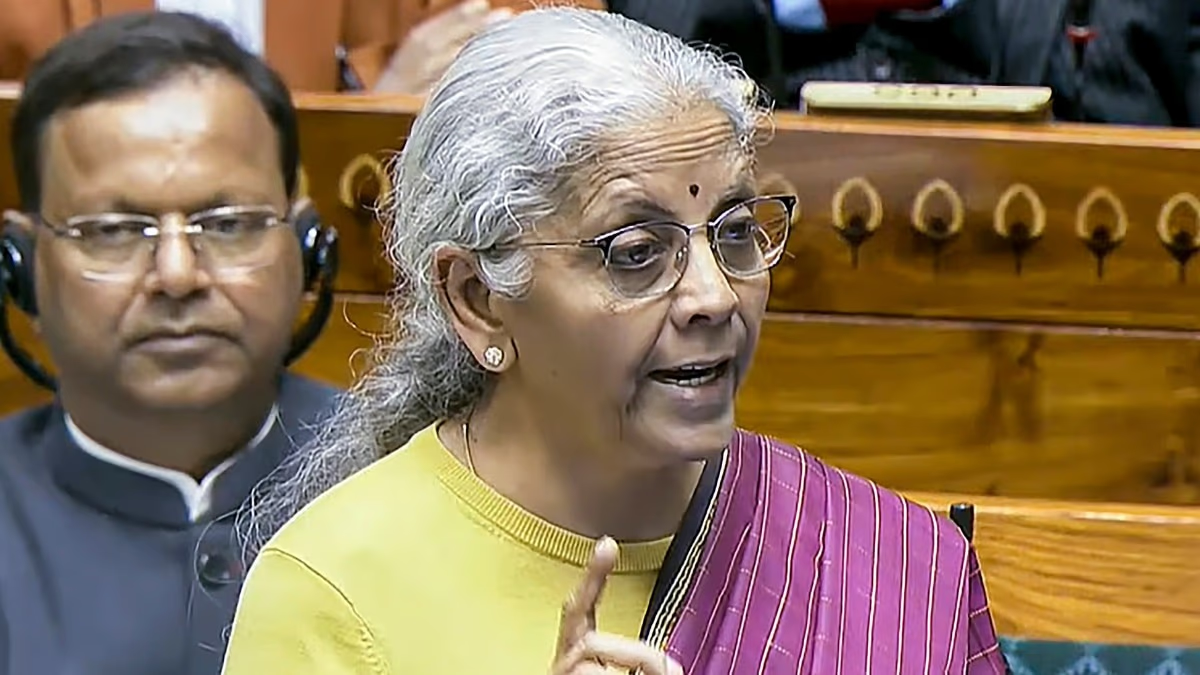
Finance Minister Nirmala Sitharaman underscored the roadmap for the nation’s economic progress in a post-budget press conference. She stated the government's commitment to propelling the economy forward and emphasized the creation of a robust ecosystem through structural reforms that will boost productivity and generate employment.
The Finance Ministry hosted a major press conference post-budget, attended by Finance Minister Nirmala Sitharaman and ministry secretaries. They clarified the government's ongoing process of establishing a strong ecosystem via structural reforms. Although many reforms have been implemented, this process will continuously evolve to enhance productivity and ensure job creation.
Boost in Agricultural Productivity
She stated that the 21st century is driven by technology, and efforts will be made to ensure technology benefits the common man. This includes easing living standards, enhancing business opportunities, boosting farmers’ productivity, and improving logistics. The Finance Minister labeled cities as engines of India’s development, innovation, and opportunity. She added that the government is now focusing on Tier-2 and Tier-3 cities and even temples, areas requiring modern infrastructure and fundamental facilities. Under the City Economic Region (CER) scheme, a proposal to allocate 50 billion INR per region over five years was presented.
Major Announcement on Semiconductor Mission
Discussing two significant budget highlights, the Finance Minister elaborated on the Semiconductor Mission and Electronic Component Manufacturing Scheme. Announcements in the budget included significant initiatives in the Semiconductor Mission and Electronics Manufacturing. A provision of 400 billion INR has been set aside for manufacturing electronic components, marking a notable step towards self-reliance in the electronics sector.
Construction of Rare Earth Corridor
Additionally, India has decided to establish 'Rare Earth Corridors' to reduce dependency on foreign sources. These corridors will be set up in states like Odisha, Kerala, Andhra Pradesh, and Tamil Nadu and are projected to benefit the Indian economy for decades. It was reported at the press conference that for fiscal year 2026-27, non-debt receipts are estimated at 36.5 trillion INR, with total expenditure anticipated at 53.5 trillion INR. Net tax revenues are expected to be 28.7 trillion INR, with the government's gross market borrowings estimated at 17.2 trillion INR.
The Finance Minister revealed that compared to last year's revised estimates, capital expenditure this time is set at nearly 11 trillion INR, underscoring the government's dedication to infrastructure development. Special attention has been given to controlling the fiscal deficit to maintain a healthy economy, with projections for fiscal year 2026-27 showing a fiscal deficit at 4.3% of GDP, lower than the previous year's 4.4%. Likewise, the debt-to-GDP ratio has improved, expected to drop from 56.1% to 55.6%.