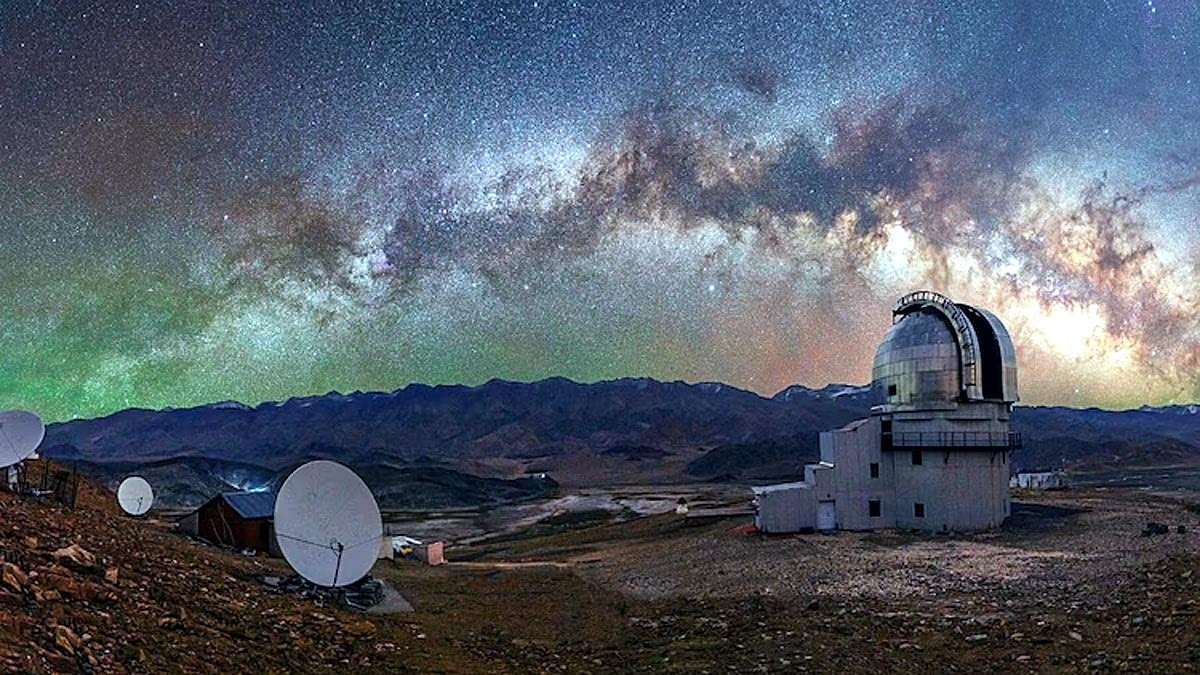
Finance Minister Nirmala Sitharaman presented the Union Budget for 2026-27 in Parliament. The government announced the establishment or upgrade of four major telescope facilities, signaling a boost in India's astrophysics and astronomy prowess.
What are the four key facilities?
The budget discusses infrastructure for four telescopes...
National Large Solar Telescope (NLST)
– This 2-meter class optical and near-infrared telescope will be constructed near Pangong Lake in Ladakh (close to Merak village). It will study the sun's magnetic fields, solar flares, coronal mass ejection, and space weather.
After ISRO's Aditya-L1 mission, it will monitor the sun in high resolution from the ground. Solar storms can affect satellites, power grids, and communication, making this project vital for national security.
Also Read: Japan's Cold Catastrophe as Snowfall Breaks 81-Year Record
National Large Optical-Infrared Telescope (NLOT)
– This 10-13.7 meter class observatory will work in optical and infrared wavelengths, studying distant galaxies, exoplanets, star-forming regions, and objects billions of light-years away. NLOT will be built at the IAO site in Hanle, Ladakh, placing India among nations with large telescopes.
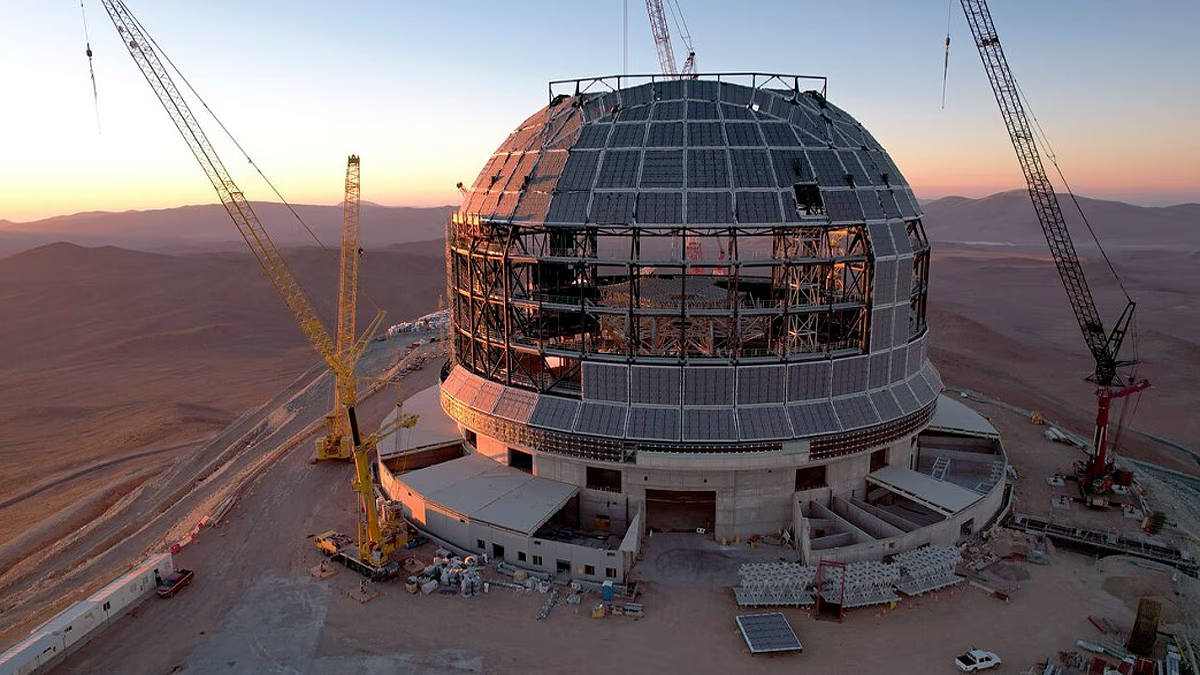
Source: aajtak
Himalayan Chandra Telescope (HCT)
– This 2-meter optical-infrared telescope has been operational in Hanle, Ladakh, since 2000, at one of the world's highest observatories. The budget includes its upgrading. HCT has provided significant research on variable stars, active galaxies, and more.
COSMOS-2 Planetarium
– Set to be developed in Amravati, Andhra Pradesh, this modern immersive science education hub will feature interactive exhibits, dome shows, and celestial simulations, sparking scientific curiosity among students and the public. COSMOS-1 is under construction in Mysuru.
Also Read:
Why is this announcement significant?
Significance of Ladakh: Both NLST and NLOT are rooted in Ladakh. Hanle's elevation, clear skies, and long nights rank it among the best observation sites globally. India is now leveraging its geography for world-class facilities.
Science and Society: Large telescopes deliver not just data but inspire imagination. Planetariums help the public understand the universe and promote scientific thinking.
No Mention of ISRO: The budget doesn't explicitly mention ISRO, perhaps due to ongoing pre-funded missions or recent launch failures shifting focus to astronomy. Work continues on missions like Gaganyaan.
Developing India's Direction: This announcement shows India's intention for intellectual leadership alongside economic growth. Studying from the sun to distant galaxies will enrich knowledge.
The focus on telescopes in the 2026-27 budget forms part of India's long-term science policy. It combines ancient astronomical traditions with modern technology. NLST will provide insights into space weather. NLOT will delve into cosmic depths, HCT will bolster research, and COSMOS-2 will spread public awareness. India is not only advancing in space but also becoming a global leader in sky observation.