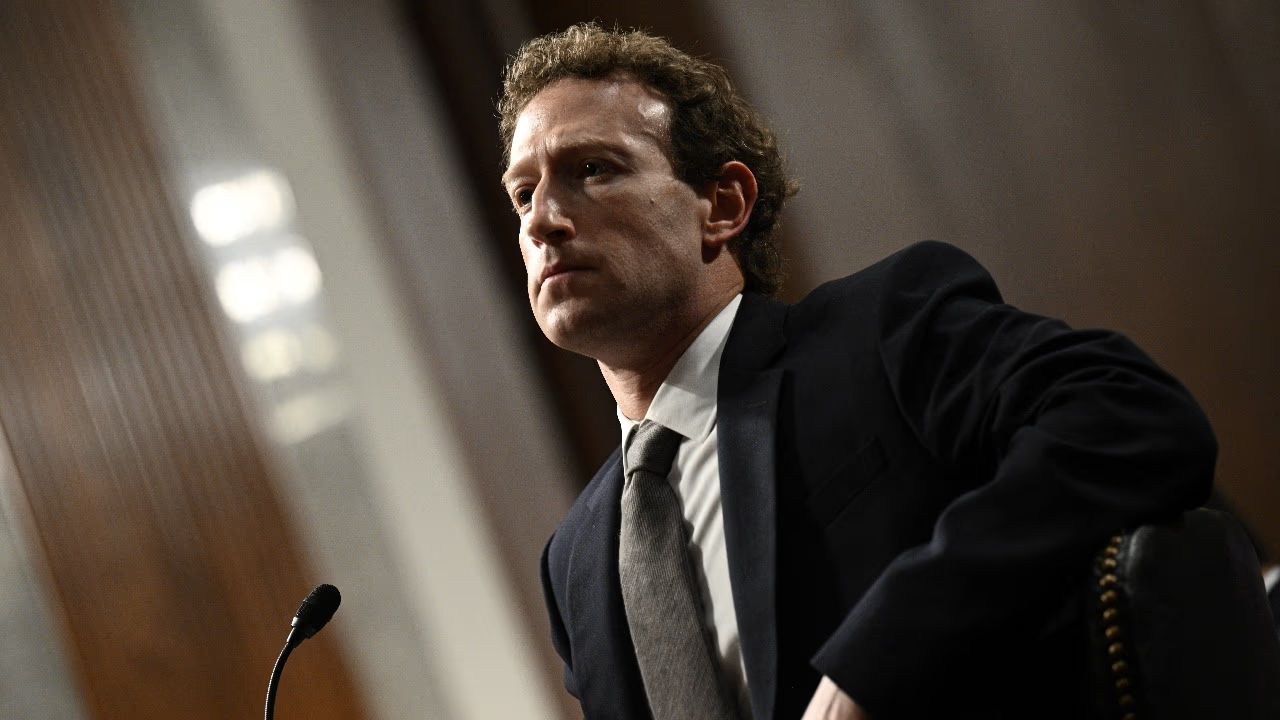
In the corridors of America's Silicon Valley, a crucial question is circulating. Has an internal battle over AI ignited within Meta? The focus is on the growing tension between the company's CEO, Mark Zuckerberg, and the recently appointed star AI Chief, Alexander Wang.
On the surface, this may seem like just a news of management restructure, but the underlying story raises significant questions about Meta's AI future and corporate culture.
Did 28-year-old Wang receive $14 billion?
Last year, Mark Zuckerberg made a bold move concerning artificial intelligence. He appointed 28-year-old Alexander Wang as the head of Meta's new superintelligence labs, with Meta investing approximately $14 billion in his creation, Scale AI. This development caused a stir in the tech industry.
This investment by Meta was one of the largest deals in modern AI history. By 2025, Wang became Meta's highest-paid employee and was hailed as the company's AI leader.
Further Reading: Zuckerberg's Dream Shattered, Fires a Team of 1000 That Made Facebook Originally Meta—The Inside Story
Yet, what was initially seen as an accelerator for Meta's AI progress is now reportedly causing internal strife within the company.
Why is Wang discontent with Zuckerberg?
Reports suggest that Wang is frustrated by Zuckerberg's methods, which he feels are stifling his work. Some senior employees and insiders express that Wang's relative inexperience and youth might not suit leading Meta's AI division.
It is noteworthy that Alexander Wang is no ordinary tech executive. Having founded Scale AI at a very young age, it is now recognized as one of the world's largest data labeling companies.
Last year, Meta made him the face of its AI mission with a hefty package, aiming to regain leadership in AI, competing with OpenAI, Google, and Microsoft. However, reports indicate that the internal landscape is not as smooth as it appears.
Meta changes its reporting structure
Recently, Meta implemented a new reporting structure, which altered direct reporting lines of several teams. Among these changes, it was revealed that Alexander Wang does not have complete operational freedom with Zuckerberg's AI vision. On the other hand, Zuckerberg himself is deeply involved in AI product's micro-management. This friction is beginning to surface.
In the tech industry, this situation is more than just an ego clash. It's essentially a clash of differing philosophies—Zuckerberg's product-first, fast-shipping model versus Wang's research-first, foundation-model focus. Consequently, many AI researchers at Meta are now uncertain about their direction.
Top AI talents departing Meta
Amidst this, the departure of some top AI talents from Meta is also a hot topic. Insiders report many senior engineers and researchers feel uncertain about their roles and priorities. This phase is often referred to as a 'cultural crack' in the tech industry, where hyper-growth ambitions create gaps with ground reality.
For Meta, this is a crucial time. The company has already committed significant funds to the Metaverse bet, which hasn't shown returns as expected. Now, AI is the next big bet on which future growth hinges. Internal conflicts in AI leadership pose challenges for both investors and employees.
Interestingly, Zuckerberg recently declared Meta as an AI-first company. From open-sourcing Llama models to an in-house foundation model roadmap, AI is becoming the company's core identity. However, if clarity and alignment are lacking within the AI team itself, AI could face risks like Metaverse.
Founders unwilling to relinquish control
In Silicon Valley, this is seen as familiar. Tension between visionary founders and high-profile specialist hires often becomes inevitable after some time. History has seen many such clashes, casually referred to as 'ruckus.' It's when company founders are reluctant to let go of control, while specialists like Alexander Wang crave freedom. Meta appears to be at such a crossroads.
Currently, the company hasn't publicly acknowledged any internal conflict officially.