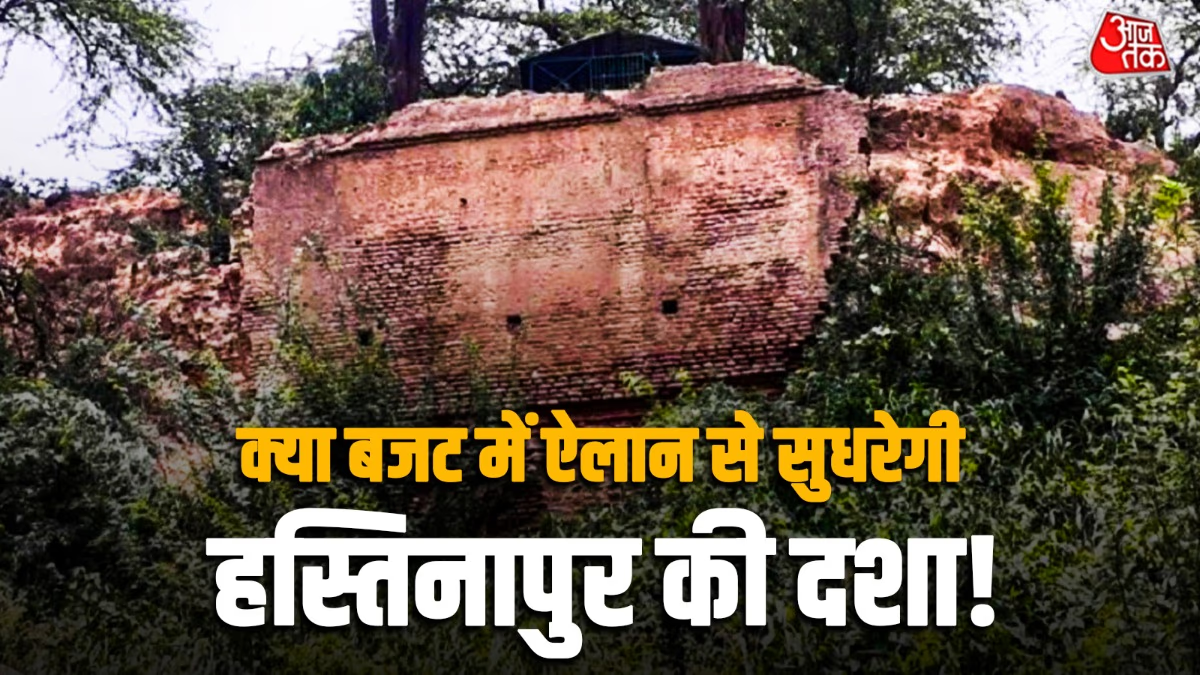
Approximately 38-40 kilometers from Meerut, Hastinapur, nestled in the Mawana Tehsil, is once again attracting attention. In her budget presentation on Sunday, Finance Minister Nirmala Sitharaman announced the development of Hastinapur as an archaeological-tourist destination. Its mention drew focus to this city known as Mahabharata's mythical capital, which has, however, become renowned as a prominent Jain pilgrimage site for several decades.
How did Hastinapur, with its rich 5000-year-old mythological heritage, transition from Mahabharata to a Jain pilgrimage site?
The Silence of Mahabharata's Land
The name Hastinapur conjures images of the Kauravas and Pandavas, royal courts, dice games, and epic wars. In Indian tradition, Mahabharata is regarded as an ancient event, hence one might expect solid remnants of that tale to be found here. Yet upon arrival at Hastinapur, one is met with disappointment. No memorials related to the Kauravas or explicit architectural evidence of the Pandavas' presence can be seen. There's no definitive temple claiming to be from the Mahabharata era.
A huge mound stands conspicuously at the city's center, about 55-60 feet high, locally referred to as 'Pandav Tila.' Folklore suggests that Hastinapur's lavish palace lies buried beneath it. It is also said that a curse led the entire city to gradually sink into the earth.
'Draupadi's Curse': From Folklore to Reality
The most prevalent Hastinapur tale is Draupadi's curse. Legend has it that when the Kauravas attempted to disrobe Draupadi in the royal court, she, in her fury, wished to destroy everything, but Gandhari stopped her. Draupadi then cursed Hastinapur to gradually merge with the soil.
This story may be a matter of faith, but it also serves as a socio-historical allegory. The process of merging into soil is slow. First, termites eat away at the walls, then, one by one, people die or migrate. Internal conflicts grow, more lives are lost, structures become hollow and eventually eerie, before turning into ruins and sinking into the soil. Such events transpired in Hastinapur, as local legends indicate.
Source: aajtak
Continual Archaeological Efforts Yield No Results
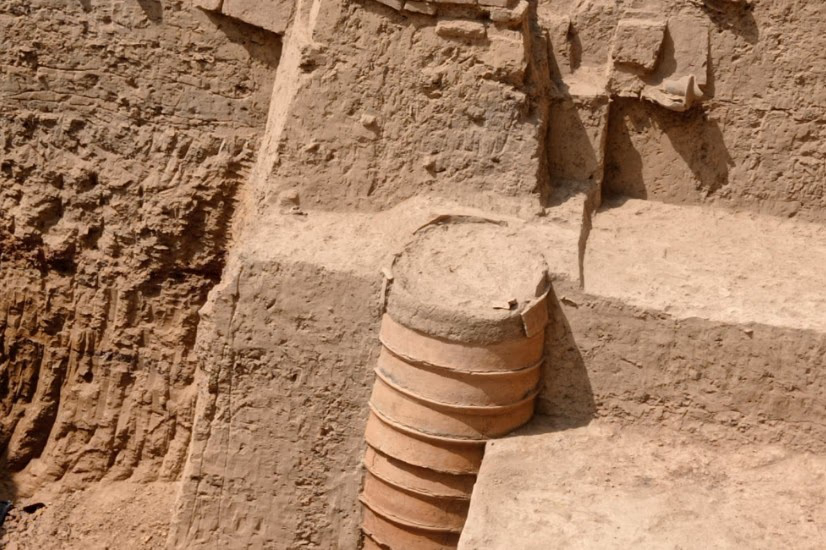
Efforts to understand Hastinapur's antiquity have been made. Significant steps were taken post-independence. Assistant Professor Priyank Bharti from Shobhit University explains numerous excavations around Pandav Tila. Notably, between 1950-52, eminent archaeologist and historian Professor BB Lal conducted excavations in Ulta Khera area under the 1949 clearance from then Prime Minister Jawaharlal Nehru.
Findings included artifacts from 1100 to 800 BC. The Archaeological Survey of India's 1954-55 bulletin 'Ancient India' noted deluxe pottery from Pandav Tila's excavation. A large structure's remains found about 20 feet down were believed to be a palace.
Subsequent excavations in 2006 and 2018 in Bagpat's Sinauli region shed new light on Western Uttar Pradesh's ancient culture. Excavations at Pandav Tila in 2021-22 unearthed ancient pillars' remnants, pottery from various eras, ivory objects, and seals down to 30 meters.
Yet, scholars disagree on directly linking these remnants to Mahabharata-era Hastinapur. The mythical Hastinapur still swings between research and speculation.
Distinct Jain Tradition Amidst Mahabharata Shadows
In stark contrast, Jain tradition always recognized Hastinapur distinctly and robustly. According to Jain beliefs, it was the birthplace of three Jain Tirthankaras, Shantinath, Kunthunath, and Arhanath (16th, 17th, and 18th Tirthankaras).
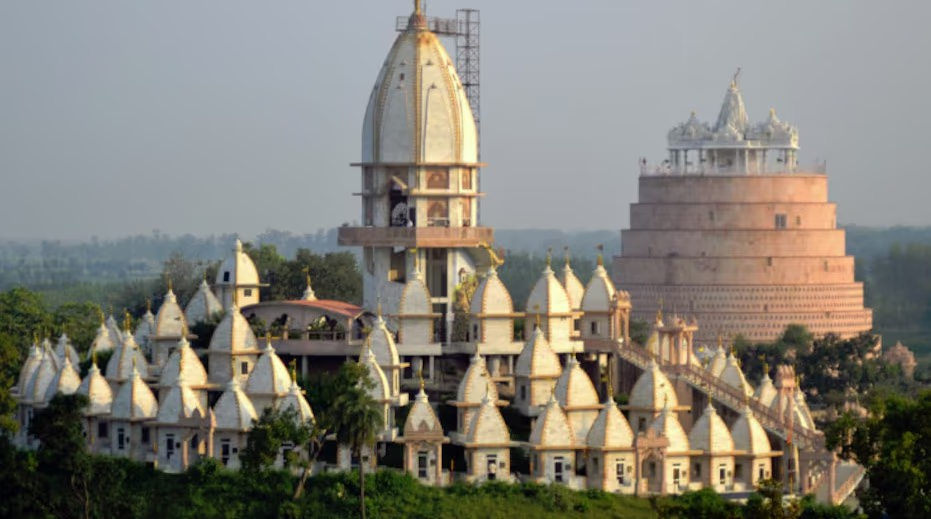
In 1801, the Digambar Bada Jain Temple was constructed, followed by grand religious complexes developed by Jain tradition. Symbolic religious sites like Jambudweep, Ashtapad, and Kailash Parvat endowed Hastinapur with a structured Jain pilgrimage identity.
In 1974, Acharya Shiro Mani Shri Gyanmati Mata's creation of Jambudweep complex elevated Hastinapur to international recognition as a Jain pilgrimage. In Jainism, Hastinapur holds a sacred status equivalent to Kashi. Pink marble structures like Sumeru Parvat, Terahdweep Jinayal, the 46-meter tall Ashtapad Teerth, and the 131-foot Kailash Parvat are major attractions for Jain pilgrims.
Source: aajtak
Lord Neminath, Shri Krishna, and Mahabharata
A major factor solidifying Hastinapur's Jain identity is Lord Neminath's temple. Neminath, the 22nd Jain Tirthankar, has a statue here over a thousand years old. His idol also adorns the Bada Jain temple.
According to Jain tradition, Lord Neminath was born in the Yadu dynasty, often referred to as Shri Krishna's cousin. In Jain beliefs, Shri Krishna is deemed a 'Shalakapurus'—a great person who can emerge as a Tirthankar in any era. Such intertwining narratives made Hastinapur a bridge between Jain and Mahabharata traditions, though practically Jain tradition established concrete religious structures while Mahabharata's legacy remained as mere symbols and stories.
Now, with the budget mentioning Hastinapur's development as an archaeological-tourist site, a fundamental question arises—Which Hastinapur does the government wish to showcase? Mahabharata's capital, teetering between research and belief, or the Jain pilgrimage that sculpted its identity, structure, and global recognition in the past fifty years? The intriguing question remains—Will this budget proclamation dispel the 'curse of Draupadi' and deepen Hastinapur's identity quandary?