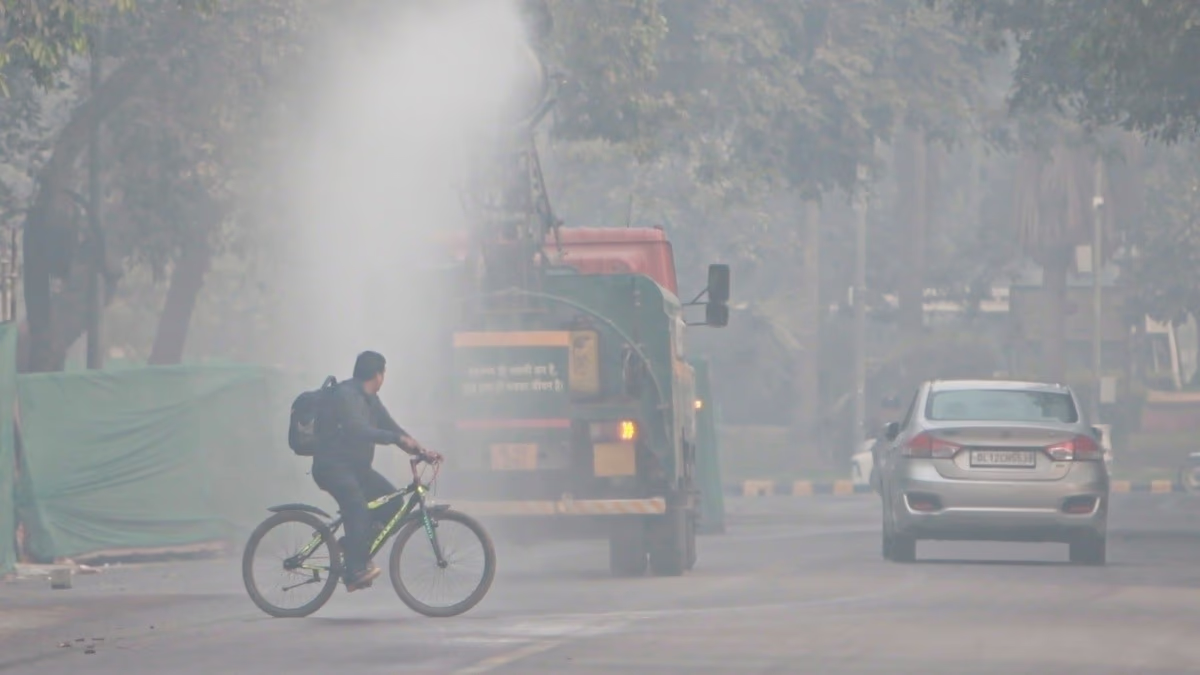
As December ushered in, Delhi found itself under siege by both winter and pollution. With a steep drop in temperature and declining wind speed, a thick haze has enveloped the sky. Today, RK Puram once again secured the unenviable title of Delhi's most polluted area with an AQI reaching 335.
The CPCB indicates Delhi's average AQI remains stuck in the 'Very Poor' category, signaling marginal improvements in conditions, though air quality in several areas continues to languish in poor standings. As of 6 AM, Anand Vihar recorded an AQI of 323, Bawana at 337, and RK Puram stood at 335.
Key Areas AQI
RK Puram: 335 (worst)
Bawana: 337
Anand Vihar: 323
Wazirpur: 321
JLN Stadium: 311
ITO: 310
Burari: 304
Alipur: 282
Narela: 281
North Campus DU: 277
Nazafgarh: 269
Aya Nagar: 250
IGI Airport: 245 (lowest)
Concerns Rise for Coming Days
Delhi's AQI currently clings to the 'Very Poor' classification. With dropping temperatures and stagnant air, there is a growing concern that conditions might deteriorate further in the coming days.
The Meteorological Department warns that over the next 4-5 days, the wind's slow pace will likely trap pollutants in the atmosphere. Even as the impact of stubble burning diminishes, vehicle emissions, construction dust, and wintertime waste burning emerge as major pollution sources.
Historical Improvements in AQI
The Commission for Air Quality Management (CAQM) proclaimed on Sunday that 2020's COVID lockdown year excluded, the average air quality index from January to November in Delhi marks the lowest since 2018.
This Year Remains Below 450
According to a CAQM statement, this year's average AQI for the period was 187, when compared to 201 in 2024, 190 in 2023, 199 in 2022, 197 in 2021, 172 in 2020, 203 in 2019, and 213 in 2018. The statement proudly noted zero instances of the AQI exceeding 450 this year.
From January to November this year, only three days saw the daily average AQI surpass 400 (Severe category). In prior years, there were 11 such days in 2024, 12 in 2023, four in 2022, 17 in 2021, 11 in 2020, 16 in 2019, and 12 in 2018.
Apart from 2020, PM10 levels during this period have been the lowest since 2018, with this year's average at 183 micrograms per cubic meter, as opposed to 205 in 2024, 193 in 2023, 202 in 2022, 200 in 2021, 167 in 2020, 210 in 2019, and 228 in 2018.
CAQM asserts it intends to intensify efforts toward enhancing air quality in Delhi-NCR, working closely with all agencies to implement pollution prevention and control measures.