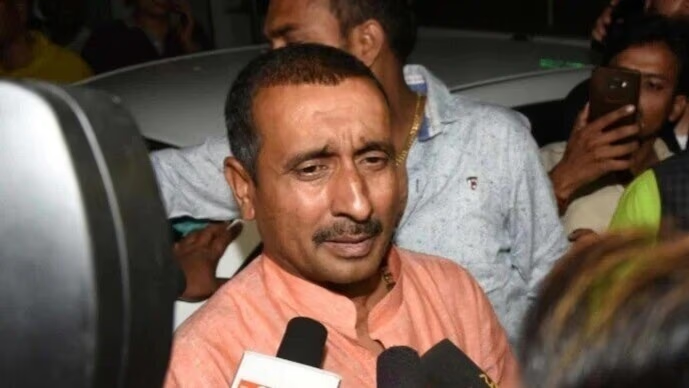
The recent suspension of the prison sentence for former legislator Kuldeep Singh Sengar, convicted in the Unnao rape case, by the Delhi High Court has provided him significant relief. The court, citing the landmark 1984 A.R. Antulay case, refused to categorize Sengar technically as a 'public servant'.
According to the current definitions in the Indian Penal Code and the POCSO Act, MPs and MLAs are not considered government employees. This technicality allowed Sengar to escape the stricter penalties prescribed for public servants.
This decision challenges the core objectives of special laws that aim to hold those in power accountable.
Why is the Definition of 'Public Servant' Crucial?
In Indian criminal laws, the role of a 'public servant' is of high importance. Special laws related to serious crimes impose higher accountability on public servants compared to ordinary citizens. There are harsher penalties for crimes committed by public servants to ensure they do not misuse their positions of power or authority.
Read also: Why Do Courts Relieve Convicts Like Ram Rahim Repeatedly While Suspending Sengar's Sentence?
The Major Gap in POCSO Law...
The POCSO (Protection of Children from Sexual Offences) Act and related laws impose strict rules for public servants and others in positions of authority over victims. For instance, if an 'ordinary person' commits rape on a child, the minimum sentence is 10 years of imprisonment.
However, if the same crime is committed by a public servant or someone influential, the minimum penalty is straightaway increased to 20 years. The relief granted to Sengar by the Delhi High Court is based on the technical point that he was not a 'public servant' at the time of the crime.
The High Court's Argument...
The Delhi High Court maintained in its decision that Sengar, being a legislator, cannot be deemed a 'public servant' as defined under IPC or POCSO. This decision leaned on the Supreme Court's 1984 verdict that elected representatives do not qualify as public servants under criminal laws, sparing Sengar the additional punishment faced by government officials for similar offenses.
Read also: 'Sengar Can Reach Anywhere...', Unnao Rape Survivor Requests Rehabilitation in a Congress-led State
Why Do Parliament and Legislative Members Receive Exemptions?
The term 'public servant' is elaborately defined in the Indian Penal Code (IPC) and now in the Bharatiya Nyaya Sanhita (BNS). Bureaucrats, police, judicial officers, and military officials fall under this category since they are employed by the government and paid from the public treasury. Conversely, legislators and MPs are not technically government 'employees' as they receive payment from India's consolidated fund, which excludes them from specific legal purviews.
The Different Rule in Corruption Law
Interestingly, under the Prevention of Corruption Act of 1988, legislators and MPs are recognized as 'public servants'. Supreme Court's 1997 ruling in the L.K. Advani case confirmed that legislators qualify as public servants in matters of corruption. Additionally, the 2024 Sita Soren case ruling by a seven-judge bench clarified that MPs and MLAs cannot claim parliamentary privilege in bribery cases. However, in sexual offenses, the definition remains unclear.
Read also: How Did Convict Sengar Secure Bail? Petition in Supreme Court Against High Court's Decision
Opinions of Former Judges and Legal Experts
Former Supreme Court Justice S. Ravindra Bhat told 'India Today' that there's a need to revisit the definition in law. The aim of amendments in rape and POCSO laws was to impose strict penalties on those wielding power and authority. Justice Bhat also expressed surprise that a decision on bail and sentence suspension was taken years after the 2020 appeal. He believes the court should not indulge in such extensive discussion over the definition of a public servant at this level.
Questioning Trust in the Judicial System
Senior Advocate Vijay Hansaria raised concerns about influential people claiming immunity as 'public servants' in cases like 'cash for vote' but denying the same status in heinous crimes. Senior Advocate Mahalaxmi Pavani mentioned the sympathy shown to Sengar sends a disheartening message to victims across the nation. She believes such decisions weaken public trust in the justice system as influential individuals exploit legal nuances to escape stern punishment.
Read also: Big Relief for Sengar in Unnao Rape Case, High Court Halts Life Sentence
ADR Report: Startling Numbers of Tainted Leaders
According to the 2024 ADR (Association for Democratic Reforms) report, a significant number of leaders are involved in crimes against women. The report highlights that 151 current MPs and legislators have declared cases of crimes against women. Among them, 16 are charged with rape (IPC 376). As per the data, 54 from the BJP, 23 from Congress, and 17 from TDP face such cases. At least one current legislator and one MP face severe charges under POCSO Act.
Is it Time for Legislative Change?
A significant group of legal experts believes until the definition of 'public servant' is broadened, politicians will continue exploiting such loopholes. Current data shows a large number of candidates and leaders facing serious charges like sexual harassment. Thus, it's valid to question whether lawmakers deliberately leave such routes for future benefit. Experts stress that the Supreme Court should urgently address this decision to prevent influential figures from escaping in the future.