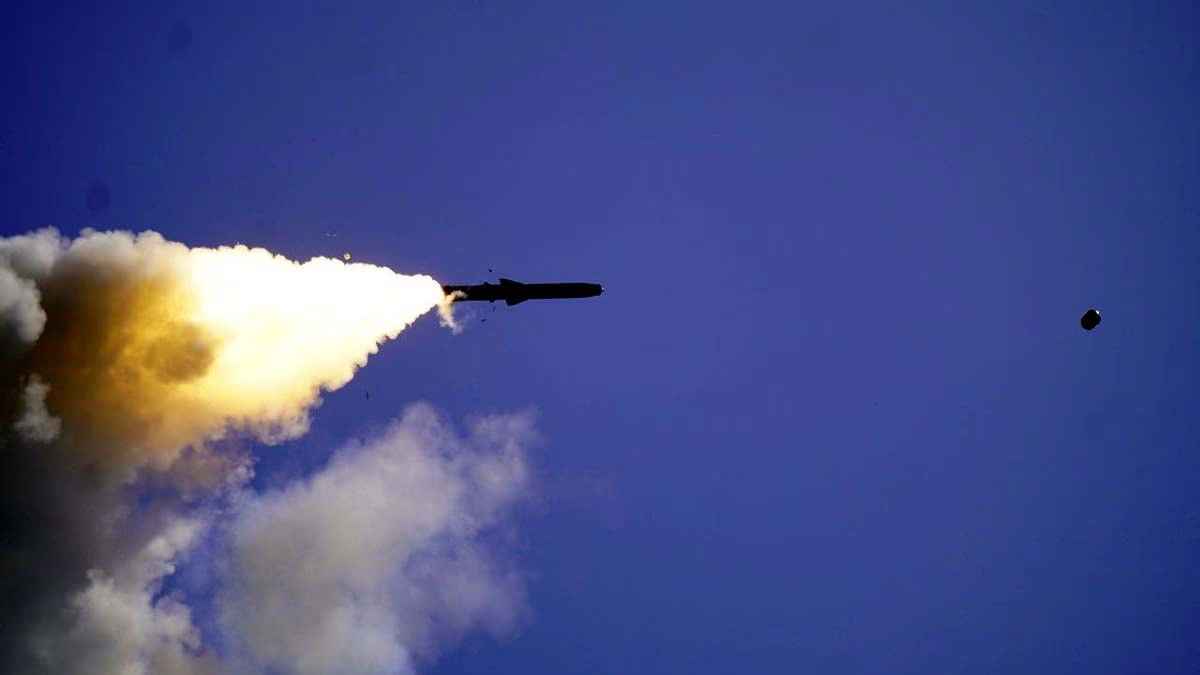
On December 1, 2025, the Southern Command of the Indian Army executed a combat launch of the Brahmos supersonic cruise missile in the Bay of Bengal. This wasn't merely a test but a demonstration of its formidable power under war-like conditions. Achieving a speed of 3457.44 km/hr, the missile precisely struck its target out at sea.
With a Circular Error Probable (CEP) of just one meter—meaning it could only deviate up to one meter from the target—its precision was so flawless that no enemy defense system could intercept it. This launch reinforced India's long-range precision strike capability and was a salute to the spirit of self-reliance. It celebrated the moment as #BattleReadyBharat.
Explore Further: Largest Deal Prep During Putin's Visit... Clear Message to PAK-China
The Brahmos missile is a joint venture between India and Russia, named after the Brahmaputra River and the Moskva River. Initiated in 1998, the project became part of the Indian Navy by 2005. Initially, its range was restricted to just 290 km due to the Missile Technology Control Regime (MTCR) norms prohibiting export of longer-range missiles. However, India's inclusion in MTCR allowed the range to be extended in 2016.
The first extended range (ER) version of 450-500 km was tested in 2017. By 2025, an 800 km combat long-range version was available, first used during Operation Sindhur in May 2025. This missile can be launched from land, sea, air, and even submarines—making it versatile for use by the Army, Navy, and Air Force.
Related Story: Operation Sagar Bandhu: India Stands By Sri Lanka During Cyclone Ditva; Hundreds Saved, Massive Aid Provided
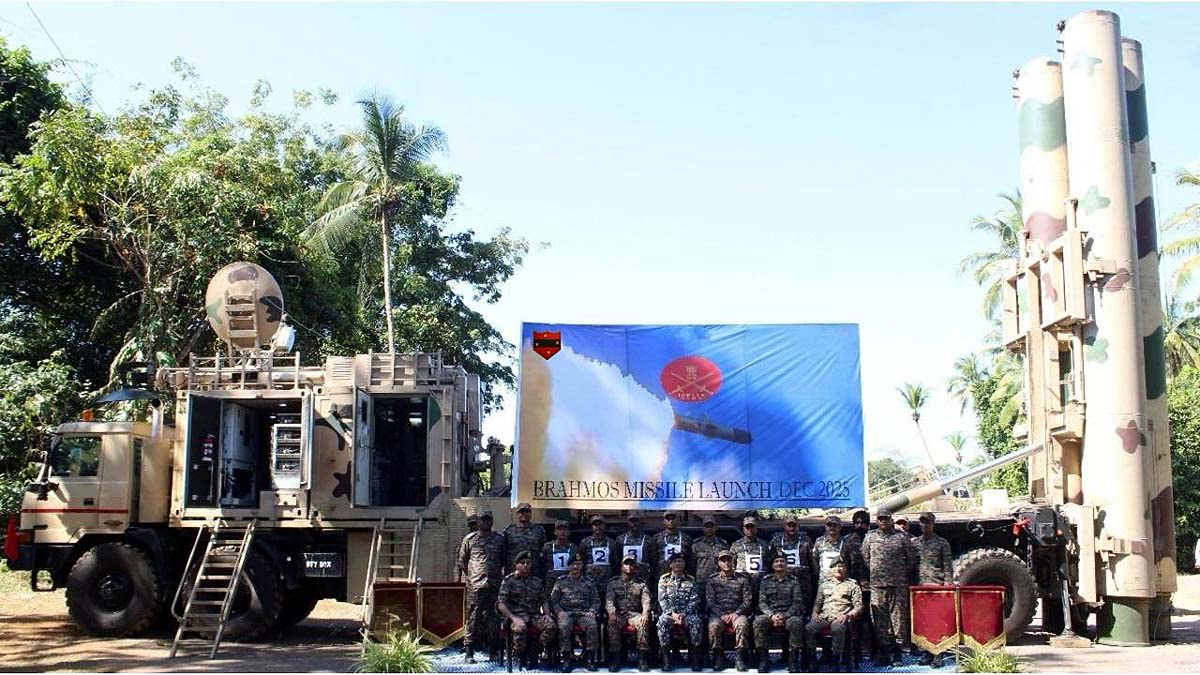
Source: aajtak
This new version is far more dangerous than its predecessors. Key improvements include:
Astonishing range: From a previous 290-450 km to now 800 km, allowing targets as far as Karachi, Lahore, Islamabad, Rawalpindi, and even Multan to be within reach from India's western coast. It covers all of Pakistan from the eastern coast.
Reduced weight and size: The old missile weighed around 3000 kg. The new one is trimmed by 1200-1500 kg, making it compatible with lighter fighter jets like Tejas. Heavier jets like Su-30MKI can carry up to four of them.
Engine and fuel innovations: Fitted with a modified ramjet engine and larger fuel tanks, the missile can fly at an altitude of 15 km or just 10 meters—making radar evasion easier. The fire and forget mode locks onto targets with zero reaction time.
Indigenous parts: The seeker (targeting system) is developed by India’s Data Patterns company. The booster and airframe are also domestically produced. Tests were conducted in 2025.
Dual role: Perfect for attacking airbases, camps, or ships—operating in both land-attack and anti-ship modes.
These changes make it a hit-and-fly missile—striking undetected by the enemy.
More Insights: Beak-like Teeth, Fish-like Bones... The Human Evolution in 100 Years?
This version debuted during Operation Sindhur in May 2025, a response to a Pakistani terrorist attack in Pahalgam on April 22, 2025. From May 7-10, the operation saw the air force launching 12-15 Brahmos missiles from Su-30MKI, decimating 11 major Pakistani airbases like Rafiki, Sargodha, Noor Khan, and Murid.
Jaysh-e-Mohammed and Lashkar-e-Taiba's 9 camps were obliterated, and over 100 terrorists were neutralized. Pakistan’s Chinese-made air defense systems couldn't thwart them. Defense Minister Rajnath Singh noted the missile’s accuracy changed warfare dynamics. Following this success, rapid deployment of the 800 km variant was decided.
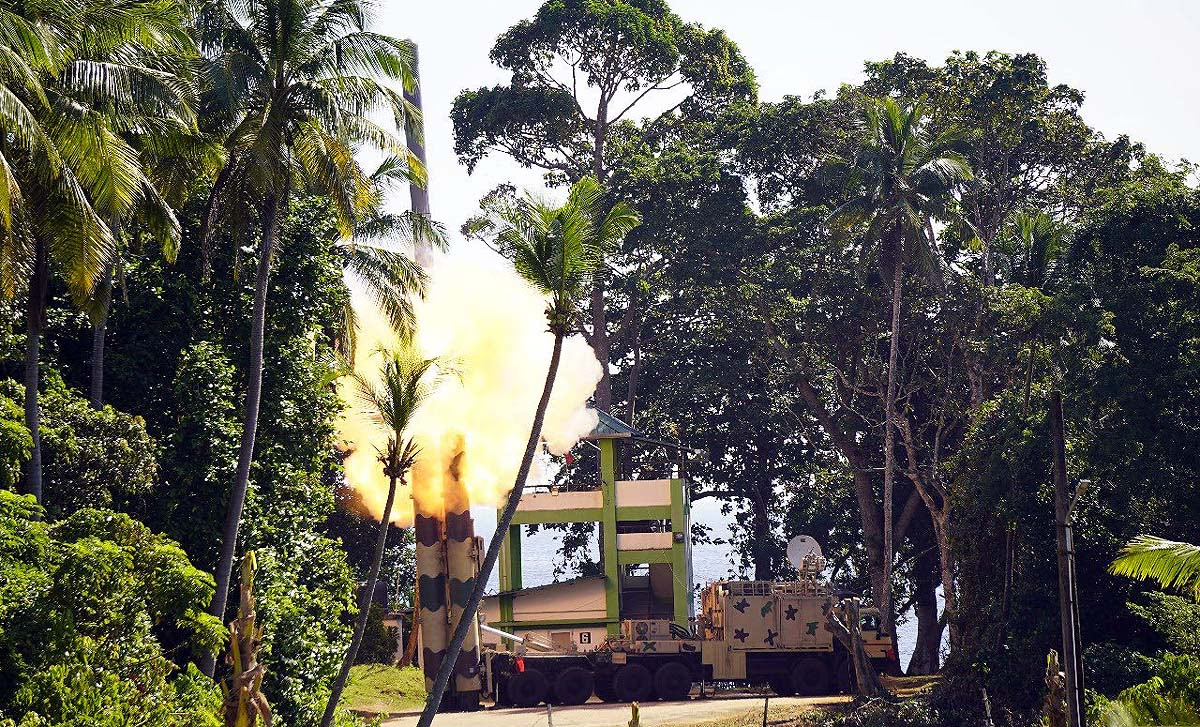
Source: aajtak
Army: Deployed in coastal regiments of Southern Command. Now strike-ready on the Pakistan border with the 800 km version.
Navy: Deployed on over 20 warships (destroyers, frigates) with vertical launch systems. Ordered 220 missiles in March 2024, including the latest variant.
Air Force: Air-launched version on Su-30MKI. Ordered 400 missiles, with deliveries over five years. The 222 Tiger Sharks Squadron is based in Tamil Nadu.
Overall, over 1000 Brahmos missiles will be deployed by 2025. Retrofitting the new version is straightforward—software updates can extend the range of old missiles to 800 km.
Brahmos-NG (Next Generation): Lighter (1,200 kg), smaller, and stealthy. Flight tests expected by end 2025 or 2026. Compatible with Tejas, Mig-29, Mirage-2000. Range 290-450 km but hidden from enemy radar due to low radar cross-section.
Brahmos-2 (Hypersonic): Speeds of 8643 to 9878 km/hr. Based on Russia's Zircon. Scramjet tests completed in 2025. 2026 flight trials. This version will further empower India against neighbors like China.
More to Explore: China's Entire PAK Range Under Radar, DRDO Prepares to Test 1500 KM Hypersonic Missile
Deterrence tool: An enemy wouldn't dare attack given the precise strikes possible 800 km away. Pakistani airbases are no longer secure.
Tri-service integration: A single missile for land, sea, and air strikes—reducing costs and simplifying training.
Self-reliant India: 70% parts now indigenous. Exports have begun—deals with the Philippines and Indonesia confirmed. Secured $450 million in export orders.
Security message: We can strike anywhere, anytime, without warning. This missile is not just a weapon but a symbol of India's growing might.
This new avatar of Brahmos will make 2025 the Year of the Missile for India. The success of Operation Sindhur and recent combat launches prove our military is ever-prepared and ever-advancing.