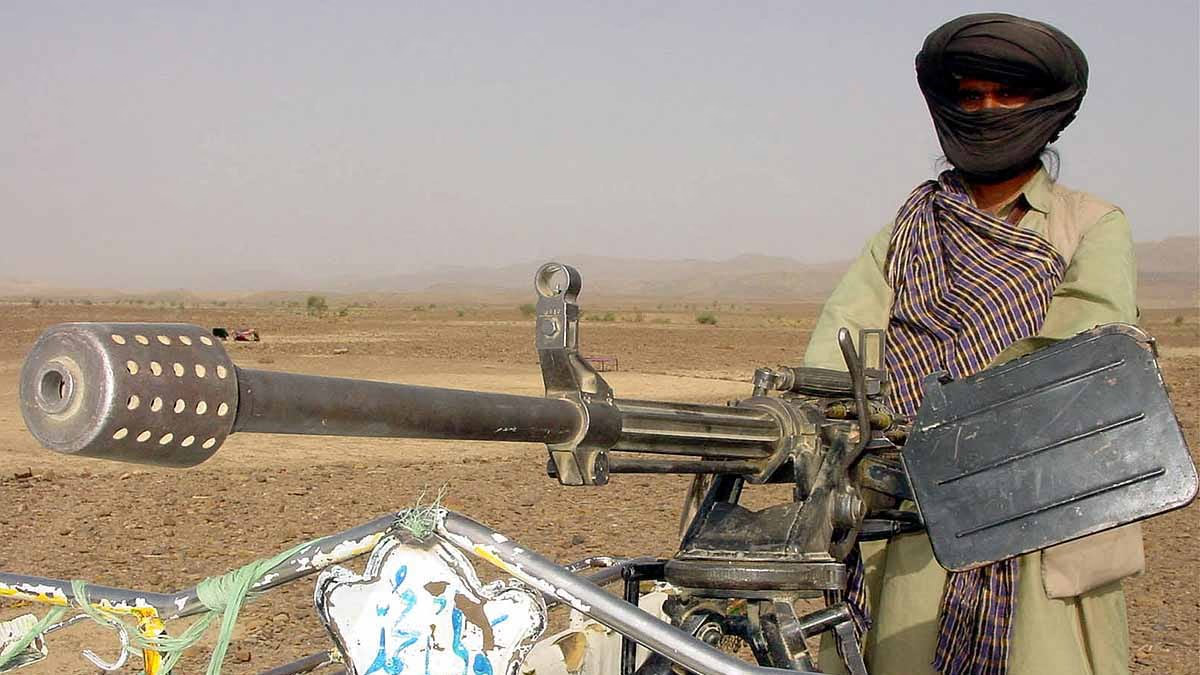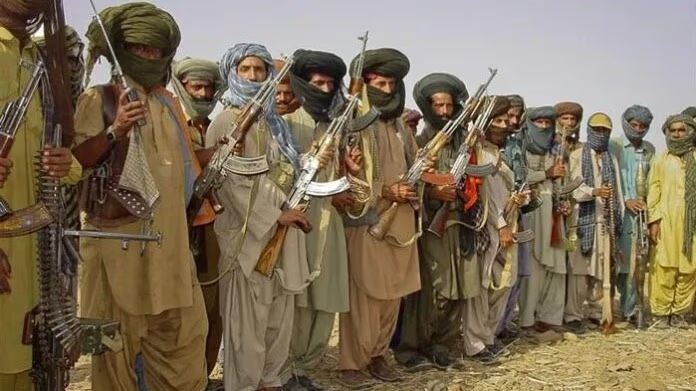
A deadly assault took place on Saturday in Balochistan, Pakistan's turbulent province, marking one of the largest and deadliest in decades executed by the Balochistan Liberation Army (BLA) through simultaneous suicide attacks and armed operations across multiple districts.
Under the operation dubbed 'Herof-2'—which translates to 'Dark Storm' in Balochi literature—the BLA launched attacks provincial-wide. Civilians, police, military, and paramilitary installations were targeted, marking the day as one of the bloodiest in recent history.
The scale of the attacks serves not only as a warning to Pakistan but also to the US and China, whose economic and strategic interests are deeply tied to the region. Despite its underdevelopment, Balochistan is rich in natural gas, copper, gold, and rare minerals, attracting attention from Pakistan and China through the China-Pakistan Economic Corridor (CPEC), and now the US.
Foreign policy expert Michael Kugelman commented on social media, “The attacks in Balochistan are warnings to everyone, especially those in the White House keen on investing in Pakistan's critical minerals. The BLA's primary grievance remains the exploitation of local resources by external powers.”
'Herof-2': A Well-Strategized and Comprehensive Assault
BLA christened this campaign “Herof-2,” a more extensive and violent operation compared to the 2024 Herof-1 campaign.
According to Pakistani security sources, coordinated gunfire, bombings, and suicide attacks transpired in over 15 areas, including Quetta, Mastung, Gwadar, Panjgur, Turbat, Kech, Kalat, and Nushki.
In Quetta, police stations and mobile units fell under attack, with at least 30 prisoners released from Mastung Central Jail. A workers' camp in Gwadar was attacked, resulting in the death of 11 individuals, including women and children.
Intelligence reports suggest that 800 to 1000 fighters, some women included, were involved. Media reports speculate fatalities could reach about 200. Balochistan Chief Minister Sarfaraz Bugti confirmed 31 civilian and 17 security personnel deaths, whereas the Pakistan Army claimed 145 BLA fighters were killed. Meanwhile, BLA spokesperson Jiend Baloch dismissed official claims, stating 84 Pakistani security personnel were killed, 18 captured alive, and only 7 BLA fighters lost.
A senior police officer informed Reuters that in Gwadar, insurgents targeted a migrant workers' camp, killing 11 including women and children. Clashes occurred near Kalat's Deputy Commissioner's headquarters and police lines, while in Nushki, insurgents kidnapped Deputy Commissioner Hussain Hazara and his family.
In Pasni, a Coast Guard post was attacked, highways in Bolan, Lak Pass, and Kila Saifullah-Rakhni were shut, and explosives sabotaging the railway line in Nasirabad were neutralized.
Why is Balochistan So Important?
Balochistan is Pakistan's largest province by area, sharing borders with Iran and Afghanistan, granting access to the Arabian Sea. The Gwadar port hosts the heart of the China-Pakistan Economic Corridor (CPEC), deemed crucial by China for its energy supplies and trade routes.
The province's rich mineral resources, such as the Sui gas field, form Pakistan's energy supply backbone. The US has recently committed $1.25 billion to mining projects in Balochistan's Reko Diq area. For China, CPEC represents the most vital part of its Belt and Road Initiative.
However, this very foreign investment is a major cause of BLA's dissatisfaction. The organization accuses external powers of exploiting Balochistan's resources without benefiting the local populace.
The Grave Security Threat
The Baloch insurgency, ongoing since 1948, has now peaked in its intensity. Experts assert that US and China's economic interests are clashing with BLA. Attacks on Chinese engineers in 2023 and 2024 stand as clear evidence of these conflicts.
Analysts contend that economic aspirations cannot be divorced from local discontent, representing a paramount challenge for Washington and Beijing.
1948:
The Baloch insurgency officially began, marking the start of a struggle still ongoing.