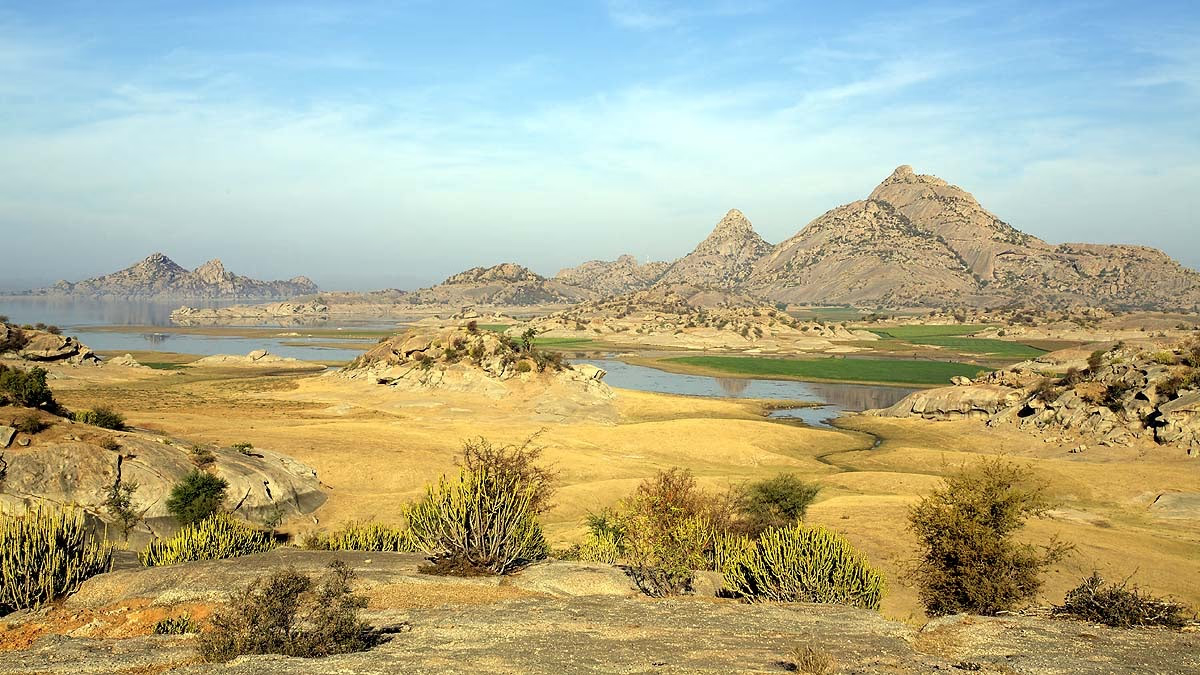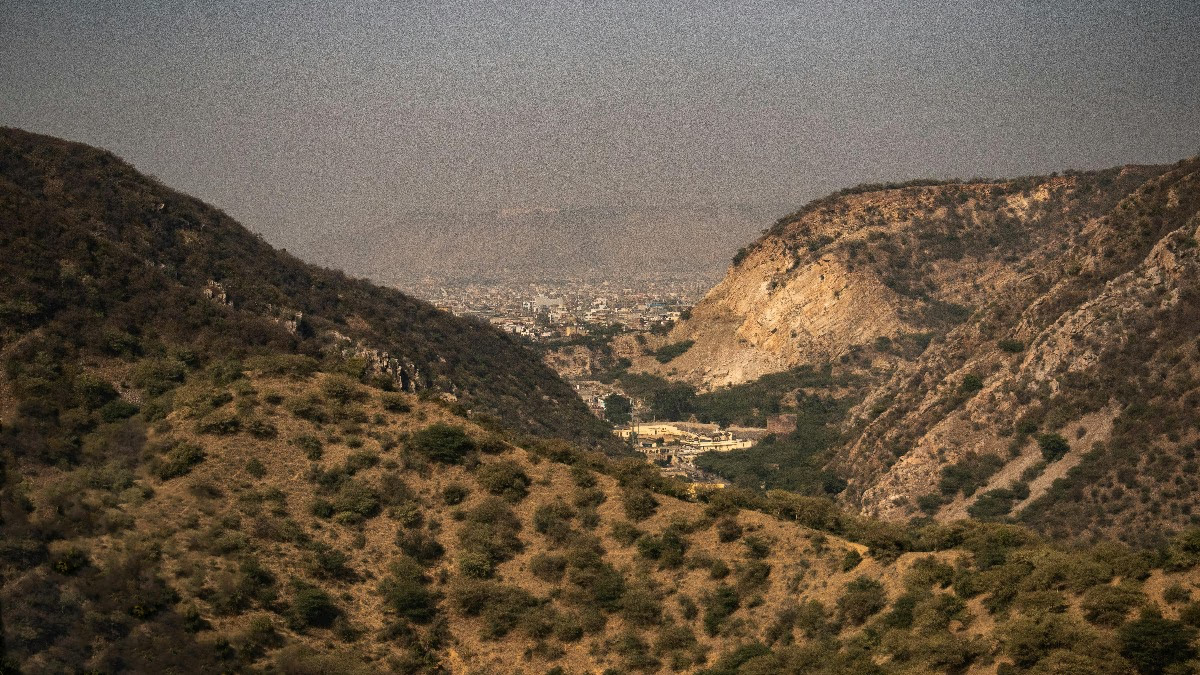
The Aravalli Hills, one of the oldest mountain ranges in India, have acted as the environmental shield of Northern India for centuries. Spanning four states - Rajasthan, Haryana, Gujarat, and Delhi - they play a pivotal role in halting the expansion of the Thar Desert, conserving water, fostering biodiversity, and purifying the air.
Recently, in November 2025, the Supreme Court approved a new definition of the Aravalli, identifying only land with a height of 100 meters or more as an 'Aravalli hill'. This decision was based on a public interest petition pending since 1985, aimed at implementing a uniform definition across all four states to clarify rules regarding illegal mining, land use, and environmental regulations.
Following this decision, there was uproar among opposition parties, environmental activists, and the general public. Under the #SaveAravalli campaign, thousands protested, leading the issue to go viral on social media. Critics allege that this definition excludes large sections of the Aravalli from protection, escalating mining and real estate activities.
What Environmental Minister Bhupender Yadav Said
On the other hand, the central government and Environmental Minister Bhupender Yadav described this decision as a robust step towards environmental conservation. Through multiple statements and social media posts, Yadav explained that more than 90% of the area is now under 'protected zone', with only 0.19% eligible for mining. Even this is subject to sustainable mining plans supervised by the Supreme Court and approval from the Indian Council of Forestry Research and Education (ICFRE).
Yadav dismissed 'misinformation' spread on YouTube and other media outlets, emphasizing that the definition covers the entire spread of the hill from top to base, including slopes and foothills. No mining will occur in Delhi, and through the 'Green Aravalli Wall' project, afforestation, local plant nurseries, and protection of the entire ecosystem (grass, shrubs, medicinal plants) are being ensured. The validity of the government's rationale and Yadav's clarifications can be evaluated on at least five points.
Point 1: Height of the Hills on a Scientific and Geographic Basis
The government's main argument is scientific. The definition of Aravalli is based on the recommendation of geological experts. In May 2024, the Supreme Court established a committee led by the Secretary of the Ministry of Environment, including state representatives and experts.
This committee adopted the 2006 definition from Rajasthan, considering land with a height of 100 meters as a hill. Yadav clarified that this definition is based on 'relief' (local elevation), with adjoining hills (within 500 meters) considered a range, including slopes and bases.
The government claims that more than 90% of the total 1.47 lakh sq km is protected, with only 217 sq km (0.19%) eligible for mining. This data is sourced from the Forest Survey of India (FSI) and the Geological Survey of India (GSI).
How Credible Are the Minister's Statements?
Scientifically, this argument appears strong because previous ambiguities in definition led to illegal mining. For instance, different standards in Haryana and Rajasthan caused disputes. Experts like geologist Richard Murphy, on whom this is based, aligns with international standards where hill definitions depend on height and spread.
However, critics like Neelam Ahluwalia from People for Aravalli argue that this definition limits the 3-billion-year-old ecosystem. Internal reports from Forest Survey of India warned this would leave only 8.7% of Rajasthan protected, with the rest vulnerable to desert expansion. Minister Yadav argues that hill height should not be measured only from the ground. Provisions exist to measure the elevation from the underground part of the hill, and length will not be measured directly from the top to the surface. It's evident that if Yadav's assertions hold true, there's no threat to Aravalli.
Geographically, most of the Aravalli's height is under 100 meters, particularly in Rajasthan, where the average height is 50-80 meters. Therefore, the government's claim of 90% protection doesn’t seem 'spin' if the hill measurements align with Yadav's words.
Point 2: Examination of Legal and Regulatory Aspects
Legally, the government's argument is based on the Supreme Court's orders. The Court has halted new mining leases until the Sustainable Mining Plan (MPSM) is developed with ICFRE approval.
Yadav clarified that the definition was agreed upon by the four states, and mining in 'core/inviolate' areas will remain prohibited. The government stated it aligns with the 1992 Forest Conservation Act and the 2006 Environment Impact Assessment rules. No new relaxations were given; rather, ambiguities have been removed.
How Justifiable Are Yadav’s Explanations?
Legally strong, given the Supreme Court's approval, and the committee's recommendations are transparent. Historically, the Court has intervened over 10 times in Aravalli matters, like halting activities on 31 'vanished' hills in 2018 or ordering the removal of 10,000 illegal constructions in Faridabad in 2021.
This new definition seems to extend those decisions, though critics assert that it declares 90% of the area 'non-hill,' removing forest act protections. Yet, this appears to be an exaggeration. However, opponents have valid points.
For example, Haryana's amendment to the Punjab Land Preservation Act (2019) already permitted constructions, which the Court warned against. Yadav's assertion that 'only 0.19% is eligible' is legally accurate, but if state governments misapply it, issues could arise. This point holds 80% credibility, with court backing, but regulatory drawbacks remain.
Point 3: Examination of Environmental Impact
Environmentally, the government claims this decision fortifies ecology. Yadav mentioned the 'Aravalli Green Wall' project, which will undertake afforestation across a 700 km area, enhancing biodiversity and water conservation. He stated that halting illegal mining would reduce pollution, and sustainable mining would balance economic gains with environmental preservation.
How Credible Is This?
Positive effects like arresting desertification and groundwater recharge are possible. However, strong criticisms exist: the new definition may leave 90% (especially in Rajasthan) unprotected, increasing mining, shrinking wildlife habitats, and heightening human-animal conflict.
In Delhi-NCR, dust pollution, water scarcity, and extreme weather might escalate. Loss of per hectare 2 million liters of water recharge could occur. Yadav's statement of 'complete hill cover' seems environmentally weak because lower areas are integral to the ecosystem. Overall, Yadav's arguments are theoretically sound but practically appear negative.
Point 4: Examination of Implementation Potential and Historical Records
The government's argument relies on implementation. MPSM and ICFRE approval will impose strict measures. Yadav stated that illegal mining will be halted, and the Green Wall project (including 1 million hectares of restoration) serves as proof.
How Justifiable Is This?
The historical record is weak, as illegal mining has led to the disappearance of 31 hills per a 2018 report. The Court intervened repeatedly, but enforcement was lax. If state governments (like Haryana) are influenced by real estate lobbies, implementation may fail. Yadav's clarifications are optimistic but appear hollow without strong monitoring. This point holds credibility but historical context raises doubts.