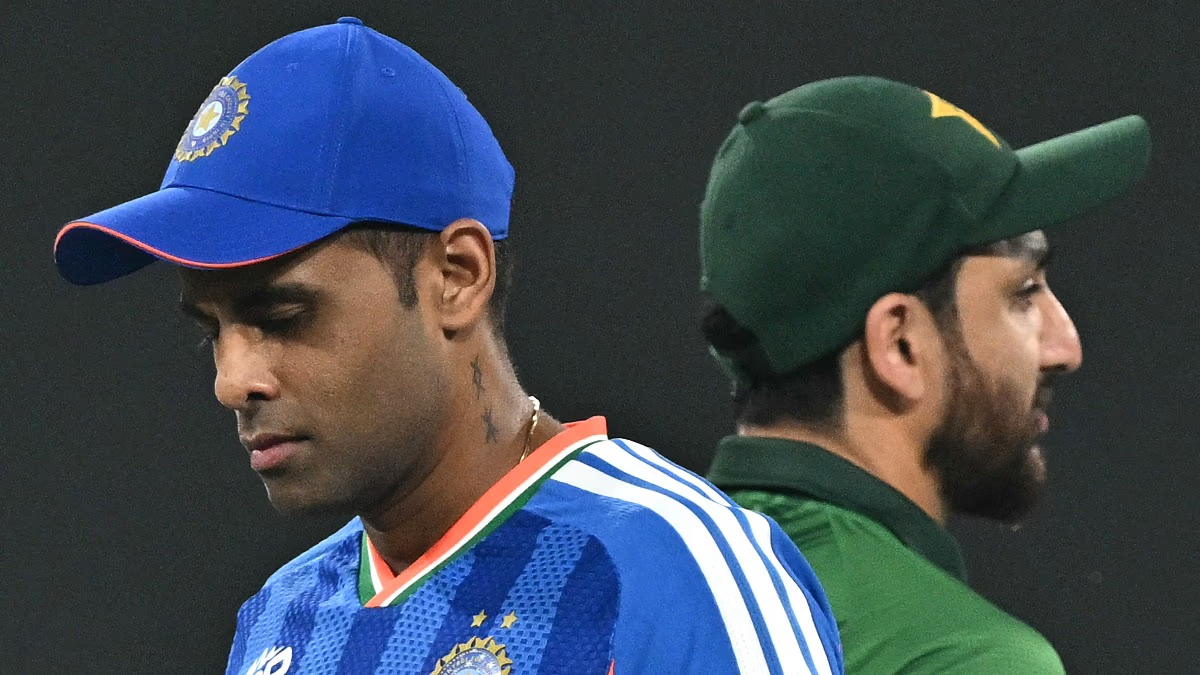
The Super 8 lineup in the 2026 T20 World Cup has sparked debates questioning why the Indian team is pitted against all the group toppers. This isn't a spur-of-the-moment happenstance but a direct outcome of the pre-seeding methodology set before the tournament commenced.
The T20 World Cup began with 20 teams, divided into four groups: A, B, C, and D, with five teams in each. The top two teams from each group advanced to the Super 8, creating the next round of competitive play.
Upon reaching the Super 8 stage, these teams were reorganized into two groups (Group 1 and Group 2) containing four teams each, where they will compete in a round-robin format. The top two from each group will advance to the semi-finals.
Why is India grouped with all table-toppers?
This can be traced back to the tournament's pre-seeding mechanism. Before the tournament, the ICC allocated the top eight teams into different slots (X and Y classification) to keep the subsequent rounds structured.
India was allocated to the X1 seed. Strong teams were also classified in this category. As a result, Group 1 of the Super 8 formed nearly as anticipated, accommodating teams that qualified later into the same slots.
The altering equation with Australia's exit
Australia's absence from the Super 8 created a void. Zimbabwe, qualifying from the same group, filled that slot, consequently shifting the balance within India's group as all table toppers coalesced in one group.
Who joins India? India finds itself in Super 8 Group 1 alongside formidable teams like West Indies, South Africa, and Zimbabwe. Intriguingly, these teams not only topped their individual groups but remained undefeated in the group stage.
Who advanced to the other group?
In contrast, Group 2 comprises Pakistan, Sri Lanka, England, and New Zealand, each securing second places in their respective groups. While the intent was to maintain balance on paper, the outcome deviated.
India's Super 8 Schedule
February 22 vs South AfricaFebruary 26 vs ZimbabweMarch 1 vs West Indies
The matches in Group 1 are deemed the toughest in the tournament due to the strong opposition. India's challenging group isn't a stroke of luck but the direct consequence of the tournament's design. Pre-seeding ensured certain slots, albeit with unforeseen outcomes intensifying competition making one group a 'mini world cup'.
Deciphering Pre-seeding in Layman's Terms
During the Super-8 stage, all teams will face each of their group's three remaining teams. The top 2 teams from both groups will proceed to the semi-finals. The points from the league stage will not carry forward into the Super-8.
The qualifying teams from the group stage were predetermined to fit into designated slots. South Africa, West Indies, India, and Australia were seeded for Group 1. For Group 2, New Zealand, England, Sri Lanka, and Pakistan received pre-seeding.
It was also predetermined that if a seeded team did not qualify for the Super-8, the next team advancing from the same group would fill that slot. For instance, Australia and Sri Lanka were seeded in Group B but Australia failed to qualify for the Super-8. Zimbabwe took Australia's place and entered Group 1.
Despite topping their respective groups, India, South Africa, Zimbabwe, and West Indies were grouped in Super-8 due to pre-determined seeding, offering no advantage for finishing first in the group stage. Zimbabwe, for instance, defeated Sri Lanka to top their group but remains in Group 1. Meanwhile, Sri Lanka, Pakistan, England, and New Zealand, each took second place in their groups, forming the second group in Super-8. This creates a direct clash of toppers against runner-ups.
Group 1 (Pre-seeding):
India X1
Zimbabwe X2 (Replacing Australia)
West Indies X3
South Africa X4
England Y1
New Zealand Y2
Pakistan Y3
Sri Lanka Y4
The Complete Schedule of Super-8 Matches
February 21: New Zealand vs Pakistan (R. Premadasa Stadium, Colombo, 7 PM)February 22: England vs Sri Lanka (Pallekele Cricket International Stadium, Pallekele, 3 PM)February 22: India vs South Africa (Narendra Modi Stadium, Ahmedabad, 7 PM)February 23: Zimbabwe vs West Indies (Wankhede Stadium, Mumbai, 7 PM)February 24: England vs Pakistan (Pallekele Cricket International Stadium, Pallekele, 7 PM)February 25: New Zealand vs Sri Lanka (R Premadasa Stadium, Colombo, 7 PM)February 26: South Africa vs West Indies (Narendra Modi Stadium, Ahmedabad, 3 PM)February 26: India vs Zimbabwe (MA Chidambaram Stadium, Chennai, 7 PM)February 27: England vs New Zealand (R Premadasa Stadium, Colombo, 7 PM)February 28: Pakistan vs Sri Lanka (Pallekele Cricket International Stadium, Pallekele, 7 PM)March 1: Zimbabwe vs South Africa (Arun Jaitley Stadium, Delhi, 3 PM)March 1: India vs West Indies (Eden Gardens, Kolkata, 7 PM)
How did all the table-toppers land in Group 1 of Super-8?
Cricketer Aakash Chopra shared a video on his social media, explaining this unusual grouping in detail. He highlighted that all the top teams - India, South Africa, Zimbabwe, and West Indies - have reached Group 1 without losing any league match, whereas the teams in Group 2 - England, New Zealand, Pakistan, and Sri Lanka - joined after losing one match each.
In the video, Aakash explained that fans were puzzled over this pre-seeding, wondering how these scenarios unfolded. He suggested that similar pre-seeding formats had been implemented in earlier World Cups in 2007, 2009, 2010, and 2011, and notably in 2012 similar to 2026. At that time, the groups ended similarly composed with top teams like India, Australia, South Africa, and Pakistan grouped together due to pre-seeding.
According to Aakash, such systems of predetermined groups/seeding have been utilized in previous tournaments, based on his experience and analysis, but not formally documented by the ICC.
Why is Pre-seeding Used in T20 World Cup?
Aakash further delved into the reasoning behind pre-seeding in the 2026 T20 World Cup, expressing that the tournament takes place in India and Sri Lanka. Consequently, India's matches are scheduled in India, with Sri Lanka's in Sri Lanka. Given Pakistan's reluctance to travel to India, it became necessary to include Sri Lanka and Pakistan in the same group, while ensuring India is placed in a separate group.
Aakash also addressed various speculations, such as this pre-seeding serving the BCCI's interests, by arguing that logistically, if anything, India has drawn a challenging group with South Africa, Australia (subsequently replaced by Zimbabwe), and West Indies. Though no one anticipated Australia’s unexpected exit from the T20 World Cup.
Format:
- 20 teams, 4 groups (5 teams each)
- Top 2 from each group reach Super Eights
- Super Eights: 8 teams, 2 groups (X and Y)
- Top 2 from each group proceed to semi-finals
Some teams receive predefined 'slots' for Super Eights:
- Group X: India (X1), Australia (X2), West Indies (X3), South Africa (X4)
- Group Y: England (Y1), New Zealand (Y2), Pakistan (Y3), Sri Lanka (Y4)
- If teams qualify, they retain the predetermined group slot, regardless of order of finish.
- Replacement of a non-qualifying team gives the next qualifying team the open slot.
- Super Eight matches are pre-scheduled
- Group stage points do not carry into Super Eights
- Essentially, the Super Eights act as a standalone tournament, though the groups are predetermined.