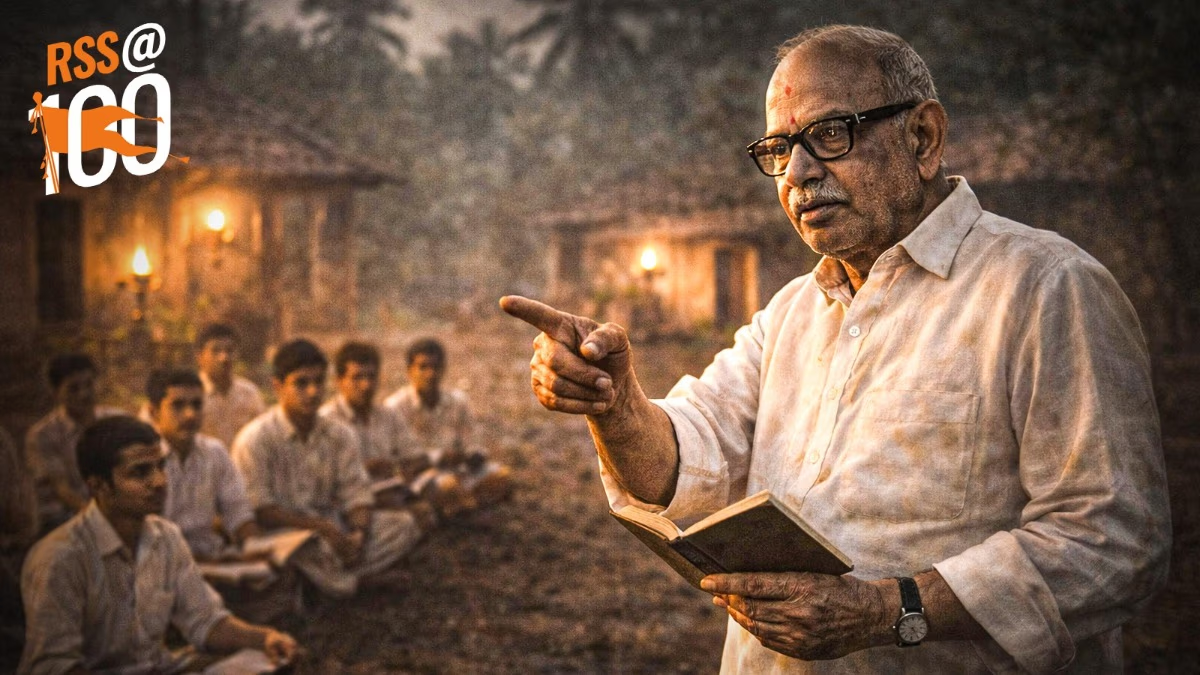
At times, senior leaders feel the need to retain certain volunteers or propagators closer to the headquarters rather than sending them to distant regions due to their skills and utility. For instance, Dr. Hedgewar first entrusted Guru Golwalker with Nagpur’s responsibilities, appointed him in charge of the Sangh Shiksha Varga, and even sent him briefly to Bengal. Recognizing his potential to succeed as the next Sarsanghchalak, his base remained Nagpur. Golwalker, recognizing Balasaheb Deoras as someone with deep comprehension of the organization's mission akin to Dr. Hedgewar, summoned him to Nagpur, ensuring he remained there. While many didn't climb to the highest ranks, their significant contributions ensured they weren’t sent afar. Today, explore the riveting stories of these four volunteers who significantly contributed to the narratives surrounding all Sarsanghchalaks, which you often read about in diverse publications.
Abaji Thatte: The Shadow of Guru Golwalker
“The only repose for a diligent worker is the three-letter word ‘death’.” Imagine the depth and character of the person who wrote these lines. This was Vasudev Keshav Thatte, who chose the RSS over a promising career even after securing an MBBS degree before independence. Known as Guru Golwalker's shadow, Balasaheb quickly recognized his talent and dedication, intending to assign him significant responsibilities. However, before that, he was sent as a propagator to Shivpur in Bengal.
Vasudev Keshav Thatte, or Abaji Thatte, was of a unique mold. Within months in Shivpur, he began producing new propagators. Recognizing his commitment, Balasaheb appointed him to serve Guru Golwalker. Abaji shadowed Golwalker across the country, familiarizing himself with numerous events, including rescuing volunteers during the Karachi bomb incident and Golwalker's ventures during partition turmoil — all of which he kept a secret except for occasional entries in his diary.
Abaji often sketched while observing Guru Golwalker, preserving these sketches in his diary. When urged to pen a book detailing his experiences with Golwalker, he modestly replied, “Hanuman lived alongside Shriram for years, yet it was Maharshi Valmiki who chronicled Ram's tales.” This left the inquirer speechless.
However, the extensive network he established nationwide later proved invaluable for Balasaheb Deoras, the subsequent head of the RSS. As Deoras traveled the country in his new role, Abaji acquainted him with key volunteers in every city, facilitating his work. Additionally, when Abaji was designated All India Propagator Chief, he adeptly integrated connections from earlier decades into newer initiatives like the National Volunteer Service and women's organizations.
Born in Bombay (now Mumbai) in 1918, Vasudev Keshav Thatte was raised by his elder brother, who influenced his initial forays into the Sangh's activities in Shivaji Park around 1939. Despite having an MBBS degree, he insisted on becoming a propagator, leading to his first assignment under Dr. Pandey in Bombay's Badkas Chowk before stints in West Bengal and later serving Guru Golwalker. Abaji passed away in 1995.
The Volunteer Who Hand-Copied 11,000 Letters by Guru Golwalker
Baburao Chauthaiwale's family tree revealed an intriguing fact: six brothers, three of whom became full-time RSS propagators, while Baburao served as a temporary propagator for two years. Despite not officially being a propagator, he connected deeply with subsequent Sarsanghchalaks, earning the title of their personal letter writer. His brothers, who joined as propagators, included Sharadrao, Shashikant, and Arvind Chauthaiwale.
While in ninth grade, Baburao met Dr. Hedgewar, who encouraged taking the organization's pledge. Even though Baburao’s father wasn’t a volunteer, his reverence for Hedgewar and Savarkar led him to allow his son to join. After completing the twelfth grade, Baburao spent two years as a propagator in Chhindwara. Completing his higher education, he diligently attended RSS training camps and taught at various institutions.
In 1948, during the organization's ban, Baburao operated underground to coordinate protests. In 1975, when the emergency imposed further restrictions, he safeguarded Guru Golwalker's belongings and consequently spent time imprisoned until the ban was lifted.
Murli Krishnao (Baburao) Chauthaiwale was born on July 27, 1922, in Barshi, Solapur, Maharashtra. The family originated from the region, although light of educational opportunities brought them to Kalmeshwar, then Nagpur. With the RSS office nearby, Baburao interacted directly with Golwalker and Deoras, who even considered Baburao’s home a personal retreat. Such familiarity helped dismantle hesitations between Baburao and his mentors.
From 1954, Baburao began managing correspondence for Sarsanghchalaks like Guru Golwalker. Every incoming letter was logged and diligently copied, with approximately 11,000 such copies collated into the book ‘Patrarup Shri Guruji.’ While Guru Golwalker personally responded to each letter, successors like Deoras often delegated to Baburao, who transcribed dictated messages. Baburao’s knack extended beyond letters; Deoras shared main ideas for speeches like Vijayadashami, which Baburao drafted, owing to Deoras’s aversion to writing.
Babus' insights deftly chronicled the evolving dynamics of successive Sarsanghchalaks, with critical anecdotes allegedly detailing how RSS pamphlets were organized and stored during turbulent political eras.
These relationships gave rise to significant anecdotes, revealing administrative rigors, moments with Golwalker, and the inherent respect between leaders, not the least highlighted by Deoras’s near-unconsciousness amidst news of Golwalker's passing, itself rumored to name Deoras as his direct successor.
Chauthaiwale also assisted during Dr. Abaji Thatte’s ill health, subsequently authoring ‘My Observations of Shri Balasaheb Deoras.’ Despite encouragement to write a similar account for Guru Golwalker, Baburao fell ill after drafting only two chapters and passed away in February 1996, yet his previously gathered resources contributed heavily to Ranga Hari’s biography of Golwalker.
The Guardian of Nagpur's RSS Headquarters, Finding Meaning at Home
Pandurang Kshirsagar considered the Nagpur RSS office his sacred domain, his alternate realm. Born in Wardha but drawn into full-time volunteering, he devoted early adulthood to establishing footholds across challenging regions, such as Bengal, where his perseverance heralded significant organizational milestones.
Yet, adversity constantly followed; prone to illness, Pandurang endured ‘flurecy’ complications in Bengal before respite in Maharashtra allowed a return to mayoral duties inside the RSS’s logistical heart, Nagpur. Without a breath, he excelled in coordinating far-flung initiatives, from finance to strategic meetings, with acute precision.
1955 saw Pandurang assume national responsibilities, handling accounts with such efficiency that during the police’s emergency confiscations, even the IRS couldn’t fault the records. The impeccable execution of administrative affairs under his watch promoted admiration even amongst adversaries.
The traumatic aftermath of the post-Gandhi assassination era cast shadows, with vandalized infrastructure left unrepaired until 1962’s reconstruction endeavors, closely overseen by Guru Golwalker alongside Pandurang’s detailed management.
The Riverside Meditation Temple, a grand endeavor, was marked by fierce community riots near Jabalpur, threatening construction. Muslim artisans, fearful of repercussions amidst mounting tensions, sought Pandurang and Golwalker's assurances of safety, reinforcing trust amid communal unrest.
The inevitable drew Pandurang outside Nagpur when Thane Central Jail housed him during the emergency, exacerbating his health until eventual illness culminated in passing inside the very brick walls evocative of Bhagat Singh’s alma mater, upon identical fateful day—March 23, 1976.
His legacy persists in Nagpur, with a building dedicated as ‘Pandurang Bhavan,’ manifesting steadfast dedication respected overtly across the grand span of the RSS. His presence in Nagpur fortified the city’s heartbeat, cementing enduring echoes of invaluable affection within the sacrosanct walls of Rassiwala office lines.
The President of Mauritius Held a Wedding for Him
During India’s 75th independence year celebrations, VP Venkaiah Naidu unveiled a commemorative stamp honoring an unsung hero named ‘Chaman Lal’ at Sardar Patel Conference Hall, Delhi. Union Minister Ashwini Vaishnaw recounted an amusing anecdote about Mauritius President Aniruddha Jugnauth delaying his son's wedding until Chaman Lal arrived.
The Press Information Bureau’s release described Chaman Lal, born March 25, 1920, in Sialkot (now Pakistan), as inspired towards welfare from youth. Despite academic honors and job offers, he prioritized aiding partition sufferers. His strategic engagements supported the overseas Indian diaspora and fostered essential frameworks aligned with India's foreign policy.
What linked Chaman Lal with the RSS becomes evident as history unravelled. Originating from Sialkot’s land-brokerage affluence, he emerged academically vigorous, dominating scholastic achievements, yet the call of national service outshone other aspirations.
In 1936, joining RSS’s ranks, detours through Gandhian practices momentarily diverged him, ultimately cementing links joining propagators like Chaman Lal, grounded on allegiance to national-service philosophies and bridging community gaps particularly noticeable amid partition chaos.
Years serving Himachal's remote locales reinforced his perseverance, with diaries logging every day's challenges—eventually becoming vital RSS historical documentation. Even imprisoned for indirect allegations amidst Gandhi's assassination chaos, Chaman Lal rebounded, utilizing integral office resources to weave connectivity threads across globally dispersed RSS volunteers.
Narratives reverberate of Chaman’s meticulous coordinate notes, similar to modern ‘minutes’, documenting dialogues and transglobal communication flows serving strategic RSS objectives. Integral albeit oblivious to his pivotal roles, Chaman Lal’s office represented a virtual helmsman, succinctly directing operations amid seismic political shifts, manifesting continued resilience.
Living testament to organizational resources, including publications compiled under his tenure, remain instrumental academic contributions. Mundane street ingenuity, typified by handwritten communiques circulated during India’s emergency backdrop, testified Chaman's significant archival contributions preserving, supporting, and contextualizing organizational legacies alongside broader Indian historical spectrums; passing occurred in February 2003.
Previous story:
In Kerala: RSS’s ‘The Kerala Story’ Exposes Devastating Volunteer Losses
Next story: