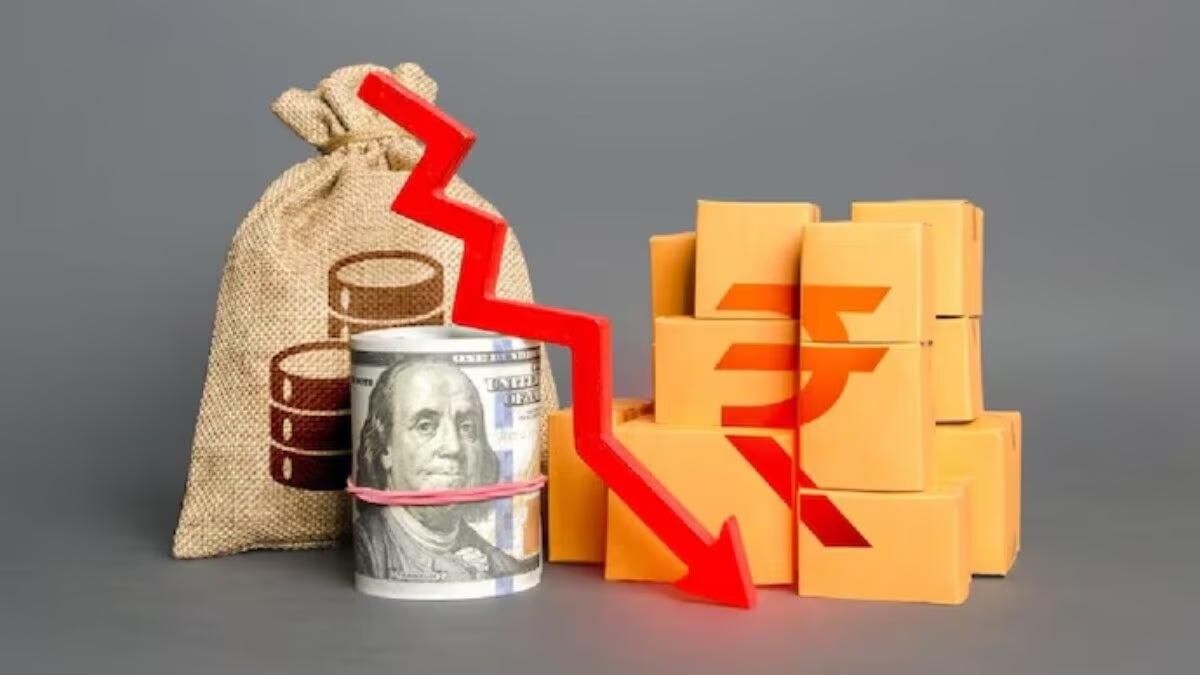
The Indian Rupee is continuously touching new historic lows (Rupee Life Time Low) and has reached 92 against the US Dollar. This significant depreciation in the Indian currency comes amid heightened global uncertainty and reduced foreign investment inflows into emerging markets. Just in January 2026, the Rupee has weakened by 2.3%. Any currency's depreciation isn't known to be beneficial for a nation and it manifests in various adverse impacts.
The Unrelenting Decline of the Rupee
Observing the Indian Rupee's performance, it has been steadily declining against the Dollar for an extended period. On Friday, it opened at 91.9125, almost equal to the previous day's closing value of 91.9550. During the last session, the Indian currency plummeted to a life-time low of 91.9850. So far this month, the Rupee has slid by about 2.3%, marking its worst monthly performance since September 2022.
Major Causes Behind the Rupee's Decline
Discussing the underlying causes for the Rupee's persistent weakness, this depreciation in the Indian currency has occurred amidst global uncertainty heightened by factors such as tariffs and trade wars. As a result, the inflow of foreign capital into emerging markets has decelerated. Meanwhile, high-interest rates in developed economies have increased returns on foreign investments, making investors more cautious.
It should be noted that India has a current account deficit. This means there's a reliance on foreign capital to bridge the gap between imports and exports. When these cash flows weaken, the pressure on the currency increases, leading to its depreciation.
Source: aajtak
E-Survey Spotlight on Rupee
During a press briefing after the Economic Survey 2026 was presented in Parliament on Thursday, Chief Economic Advisor Venkatesh Ramanan Anant Nageswaran stressed the importance of understanding the Rupee's decline. He stated that the depreciation we're witnessing is not isolated to India alone. According to the CEA, currencies in countries with current account deficits have also undergone devaluation.
Despite this, he clarified that the Rupee's long-term performance has been relatively stable. If we observe the performance of various countries' currencies since the millennium's onset, the Indian Rupee has indeed fared well. He explained that when global factors slow foreign cash flow, currencies of capital-importing countries automatically weaken.
How Will the Rupee Recover, According to the CEA?
The Chief Economic Advisor further clarified that enduring currency strength cannot be achieved solely through interventions. He emphasized that the first condition for currency stability and strength is manufacturing capacity. According to Nageswaran, robust growth in manufacturing exports improves the current account situation and supports foreign currency reserves, gradually increasing confidence in the nation's currency. Citing examples, he noted that stable currency countries like Switzerland, Japan, Korea, Taiwan, and Singapore have a significant presence in the manufacturing sector.

Source: aajtak
What Are the Downsides of the Rupee's Decline?
The CEA suggests that reaching life-time low levels cannot be immediately interpreted as an economic crisis and that it reflects global capital flow weaknesses and investor caution, factors India cannot afford to overlook. Discussing the issues resulting from currency depreciation, the Rupee's continued weakening against the Dollar poses an escalating risk of inflation.
Its impact stretches from petroleum products to students studying abroad. To understand, consider that India is a major crude oil importer, fulfilling 80% of its needs through imports. Consequently, when the Rupee falls, more Dollars are required, threatening a rise in domestic petrol and diesel prices. This, in turn, increases transportation and logistics costs, potentially driving inflation. Thus, the Rupee's weakness results in imported goods becoming more expensive, and it increases the cost of sending money overseas.