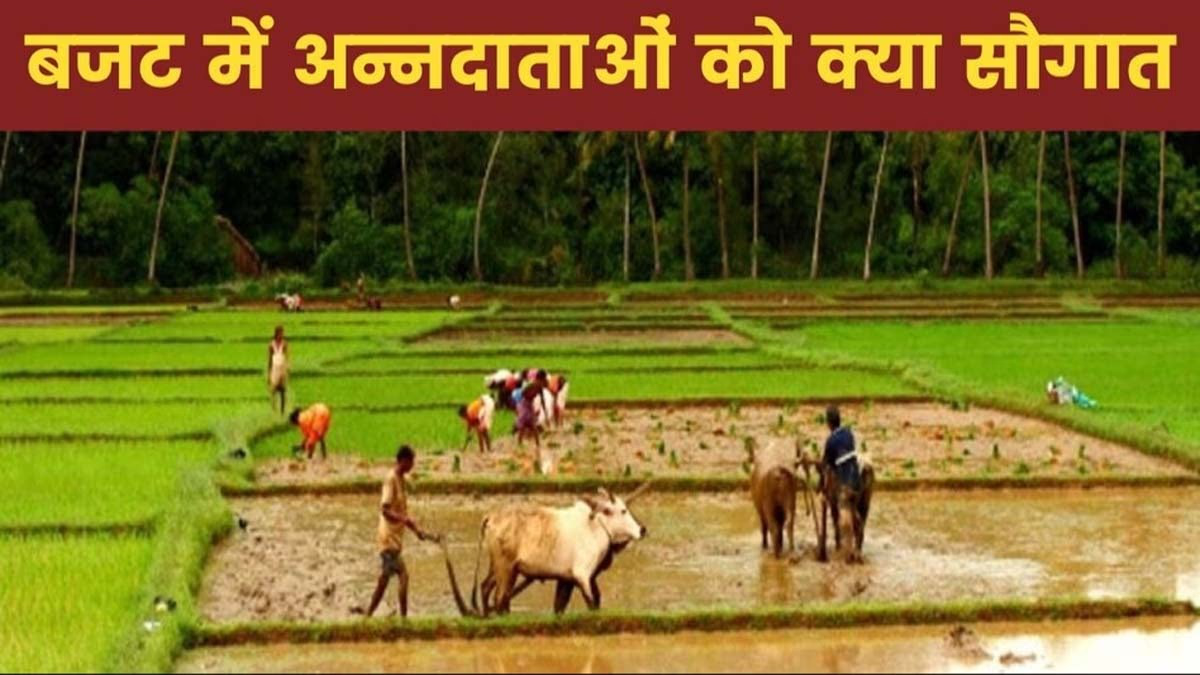
As we approach the Union Budget announcement on February 1st, farmers carry several expectations from the government. Key demands for agricultural development include ensuring supplies of fertilizers and seeds, expanding irrigation facilities, and legally securing the minimum support price (MSP) for crops. An increase in the PM Kisan Samman Nidhi scheme's fund is also sought.
Finance Minister Nirmala Sitharaman shared in the economic survey that over 11 crore farmers have received more than 4.09 lakh crore rupees under the PM Kisan Samman Nidhi scheme. Her focus remains on empowering farmers.
Incorporating these demands in the budget, feel the farmers, will strengthen the agriculture sector and elevate their economic condition. Reductions in GST for essential items like seeds, urea, fertilizers, farming equipment, tractors, and diesel could provide significant relief.
Source: aajtak
Source: aajtak
Source: aajtak
Source: aajtak
Source: aajtak
Discussions around the PM Kisan Samman Nidhi scheme (PM-KISAN) remain lively. It's anticipated that the 2026 Union Budget could increase the allocated amount under the scheme.
Will the PM-KISAN scheme's allocation change in Budget 2026?
Under the PM Kisan Samman Nidhi scheme, eligible farmers receive annual financial assistance of 6,000 rupees, transferred directly to their bank accounts in three installments. However, in the current context, farmer organizations and agricultural experts feel that considering rising inflation and farm expenses, this amount now seems insufficient.
In recent years, farm expenses have surged. Everything—seeds, fertilizers, pesticides, diesel, electricity, irrigation, and farming machinery—has grown expensive. For marginal and small farmers, the 6,000 rupees of financial aid is proving inadequate. Hence, calls for a raise in this amount are gaining momentum for the 2026 budget.
Reducing input costs and expanding agri-infrastructure
A significant farmer demand is reducing GST rates on pesticides and equipment used in farming. Currently, there is an 18% tax on pesticides, and farmers are advocating for its reduction to 5%. Additionally, the budget might see major investments in strengthening post-harvest logistics and cold-chain infrastructure.
Optimal use of government schemes
Several schemes like the PM Dhan-Dhanya Agriculture Plan are aimed to assist farming. Particular attention should be given in the budget to ensure these programs reach smallholders and regions dependent on rainfall, as well as women farmers.
Strong farming is the foundation of a developing India
To transform India into a developed country by 2047, bolstering agriculture is essential. Budget 2026 has the potential to chart a new course for Indian agriculture. Collaborating with the government, prosperous farmers will propel the nation forward.