Drama and conflict are not new to West Bengal politics, but the event on January 8, 2026, in Kolkata has brought it to a new level. The Enforcement Directorate (ED) conducted raids on the Indian Political Action Committee (IPAC) office located in Salt Lake and the residence of its chief, Prateek Jain. This raid is reportedly part of an investigation into money laundering and a coal scam, with IPAC being the mastermind behind TMC's election strategies.
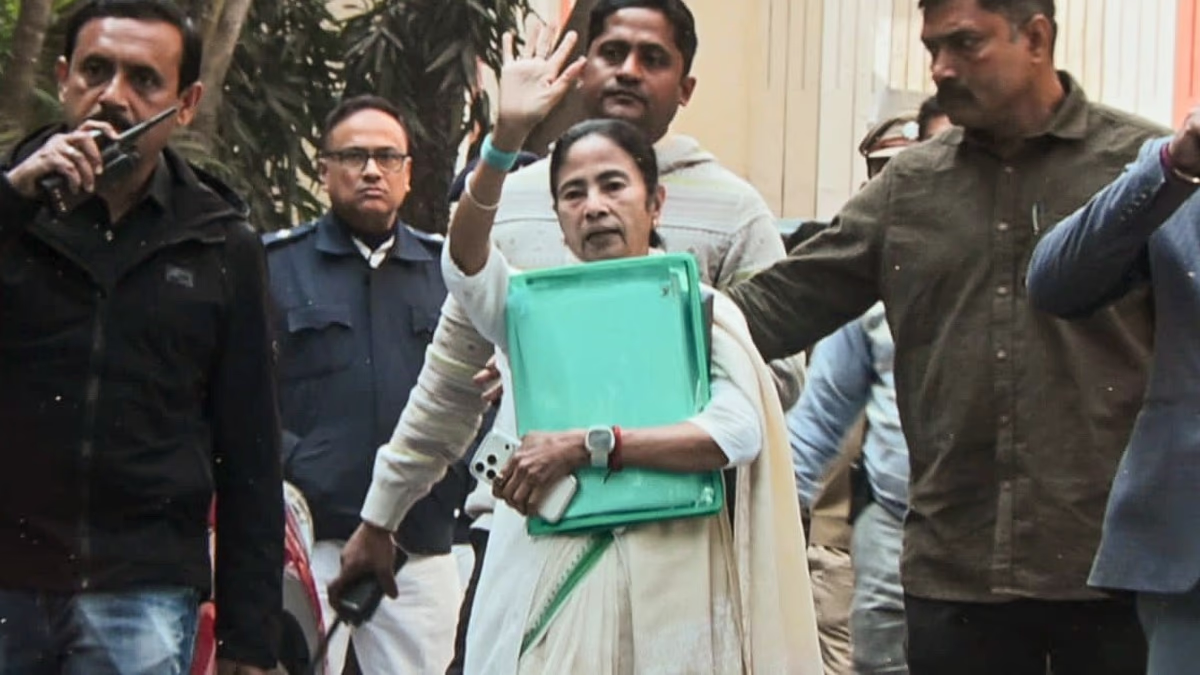
What surprised everyone was the direct confrontation when Chief Minister Mamata Banerjee arrived at the scene herself, challenging ED officials. She accused the ED of seizing TMC’s internal data and hard disks and even referred to Union Home Minister Amit Shah as 'naughty and nasty.'
The confrontation between Mamata Banerjee and ED officers went viral on social media, with Mamata seen arriving and leaving with documents and laptops. This raises the question: What nerve was struck that led an experienced leader like Mamata to personally intervene at the cost of her dignity? The incident becomes even more significant with the 2026 assembly elections approaching, where TMC and BJP are having an intense battle. Let's explore IPAC's role, Mamata's reaction, and the political calculations behind it.
The Role of IPAC in Bengal Elections
IPAC, known as the Indian Political Action Committee, is a political consultancy firm founded by Prashant Kishor of Jan Suraaj fame. This firm assists political parties in winning elections through data analytics, ground strategy, and digital campaigning. In West Bengal, IPAC played a crucial role. In the 2021 assembly elections, IPAC designed TMC's 'Khela Hobe' campaign, which outsmarted BJP's aggressive strategy. TMC won 213 seats, while BJP settled for 77. Even in the 2024 Lok Sabha elections, IPAC's strategies helped TMC secure 29 seats. Ahead of the 2026 elections, Mamata had announced a partnership with IPAC in 2025. Prateek Jain, IPAC's director, serves as TMC's IT chief.
IPAC possesses a vast data bank for TMC, including voter lists, opinion polls, social media analytics, and local intelligence. This data forms the foundation of election strategies. If ED had leaked or seized this data, TMC's campaign could derail. Mamata termed it data theft, accusing ED of attempting to seize TMC's hard drives.
Although the raid is reportedly tied to an old coal scam involving fake job scams, TMC views it as political vendetta since the action occurred three months before elections. IPAC's raid directly targets TMC's election machinery, seemingly a move to weaken Mamata.
Mamata's Confrontation Over ED's Raid
On the morning of January 8, 2026, ED's team began raiding IPAC’s two offices in Salt Lake and Prateek Jain's house. ED claims it’s part of a money laundering investigation related to an organized gang. However, as soon as Mamata heard about it, she reached Prateek Jain's house herself. The video footage shows Mamata arguing with ED officials, asserting, 'This is TMC’s internal data, do not touch it.' She personally took documents and hard drives away, striking at Amit Shah during a media interaction, calling him a 'nasty Home Minister.' What if I raid BJP offices?
ED officials objected, but Mamata's presence created tension. TMC workers gathered, chanting slogans, prompting state police intervention. Opposition leader Suvendu Adhikari termed it obstruction of investigation, questioning Mamata's dignity as a chief minister and challenging a raid on her residence could uncover 100 crores.
Mamata's Intervention in ED Raid: Protecting Secrets?
This incident occurred just before the 2026 assembly elections, where TMC and BJP were at loggerheads. Mamata’s actions raise questions about her dignity since direct interference by a chief minister in investigations can be deemed unconstitutional. BJP's Suvendu Adhikari termed it Federal agency obstruction and called for ED action against Mamata.
But the question arises: Is Mamata protecting any secrets? IPAC is the heart of TMC's election machinery. In the 2021 elections, IPAC designed the Khela Hobe campaign, forming the basis of TMC's victory. IPAC possesses a massive data bank of TMC's voter lists, opinion polls, candidate lists, and strategic documents.
If ED had seized this data, TMC's 2026 strategy could have leaked. Mamata’s arrival and taking files demonstrate her protecting data that could politically damage them, such as electoral fraud charges or funding irregularities. ED’s coal scam link suggests that IPAC’s funds might involve black money, which Mamata might be covering up.
Conversely, it seems political revenge too. Mamata termed it data theft, accusing BJP of attempting to steal TMC’s strategy.
TMC leader Abhishek Banerjee is already under ED investigation. Mamata’s reaction is part of her 'didi' image, protecting the people and party. Yet, if there are no secrets, why did she arrive herself? Do the files contain sensitive information, such as financial transactions or coalition deals? Analysts believe this is part of federal tension.
The center uses ED and CBI to target the opposition while Mamata emphasizes state rights. Yet, Mamata's anger indicates that the IPAC raid hits TMC’s weak spot. If she is protecting secrets, it could relate to funding or election strategy. Ultimately, investigation will reveal the truth, though it currently seems more political drama.
History of Confrontation Between Mamata Banerjee and Central Agencies
-It began with the Rajeev Kumar case in 2019; when a CBI team arrived at the Kolkata Police Commissioner's residence, the Chief Minister demonstrated historic resistance on the spot.
-During the Narada sting case in 2021, when her ministers were arrested, Mamata stayed in CBI’s 'Nizam Palace' office for six hours, challenging her own arrest. -In the Sandeshkhali case when the CBI took action against Shahjahan Sheikh, she termed the agency's intervention a political conspiracy, citing state sovereignty. -In the ration scam, with Minister Jyotipriya Mallick’s arrest, she directly warned ED officers of an FIR.
-On every occasion of questioning her nephew Abhishek Banerjee, she vehemently opposed it from the street to the assembly, labeling it as central government’s revenge politics.
-Last year, in the infamous RG Kar Hospital rape and murder case, she staunchly supported controversial Kolkata Police Commissioner Vineet Goyal amidst objections from doctors and the general public. They demanded action against him. Ultimately, Mamata had to remove him from the position.
In all these incidents, Mamata Banerjee consistently adopted the strategy of direct intervention against investigative agencies on both administrative and political fronts. Sometimes she personally arrived at the scene, joined protests, or defended alleged accused in court.