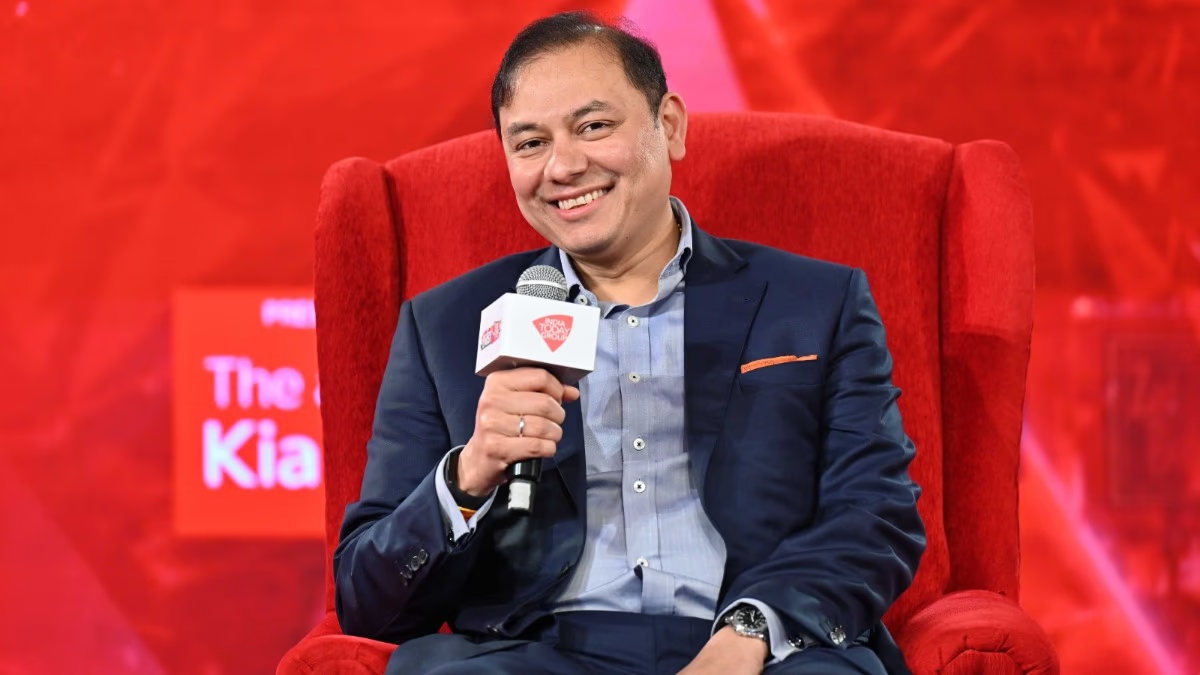
Pranav Adani, Director of Adani Enterprises Limited, opened up about the group's grand plans for 'Future India' in his first television interview. Speaking with Shweta Singh at the 'Agenda Aaj Tak' platform, he elaborated on the direction Adani Group will take in the coming years and its role in the country's economic progress.
When asked about his vision for 2026, Pranav Adani stated, 'Looking ahead to 2026, we have immense optimism about the future. We are on the path to becoming a five trillion-dollar economy with a target of 10 trillion dollars in the next five to seven years. Infrastructure plays a crucial role in India's growth journey. Be it roads, airports, ports, the energy sector, utilities, or urban sustainable living - these are all critical components. I believe that by 2026-27, the government's major focus will remain on these sectors.'
The Role of Adani Group in Making India a Developed Nation
Pranav Adani was questioned on why most companies shy away from infrastructure. He explained that infrastructure is not an easy business due to its long gestation period. It's not a business where you invest today and get returns in a year or two. It requires consistent investment over a long period. However, there are also significant opportunities. Consider airports, which we're developing for the next 50 years, along with the power and energy business, where we're thinking 25-30 years ahead. With such a long-term vision, as our Chairman Gautam Bhai always plans 15-20 years ahead, we're envisioning a developed India by 2047, focusing on self-reliance.'
Read More: Businessmen as Political Soft Targets? Pranav Adani Responds
When asked about Adani Group's role in making India a developed nation and the global models that inspire him, Pranav Adani said, 'In the businesses we're involved in, global leaders are present. Take airports, for instance. You've traveled to places like Abu Dhabi, Dubai, Qatar, or European airports, which set global standards. In the past five to six years, Indian airports have also seen rapid improvements. Many airports have been privatized and now function at global benchmarking levels.' He added, 'Annually, we evaluate passenger numbers, happy passengers, satisfied customers, the changes implemented, and how technology-driven improvements are made over time. When it comes to ports, our group manages over 15 ports in India and abroad. But our goal is always to compare ourselves to world-class ports like Rotterdam or Singapore in terms of turnaround time, whether it's container handling or other cargo operations. Recently, we've inaugurated the Vizhinjam Port, India's largest transshipment hub. Earlier, most of India's cargo was transshipped via the Middle East's Fujairah or Malacca. But we questioned, why can't India have a significant transshipment hub of its own? Vizhinjam Port in Kerala is a deep port that can accommodate the world's largest ships, exemplifying international standards.'
'Ratings are a Byproduct of Our Work'
Regarding credit rating agencies, he noted, 'Not just Moody’s, but S&P Global Ratings and others have made significant improvements in our ratings. In fact, we are among the few Indian companies whose rating matches the sovereign rating of the country. The national ratings act as a cap for our ratings.'
Pranav Adani believes, 'If you consistently perform well, focus on operations, and excel in execution, good ratings come naturally. Ratings are essentially a ‘byproduct’ of our work - the end result. You'll be pleased to know that in the coming five years, we've set a target of 10 lakh crore INR in capital expenditure for the infrastructure sector. This means an annual investment of approximately 2 lakh crore INR in India's infrastructure sector, pointing us in the right direction, especially in terms of execution.'
Read More: 53,000+ Jobs in Bihar: Why Pranav Adani is Hopeful for the State
'We Invest Where there's a Need for Investment'
On investment across states and keeping politics at bay, he noted, 'Today, we've invested across nearly 26 states in India. Across the country, we have nearly 400 locations where our businesses thrive, whether it's infrastructure, power, cement, or utility services. So, we're active nationwide. Whenever a state requires investment, they hold an ‘Investors Summit’ to welcome investors. In India, a model has emerged where each state competes with others to attract investments because today’s youth questions leaders. Bihar's youth asks why investment isn't coming to the state. Likewise, Kerala's young citizens question why they need to go elsewhere for work. The same happens in Assam and West Bengal, where we're also investing.'
Pranav Adani reflects, 'In recent years, the kind of investment we've made in Kerala - be it the Thiruvananthapuram Airport or the Vizhinjam Port - is unmatched by most private firms. Regarding Bihar, I'm uncertain about how many private companies have invested at the level we have. We're honored to develop a power plant in Bhagalpur’s Pirpainti, featuring a 2400-megawatt installation with nearly 20,000 crore INR investment. Infrastructure is crucial for development, and everyone knows that to advance a state, the most essential ‘fuel’ is energy, which is now reaching there. Therefore, when a state needs investment, we go regardless of the ruling political party.'
On allegations of political proximity, Pranav Adani asserted, 'In a democracy, everyone is accountable and equal. If anyone levels charges against us today, we must endure difficult scrutiny. This applies to all groups. If you're honest, transparent, and your governance model is robust, there's no fear of any investigation or allegations. As far as being 'soft targets' go - if a state needs something for its interest, it doesn't matter if political parties favor you or not.'
What Pranav Adani Says About the Dharavi Project?
He called it the world's largest urban regeneration project. The residents will be rehabilitated in Mumbai itself. Dharavi's history shows repeated redevelopment efforts over the last 40 years faced obstacles, but now the government selected the Adani Group through an international tender process. In terms of rehabilitation, we believe this project will perform very well in the long term, as it is a major development project in central Mumbai. Approximately two lakh homes are to be built. The government has ensured that those who lived in Dharavi before 2000 will receive new homes in the same location (in-situ).
The Director of Adani Enterprises further stated that those who arrived after that will receive homes within the Mumbai region but will be rehabilitated in it. Regarding community trust, I interact with Dharavi residents. They are more optimistic now. Social media informs them about nearby developments. As Mumbai and the country progress, many wonder why they shouldn't have the same opportunities? Change is inevitable, and soon, Dharavi residents will receive homes of 350 square feet carpet area. Assuming a rate of approximately ₹30,000 per square foot in Mumbai, this means receiving a home valued at around 1 crore INR for free. Who wouldn't want change? Everyone desires a life filled with dignity. Even now, some parts of Dharavi have extraordinarily dire and inhumane conditions.
Read More: 'Should Have Invested in Assam Earlier', Why Pranav Adani Says So
Pranav Adani explained the home allocation process, 'The greatest challenge involves a trust deficit. In past slum development projects, residents were moved to transit houses, but their return to original neighborhoods didn’t occur as promised, causing some to become nearly homeless. Recognizing this, we revamped the procedure. First, we'll build your new home, hand over the keys, enabling you to move directly into your permanent home. Only then will your old slum be removed for redevelopment. This builds trust that they’ll receive homes first, and it diverges sharply from previous transit house models.'
He added, 'We aim to develop Dharavi into a fully multi-modal corridor. It will include buses, metro, local trains, and the best roads, as a new city emerges. Central to Mumbai, this location is crucial. Well-planned logistics here can significantly enhance Mumbai's overall mobility. Our vision mirrors multi-modal networks like those in countries such as Hong Kong, where everything from basement level to the top is interconnected. Like there, seamless connections from metro to airport, local to international trains, and smooth traffic movement are intended. Our comprehensive plan reflects this vision.'
'Mumbai Needs At Least Two to Three Airports'
On the Navi Mumbai International Airport, Pranav Adani remarked, 'Many major cities around the world have multiple airports. Take London - four airports cater to the city: Heathrow, London City, Gatwick, and Stansted. Similarly, a large city like Mumbai requires at least two to three airports. The new Navi Mumbai airport will significantly enhance air travel. We hold that increasing supply will lead more people to air travel, reducing airfares. In the US, air travel and train travel often equalize in cost and convenience if booked on time. Once Navi Mumbai airport is fully operational and infrastructure works are completed, both airports will function effectively. With the infrastructure being developed in Maharashtra, reaching Navi Mumbai won't take more than half an hour.'
On investments concerning Assam airport and energy projects, he added, 'We have a complete expansion plan for Assam airport, and as you've mentioned, we are establishing a 3200-megawatt power plant there. Assam plays a strategic role in northeastern India. It connects the entire region via the ‘chicken neck’, linking with the seven neighboring states, known as the ‘Seven Sisters’. If you consider, Guwahati airport itself could become a hub for the entire region, easing travel within and internationally. Assam is strategically located, deserving timely investment.'
Read More: On Dharavi, Pranav Adani Says - Will Hand Over Keys First, Then Relocate Residents
What Potential Does Adani Group See in Bihar?
When asked about potential investment in Bihar, Pranav Adani noted, 'I've personally attended Bihar's Investors Summit twice. We’ve discovered many opportunities there. Bihar's youth is ambitious. However, due to a lack of opportunities, they often work in different cities. We believe if given opportunities in Bihar, the youth would prefer to stay. During the COVID pandemic, many people returned to Bihar, showing that people want to reside there, and nothing can prevent Bihar's development. The crucial requirement is energy for industries. If energy is accessible and the government understands its necessity, investment and development are possible. Our company has established a cement plant in Vatsaligunj, and we've initiated smart meter and two-three road projects in Bihar. I believe Bihar is now on a developmental trajectory, progressing rapidly.'
Upon being asked about governance-related allegations concerning the group cleared by SEBI, Pranav Adani reflected, 'These accusations hasn't adversely affected our business. In fact, we've achieved double the growth. You're referencing 2023, but look at how much more the group has expanded by 2025. We now register an EBITDA of nearly 90,000 crore INR. The recent announcements ensure that our internal approvals will manage all expansion plans over the next three to four years. Such incidents occur in growth trajectories. We were confident in executing them properly. In terms of governance, it initially existed but is now even more robust. We have an entire governance model, and transparency has significantly increased. Hence, you'll observe that the group is growing exponentially faster now than in the past report period.'
Pranav Adani disclosed, 'Two years ago, our group directly and indirectly employed around 55,000 individuals. Today, compared to that, nearly 2.5 lakh people and their families work for the group. This number will continue to rise. This illustrates the vast opportunities India presents, as there's increasing talent demand for various jobs. We’ll need different skills and training, but the need for people remains, and they must be included in this growth.'
70-Hour Work Week: Right or Wrong?
On the 70-hour work week debate, Pranav Adani expressed his views. He said, 'This topic has been extensively discussed with considerable controversy, so I won't dwell on it. But we believe everyone should work at their discretion. There can't be strict rules for this. Personally, I spend 12-14 hours at the office daily. However, my phone is active from 8 AM to midnight, and people contact me throughout. Stopping this is impossible. If you consider calls work, then it’s part of work from home. As I mentioned, it’s different for everyone, with no right or wrong.'
Regarding Gautam Adani's reputed strictness, Pranav. Adani clarified, 'At home, he is loving, but he is a taskmaster in the office. He is a disciplined leader, leading by example in leadership.'
Pranav Adani was asked, where he sees Adani Group in India's next growth phase. He shared, 'Logistics plays a pivotal role in a developed India by 2047. Currently, around 8% of our GDP is spent on logistics (7.98%), which is globally acceptable but can be improved. Efficient logistics requires proper connectivity, not only with ports but also with roads, ICDs, airports, and the complete network. If India manages this well, achieving a developed status won't be an obstacle. I truly believe India has a 100% possibility of becoming a 30 trillion-dollar economy.'
Base Load Power Comes from Thermal Power Plants
On international concerns regarding coal and green energy balance, Pranav Adani commented, 'Today, some people say as a trend, don't use coal. But the truth is, base load power still relies on thermal power plants. We also need to understand today's technology, known as ultra-supercritical, which significantly reduces emissions. Yes, we need thermal power for the base load, but we also need equivalent renewable energy. Adani Group plays a key role in renewable energy. We aim to become the world's largest renewable energy generation company by 2030. For instance, near Khavda (Kutch), Adani Green Energy Limited is installing 30 gigawatts (3000 megawatts) of renewable capacity at a single location. Spanning about 520 square kilometers, it's five times the size of Paris. We will produce solar power visible even from the moon. Combining all projects, we're targeting approximately 50 gigawatts of production by 2030.'
He continued, 'Challenges exist in every business. For instance, Khavda was initially barren land, very hot and desert-like, where typically no one would want to work. Transforming it into productive land is a significant achievement. Every business faces supply chain and other challenges, seen across many businesses. Now, we embrace it as part of life and move forward.'
Read More: Pranav Adani Exclusive: How Many Hours Should One Work? Pranav Adani Responds
Business Environment in India: Is it 'Easy'?
When asked if doing business in India is easy, Pranav Adani responded, 'We've talked about the importance of ease of doing business before. If you ask me personally, being Indian, we should see it in that context. Comparing 10-12 years ago with today, the ease of doing business has dramatically improved. Over the past 20-25 years, things have become much better. Now, many processes are online and transparent. For instance, a cabinet meeting in Bihar can easily be checked online for details. What's happening in any state is accessible online. While progress can always be made, we're in a much better position than before.'
On contributing to a globally competitive India, Pranav Adani commented, 'Our group is a first-generation one, not inherited over generations. It was founded by Chairman Gautam Adani. India's youth is ambitious and driven to achieve, evident in all sectors where we operate. At a national level, we're scaling to new dimensions. Our greatest asset is that half our population is under 35 years old. You recognize what a tremendous advantage this is. This is why the world is watching India. Our youth embody an entrepreneurial mindset, willing to innovate and undertake. We must nurture this spirit to start new things, emphasizing entrepreneurship, as opportunities abound here. Anyone suggesting a lack of opportunities in India is mistaken. In my view, India offers immense opportunities. Soon, you'll see reverse migration shift towards India. I'm fully confident. It’s only a matter of time.'
Desire to Contribute as Indians
Finally, on the question of legacy, Pranav Adani stated, 'For our family, it’s crucial what contributions we’ve made, changes in people's lives, and how we’ve helped them. Our efforts aim to improve lives and provide progress opportunities. All our businesses now pursue a purpose. For instance, in the Dharavi project, the satisfaction is derived from people gaining respectable living conditions, changing their lives, and opening paths for future generations. We ponder how people will remember us; hence all our projects are a source of national pride. Ultimately, as Indians, we aspire to do something for our nation. This is our national service, and our belief in our purpose.'