When discussing organizations spreading RSS's philosophy beyond Indian shores, three countries prominently feature: Kenya, Myanmar, and Mauritius. The advent of the Hindu Swayamsevak Sangh (HSS) in these regions is a remarkable tale. These areas resonate with early expansions, unlike Nepal, a Hindu-believed nation where HSS established only in 1992. Intriguingly, these expansions happened spontaneously. RSS initially aimed for national grassroots growth, but when Indians abroad took initiative, RSS stepped into a guiding role.
Pioneering Ventures: The Deck Branch by Punjabi and Gujarati
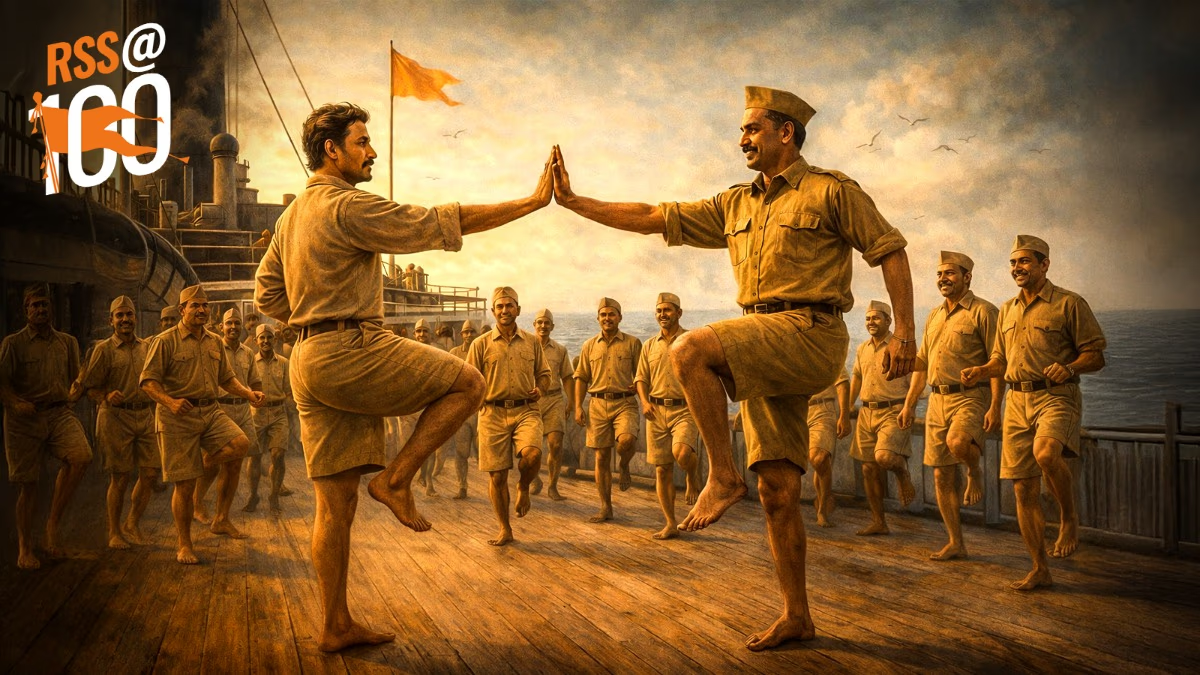
Jagdish Chandra Sharda, from Amritsar, with a scholarly title in Sanskrit, joined RSS early. His father's untimely death thrust responsibilities onto him, prompting a move to Kenya for livelihood. Nairobi's Arya Samaj required a Sanskrit teacher post-World War II due to rising Indian populations. Jagdish embarked from Mumbai for Mombasa in September 1946. Onboard, spotting someone in RSS khaki, he was intrigued. This was Mankalal Rughani, a Gujarati trader deeply influenced by RSS, proudly wearing the khaki even on a ship.
Mankalal's father, Ratanji Rughani, migrated from Gujarat to Kenya in 1914 as a laborer but later prospered to establish a business family. Their trade led them to Kenya. Together, Jagdish and Mankalal spent time engaging RSS-style activities, gradually involving 17 fellow Indians, evolving into formal gatherings even at sea.
The Genesis at Makar Sankranti: Indian Volunteers’ Hub in Kenya
Jagdish and Mankalal bonded well. They envisioned creating a mobilizing entity in Kenya. On Makar Sankranti, January 14, 1947, ‘Indian Swayamsevak Sangh’ was inaugurated in Nairobi, later renamed ‘Hindu Swayamsevak Sangh’. Despite Mankalal’s business commitments, they expanded networks across Kenyan towns. Jagdish’s efforts also reached Tanzania, Uganda, and Zambia. Eventually, he settled in Canada, continuing RSS endeavors until his last breath. Many regard him as HSS's patriarch.
Vishnu Dayal: Transforming Mauritian Freedom Fighters into Volunteers
Officially, HSS started in Mauritius in 1977. Nonetheless, Mauritius was the first international ground for RSS-like activities. Vishnu Dayal, a native, came to Lahore in 1936 to study, engaging with a robust RSS network. He became dedicated, meeting RSS founder Dr. Hedgewar. After completing studies and returning amidst Mauritius’s freedom struggle, Vishnu imparted RSS lessons to young revolutionaries.
Every Tale Linked to RSS’s Centennial Series
He named freedom fighters ‘Volunteers’, gaining fame. Though never formally organized, these activities mirrored RSS methods. Mauritius gained independence from Britain in 1968. Post-India’s Emergency, RSS outreach globally intensified. In 1977, HSS formally began in some Mauritian cities. Mauritius's first Prime Minister, Seewoosagur Ramgoolam, attended an HSS event, garnering local support. Today, HSS spans major cities.
Myanmar’s Proponent Laid Foundations
In 1956, during Guru Golwalkar’s 51st-anniversary event, his brief autobiography 'Vyakti Darshan' was introduced. Translated into Burmese, it surprised many due to RSS’s media distance. Few knew Myanmar, once part of Greater India, housed an inspired group. Initially, post-1935, a Dhirs family settled there. Ramprakash, born in 1927, came to Jalandhar, Punjab in 1942 for studies, getting captivated by RSS, becoming a full-timer.
Source: aajtak
Post India’s independence, he stayed in Punjab for RSS tasks. In 1950, Dr. Mangal Sen from Punjab established the Indian Swayamsevak Sangh in Myanmar, becoming an Indian community voice amidst political upheavals. By 1955, operations stalled, but discussions around Golwalkar’s birthday resurrected efforts. RSS appointed Ramprakash Dhir to revive Myanmar activities.
Knowledgeable of RSS, Ramprakash initiated connections using literature, collaborating with prominent personalities, like Burma's Chief Justice U Chan Thun, gifting him RSS texts. In 1957, he was invited as chief guest at ISS’s Makar Sankranti event. He and his wife visited India in 1959, attending the World Jurist Conference, honored at Mumbai’s function alongside Golwalkar. U Chan Thun suggested integrating Buddhist ideals into RSS, promoting a name change.
In March 1960, Golwalkar convened a meeting with Ramprakash Dhir and Deendayal Upadhyay, sanctioning the name ‘Sanatan Dharma Swayamsevak Sangh’ for Myanmar. Upadhyay composed a new Sanskrit prayer. RSS’s growth in Mauritius invited scholars for Buddha’s teachings too.