No incomplete becomes complete and starting anew often leaves it unfinished. So many beginnings exist that even while counting, they remain unfinished.
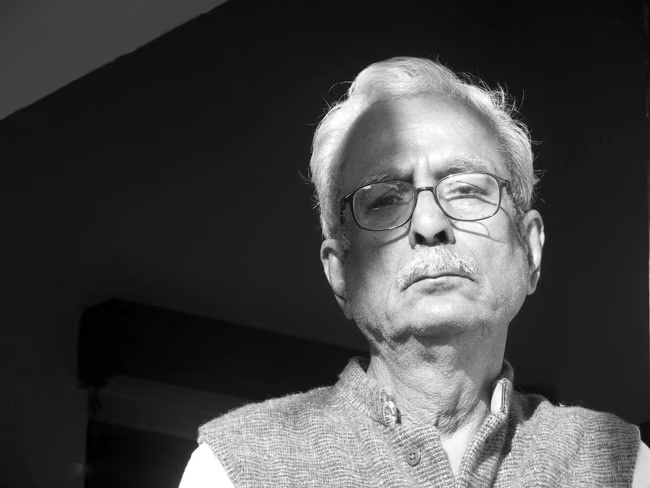
This man works magic with words, yet his personality exudes an astonishing simplicity. With a thin frame and innocent eyes akin to a child’s, he became a popular presence among readers on the first day of the Raipur Literature Festival. At 77, his back slightly bending, and vision fading a bit, he maintains a brisk pace, enthusiasm, and a sparkle that doesn’t fade. He is Vinod Kumar Shukla, the author of novels like 'There Used to Be a Window in the Wall' and 'Servant's Shirt', as well as the poet behind works like 'Everything Will Be Left to Be'.
After his poetry session at the Raipur Literature Festival, school children and adults alike surround him to converse. Various questions are posed, and he patiently responds. A twelfth grader recounts how he discovered 'Servant's Shirt' at a friend's house amidst scrap books, leading him to long for a meeting with this storyteller.
Amidst numerous admirers and engagements, Vinod Kumar Shukla found time to speak with India Today. Here are key excerpts from that conversation:
In your time, literature festivals weren't so common. How do you view this change in the literary world? Currently, I perceive it as an opportunity for literature to progress. It allows writers to reach a broader readership. It facilitates interaction between writers and readers. Although I’m not entirely unreserved or blindly optimistic about it, the fact remains that people today listen and watch less. If literary festivals serve as a venue for hearing and seeing, what’s the harm?
Was the scope of writer-reader interaction less expansive when literature festivals weren't prevalent?The form was different. Interaction existed but evolved over time. In between, a period emerged where this dialogue began to dwindle. Literary events redefine this relationship in a novel way. I believe things change and the nature of literary events evolves too.
Literature is a voice of resistance and a form of dissent against the status quo and power. So why is power so keen on promoting literature?It's beneficial for the system too. The primary reason is to at least appear impartial. It may not be genuine, but it creates an illusion of being indifferent to voices of dissent, something that's historically prevalent. Every age, every society has provided refuge to literary voices of resistance. Authors need to see it from a different perspective; it’s a chance to voice their thoughts, reach a broad readership. It’s merely a platform. Authors should go onstage and use it to express their ideas.
Does it matter if a platform is influenced by political ideology?Not significantly, especially when the platform isn't about imposing ideas or propagating them. However, maintaining one's political and ideological commitment is essential. My thinking remains unchanged, deviation is not an option.
What is your political allegiance?I stand by those marginalized and pushed to the lowest rungs of life, deprived of all basic pleasures and rights.
What are you writing these days?I just finished writing a young adult novel – 'Rasa Yasi aur T'.
Tell us about it.It's about three daughters. It consists of 24 interlinked stories forming a novel. It's centered around daughters. That’s all I'm revealing for now. Wait and read it.
These days, the voices of daughters are becoming more assertive. You must have heard about the incident in Haryana, where two girls used their belts to punish two boys harassing them on a bus.Yes, I heard and watched it on TV. Even though the TV shows its opposite side, I feel it's wonderful if girls resist. Even if they’re proven wrong, the courage instilled in many other girls is valuable. Then, just and rightful girls would voice against the wrong for the right reasons. I'm elated witnessing this change.
To ensure remembrance, here's a poem by Vinod Kumar Shukla: Let the most impoverished man's most severe ailment be attended by the most renowned doctor with the highest fee. The most esteemed physician comes to the poor man's hut to sweep away some dirt, cleaning the foul sewage to lessen the stench, fetching pure water from a municipal tap for the ill man's pot, without washing the sick's rags in the stagnant nearby green pond, nor advising him to go to a government hospital. Gratefully, the most eminent doctor, fearing to ask for a fee, heals the poorest man's sickness, where even the cheapest doctor is too costly for him.
1937:
a young boy
is born with a bright future in literature.
1976:
literary debut
captures hearts and minds across the region.
1990:
modern classic status
achieved with poetic releases.