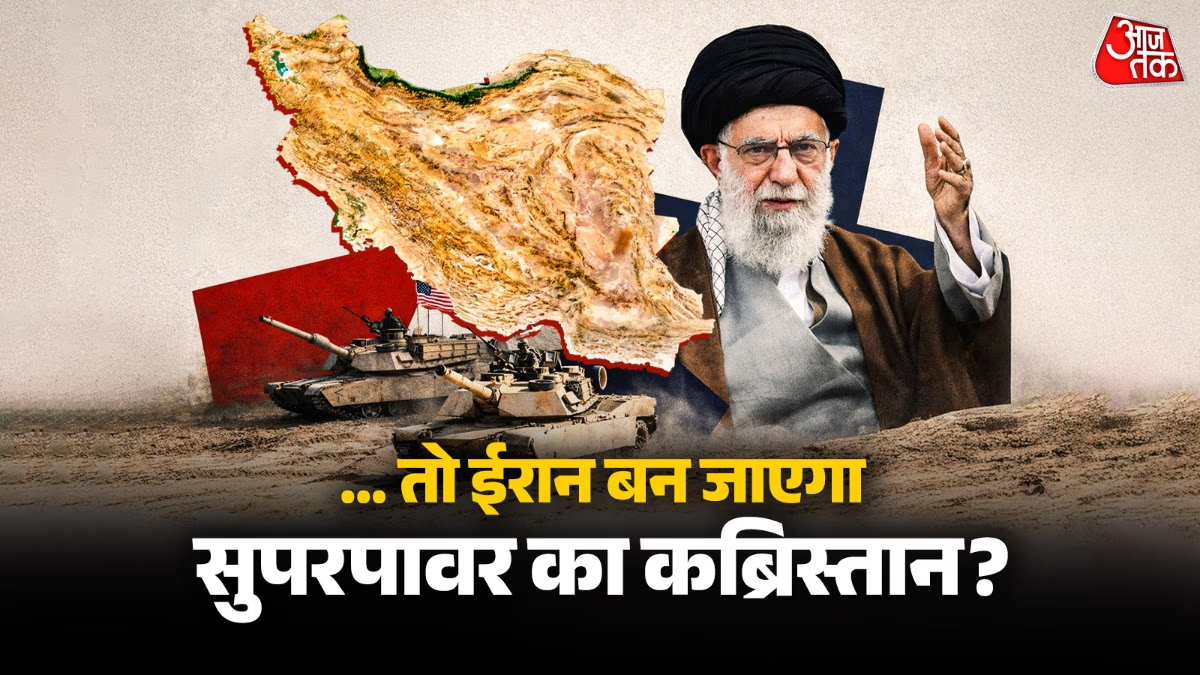
Tensions between the United States and Iran have reached a boiling point. Under President Trump's directive, American military presence in the Arabian Sea has been amplified, with the deployment of aircraft carriers, hundreds of fighter jets, missile destroyers, and advanced defense systems like THAAD. This preparation showcases a capability for long-distance strikes, yet a lingering question prevails: If the US and Israel wield such power, why don't they launch a direct ground assault on Ayatollah Khamenei's Iran?
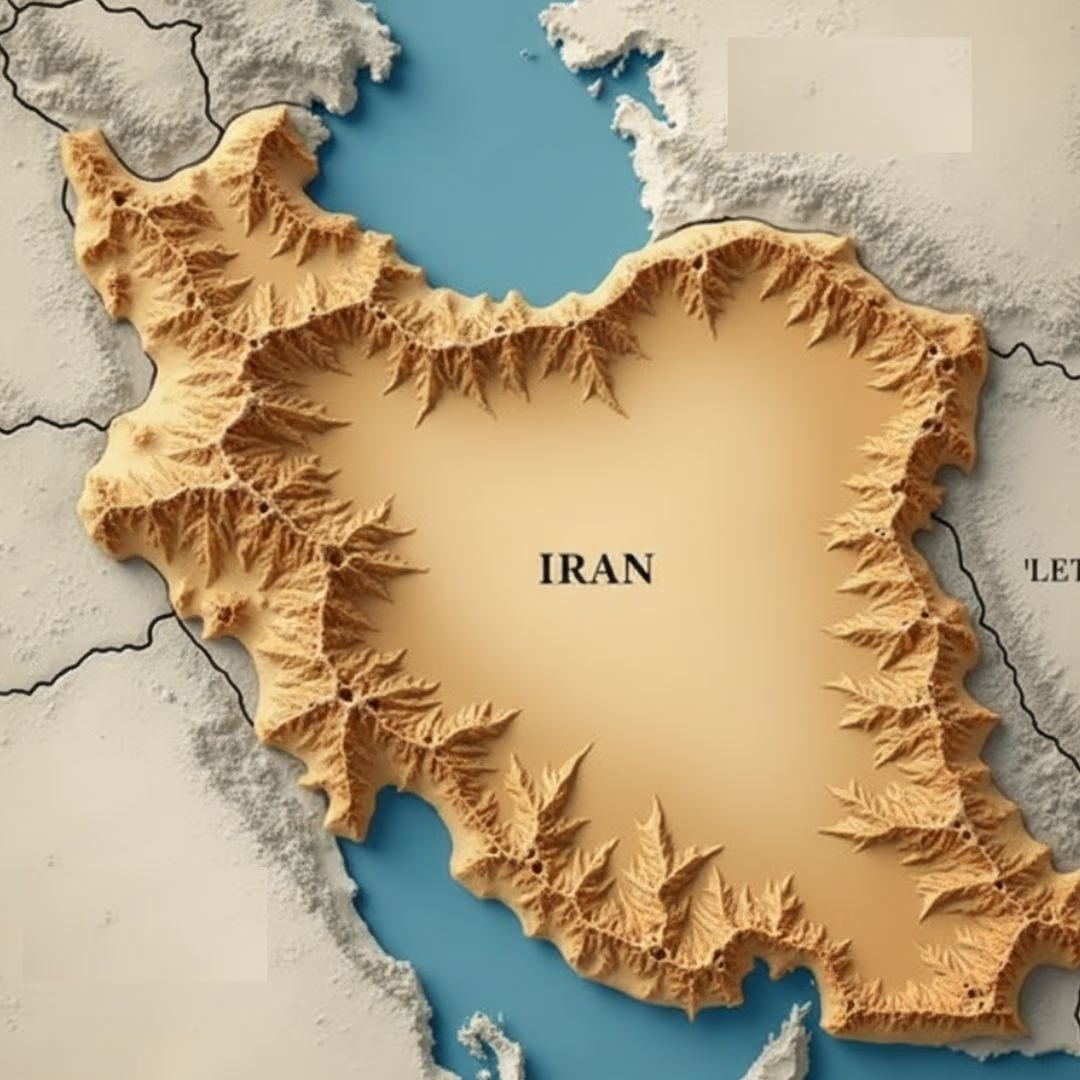
The foremost and significant hurdle is Iran's geography. In 2003, when the US invaded Iraq, the flat landscapes favored American tanks and armored vehicles. However, Iran presents a stark contrast—it’s a vast 'tableland', bordered by imposing and formidable mountains.
This implies any foreign military will find no open battlefield, but rather be forced through narrow, constricted passages where defense forces can stand ready. In such terrains, invading forces can become severely entangled, providing a strategic advantage to the defense forces in hilly regions.
Mountains: Iran's Critical Protective Layer!
The Zagros Mountains in Western Iran are the backbone of the nation's natural defense. Stretching approximately 1,600 kilometers from the Iraq border to the Strait of Hormuz, these mountains aren't a single chain but a series of parallel folds. Thus, Iran's landscape proves daunting for an invasion. The depth of the Zagros range is roughly 250 kilometers, featuring peaks soaring over 4,000 meters.
Source: aajtak
If a military unit attempts to advance from the oil-rich fields of Khuzestan towards Tehran, they must traverse elevated passes, where the weather can also pose a challenge—scorching heat in some areas, snowbound paths in others. In these conditions, transporting heavy weaponry and supply trucks becomes exceedingly difficult.
To the north, the Alborz Mountains form Iran's second line of defense. Extending 600 kilometers along the Caspian Sea, they include Mount Damavand, the tallest peak in the Middle East. This range separates fertile northern regions from the interior arid plateau. Any force trying to infiltrate from the north would face steep ascents mere kilometers from the sea.
Even if they managed to cross these mountains, they would face the Iranian Plateau, home to vast salt deserts like Dasht-e Kavir and Dasht-e Lut. These regions are nearly deserted and lack water, becoming a battlefield of life and death for a modern army. Maintaining fuel and food supply lines in such an environment can be as challenging as winning a war. Consequently, Iran's interior could serve as a graveyard for any external military venture.
Iran's Underground Airbases, Missile Cities
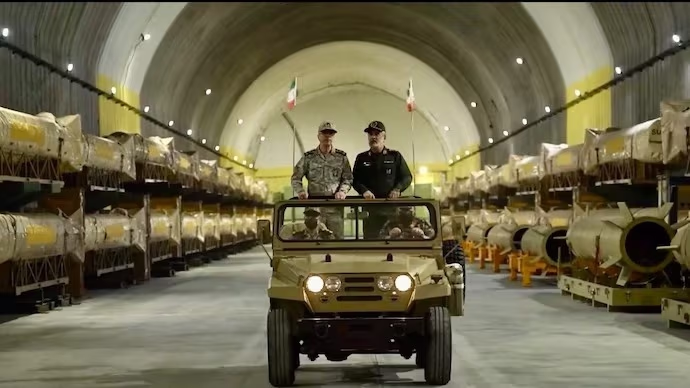
Not solely reliant on geography, Iran has developed underground military infrastructure over decades. To counter Western airpower, it has utilized tunnel and underground engineering to house production, storage, and launch systems below ground. The so-called "missile city" concept is part of this strategy.
Reportedly, these tunnel networks are constructed hundreds of meters deep and spread across every province, facilitating missile assembly, maintenance, storage, and launches. This means aerial assaults might damage surfaces, but hidden weapons could survive, enabling defense forces to retaliate.
Source: aajtak
Iran also boasts an underground airbase called Eagle-44 tucked within the Zagros, not merely a tunnel but a fully operational air station with refueling, navigation, and repair facilities. The purpose is to ensure the air force remains intact for counter-attacks, even if surface runways or airbases are destroyed. While the US has deep bunker-busting bombs, annihilating bases carved into mountains remains formidable.
Iran's Missile Arsenal, Focus on Hypersonic Power
Recent years have seen Iran push forward with concepts like "missile farms," where missiles are concealed in underground capsules, camouflaged by earth. Satellite surveillance struggles to detect them, and missiles emerge straight from the ground during launches.
Moreover, Iran is concentrating on solid-fuel and hypersonic missile technologies. The Fateh-series missiles are introduced with high-speed and last-phase maneuverability, complicating interception prospects.
Iran's Defense Strategies: Nullifying Attacks
It's not just weapons—Iran employs intricate and unique defense strategies. If its "forward defense" strategy, aimed at keeping battles away via proxies, fails, Iran may resort to its "mosaic defense" strategy—a layered, flexible defense in depth aimed at trading space for time while inflicting maximum damage on invading forces.
Source: aajtak
Iran's defense structure is divided into several independent military commands, ensuring the continuation of warfare even if central command is hit. These commands are prepared to defend during a ground attack. Additionally, volunteer forces like Basij are trained for guerrilla warfare. The tactic is to snare invaders in urban environments, narrow passes, and hostile terrains, sever supply chains, and elongate the conflict. In such scenarios, even technologically superior forces could be ensnared for an extended duration.
Strait of Hormuz: Iran's Strategic Weapon
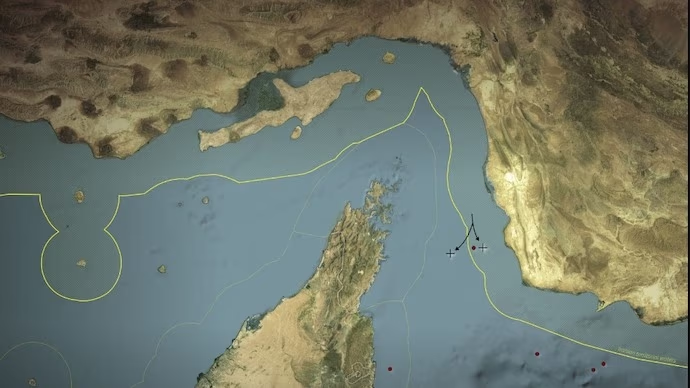
Iran possesses one more strategic weapon—the Strait of Hormuz. A vast portion of the world's oil traverses this route. In wartime, if this pathway is disrupted, the global energy market and economy could suffer immense impacts. Recently, Iranian forces conducted drills near the Strait of Hormuz with Russia and China. During a military exercise, the IRGC even enacted a blockade of the Strait of Hormuz.
Although Iran faces economic struggles and internal protests, analysts argue that internal discontent doesn't equate to the immediate collapse of the regime. Often, external threats solidify regimes further. In Iran's case, security systems and the role of the IRGC have expanded, potentially making power structures more centralized.
To sum it up, a ground assault on Iran is not merely a question of military might. It's a complex equation of geography, logistics, politics, economics, and global balance. While the US and Israel can carry out long-range strikes, a ground invasion in Iran could turn into a prolonged, costly, and uncertain conflict.