President Donald Trump's expressed intent to annex Greenland has once again thrust this area into global conversation. Questions arise about what makes Greenland so pivotal that Trump is so adamant about acquisition. Various narratives are emerging on this subject. It's not the first time America's interest in Greenland has come to light. This U.S.-Greenland relationship stretches back 85 years, serving not only security purposes but also nuclear research.
Strategically significant for decades, America's engagement with Greenland began during World War II, as Nazi Germany, led by Hitler, occupied Denmark in 1940. In 1941, the U.S. and Denmark forged a defense agreement, leading to America's involvement in Greenland. At the time, Greenland was a Danish colony.
Also Read: 'I saved it, but now don't care': Trump's response to NATO on Greenland
The U.S. didn't treat Greenland as a colony but approached it with strategic imperatives, aiming to fortify security in the Atlantic. Through defense agreements, the U.S. erected numerous airfields and weather-monitoring stations in Greenland. These were crucial for tracking German submarines and supporting U.S. military flights over the Atlantic.
1951 Agreement and Thule Air Base
In 1951, a key agreement was reached between Denmark and the U.S., permitting the construction of the Thule Air Base in northwest Greenland. Thule Air Base is 1,200 kilometers from the North Pole and about 1,500 kilometers from Nuuk, Greenland's capital.
Source: aajtak
During the Cold War, the Thule Air Base became crucial for America. Used as an Arctic outpost, it supported missile monitoring, space surveillance, and, if necessary, facilitated American bombers' reach into the Soviet Union. Numerous military and technical experiments were conducted in and around Thule Air Base.
America's Nuclear Experiment
Near Thule, the late 1950s saw the inception of the Camp Century project, an American endeavor aimed at constructing a nuclear-powered base beneath thick ice sheets. This project explored the feasibility of concealing nuclear missiles under the ice for potential launch.
Also Read: Can Trump seize Greenland in 20 days? Denmark PM warns NATO's end
This experiment did not persist long, ceasing in 1967. Despite this project's sensitivity between America and Denmark, U.S. military weapons and aircraft remained stationed at Greenland bases. Eventually, an American military aircraft crash occurred at one of these bases.
The 1968 Aircraft Crash and Radioactive Crisis
The January 23, 1968 aircraft crash marked a pivotal moment in Greenland's history. On that day, an American B-52 bomber crashed in Greenland's icy expanse. A British media report revealed the aircraft bore four hydrogen bombs.
Following Denmark's protest, the Pentagon acknowledged the presence of nuclear arms on the crash site, though precise details were not disclosed. According to reports, the bomber embedded in ice, leaving the bombs lodged there. This incident alarmed Denmark's government, leading then-Prime Minister Krag to demand full disclosure from America, insisting nuclear arms were unauthorized on Danish soil.
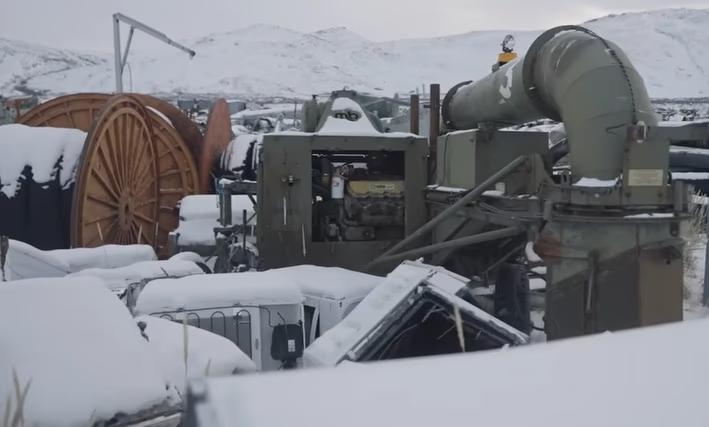
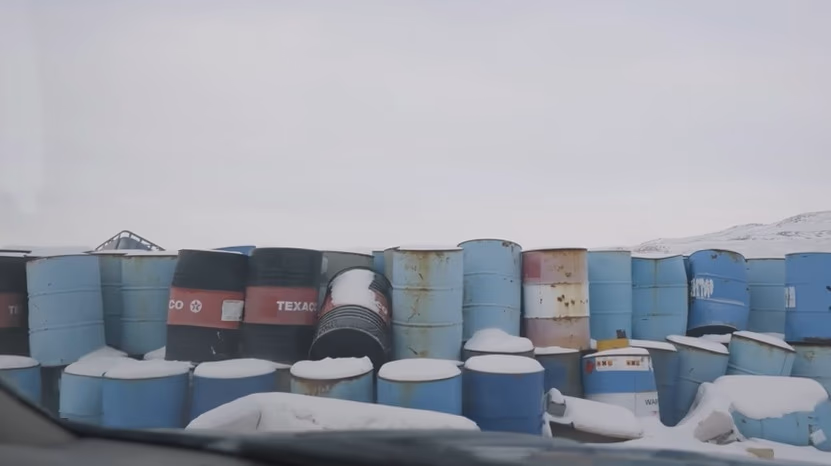
Subsequently, in March 1968, American soldiers transported radioactive ice and debris from the crash site, sealing them in 18,000-gallon metal containers for temporary storage at Thule Air Base until they could be seaborne during seasonal routes.
Source: aajtak
1946 Purchase Offer Claim
Claims about attempts to purchase Greenland persist. Some reports have suggested that on December 14, 1946, U.S. Secretary of State James F. Byrnes purportedly offered $100 million to Denmark's Foreign Minister for Greenland.
However, a January 30, 1947 report from the U.S. State Department asserted no official purchase proposal was made to Denmark. According to the State Department, discussions about Greenland's future occurred, but no formal purchase offer materialized.
Also Read: Greenland, Cuba, or Colombia? After Venezuela, the US's next target
Kangerlussuaq: A Military Base Returned for a Dollar
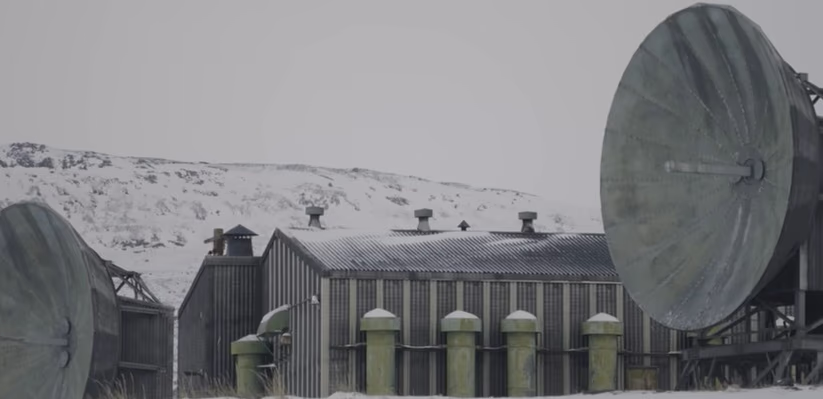
An important American military post in Greenland was Sondrestrom Air Base, later renamed Kangerlussuaq. This base, established in 1941, was a significant refueling station for transatlantic flights. With the Cold War's conclusion and modern aircraft requiring less refueling, the U.S. Air Force elected to shut down this base.
Subsequently, in September 1992, America symbolically sold the Kangerlussuaq Air Base and the surrounding town to Greenland's government for merely one dollar, encompassing the airport, facilities, and infrastructure.
Source: aajtak
From Thule to Pituffik Space Base
In April 2023, Thule Air Base's name transitioned to Pituffik Space Base, honoring Greenland's cultural heritage. Even today, Pituffik Space Base is integral to America's missile defense, space surveillance, and ballistic missile detection systems, usually hosting about 700 personnel, including approximately 150 permanent U.S. Air Force and Space Force members, alongside Denmark and Greenland officials.
Who Owns Greenland?
Greenland remains part of Denmark. The history of this connection dates back over a thousand years, when Norse settlers, the Vikings, arrived. Denmark formally controlled Greenland in the 1700s. Over time, Greenland gained considerable autonomy, though Denmark still governs foreign policy and defense. Nonetheless, calls for complete independence from Denmark arise periodically in Greenland.