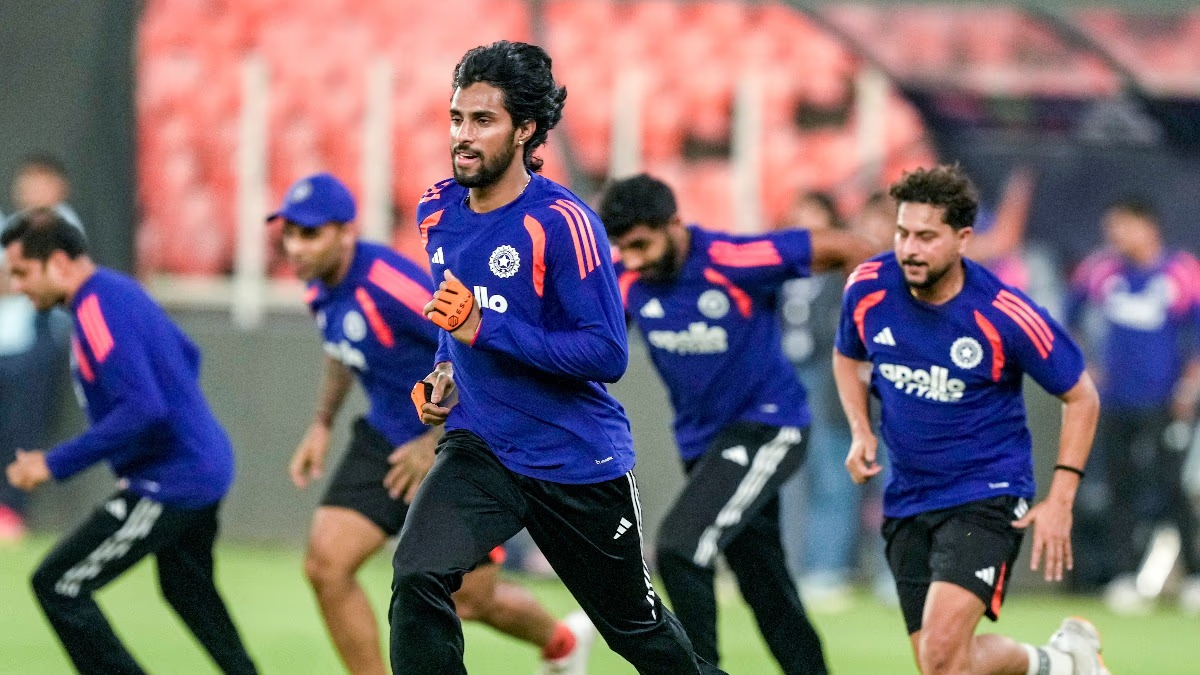
As India advanced to the Super 8s in the T20 World Cup, the top order of its batting lineup has become the biggest concern. While Abhishek Sharma has struggled to provide a solid start, Tilak Varma, who is expected to stabilize the innings after early setbacks, has not lived up to expectations.
Tilak scored 107 runs in five innings, with an average of 21.40 and a strike rate of 118.88. These figures are weak for a No. 3 batsman, a position regarded as crucial in T20 cricket.
Former Indian legend Sunil Gavaskar openly expressed disappointment with Tilak's batting mindset. He noted that after losing a wicket, a batsman's role isn't aggression, but building partnerships. In the face of South Africa's 9.5 run rate, time could have been taken to stabilize the innings. Gavaskar believed that a 55-run powerplay was also crucial for the team.
Tilak's dismissal against South Africa further compounded concerns. He attempted an advancing shot on the second ball against Marco Jansen but got caught edging. This shot appeared uncharacteristic, as if he was trying to fit into an aggressive template at the cost of his natural game.
Abhishek Sharma: A Burden on the Team
India's campaign suffered a blow with a heavy 76-run loss in the first Super 8 match. The ongoing failure of Abhishek Sharma and weak starts from the top order have neutralized the team's aggressive strategies. Opponents have identified India's batting weaknesses, making the path ahead challenging.
Abhishek's bat remained silent throughout the tournament, scoring only 15 runs in four innings. His performance in the opening game against America ended with a zero. Opponents effectively set a fielder in his favored deep extra-cover area, signaling their preparedness.
He had to miss the next game against Namibia due to a stomach infection. Upon his return against Pakistan, he again struggled against spin and was out in the first over.
The scenario was unchanged against the Netherlands, where he again fell early, putting India under pressure. It became evident that opponents have crafted a blueprint against India's top order, characterized by early use of spin and trapping openers.
Against South Africa, Abhishek finally opened his tally but failed to gain momentum. His innings of 15 off 12 balls ended with a deception by Marco Jansen's slow ball, lacking the confidence the team needed.
Arriving as the world's No. 1 T20I batsman, Abhishek's tournament has been disappointing. His failure has impacted not only his personal form but the entire Indian batting structure. As the model of fast starts crumbled, the middle order found itself under constant pressure.
The Left-Hand Composition: An Opponent's Weapon
India's top order, filled with three left-handed batsmen, has enabled opponents to set strategic matchups easily. Early introduction of spin, creating angles, and building pressure have become part of the opponents' set strategy. Struggles against spin in the powerplay have highlighted this weakness further. While Pakistan used Salman Aga's spin bowling, Aiden Markram bowled against India, both delivering setbacks in the first over. Aga dismissed Abhishek Sharma, while Markram took down Ishan Kishan.
Will Sanju's Inclusion Balance the Scale?
Team assistant coach Ryan ten Doeschate hinted at possible changes during a press conference against Africa. He raised the question of whether to maintain trust in the players based on the last 18-month performance or bring in Sanju Samson for a right-left balance. His suggestion highlights a crucial discussion before the next two significant matches. Sanju played just one match in this World Cup, scoring a brisk 22 against Namibia.
As India reaches the decisive stage of the T20 World Cup, it's time for decisions over experiments. If the team doesn't adapt in terms of roles, composition, and match awareness, even minor adjustments won't be enough to save the campaign. The next selection could determine the tournament's entire trajectory, not just the playing eleven.