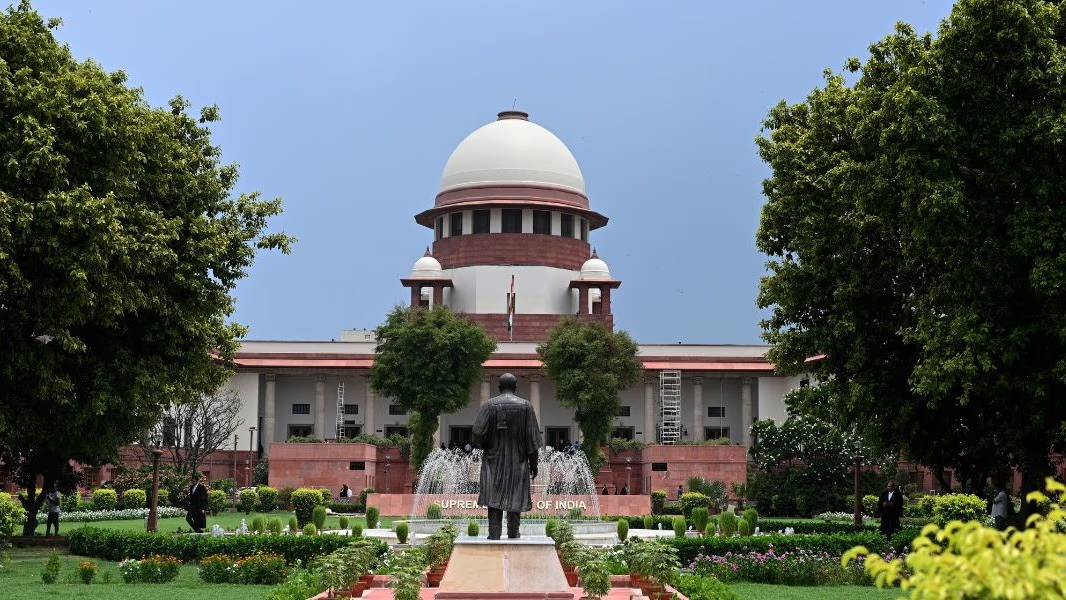
The inclusion of the subject 'Judicial Corruption' in an 8th-grade NCERT textbook has led to a significant controversy. The Supreme Court of India, taking suo motu cognizance, expressed stern discontent. The Chief Justice called it a 'preplanned and deep conspiracy' against the judiciary, asserting that the court will not permit questions on the reputation or image of the judicial institution. The Supreme Court of India undertook suo motu cognizance of the issue.
The Case Explained:
The NCERT textbook mentioned 'Judicial Corruption', drawing objection from several senior lawyers and judges. They argue it tarnishes the judiciary's image. Consequently, the Chief Justice of India (CJI) personally raised the issue. This means that the term 'Judicial Corruption' was written in the textbook, indicating the possibility of corruption within the judiciary system.
This mention saw significant pushback from eminent lawyers and judges, who stated that referencing such topics in a school textbook can damage the image of the judiciary and undermine public confidence. Thus, the CJI deemed the matter severe, choosing to address it and call for attention. The judiciary didn't take the matter lightly, understanding the need for action.
What Did the Chief Justice Say?
The CJI termed it a 'preplanned and deep conspiracy' against the judiciary. He remarked that the court would not allow anyone to tarnish the judiciary's image. Additionally, the CJI reported receiving numerous messages from judges of the High Court regarding this matter. He clearly stated that no matter how high the matter escalates, action will be pursued.
Views from Senior Lawyers:
Senior Advocate Kapil Sibal expressed distress among senior bar members over this change. Similarly, Senior Advocate Abhishek Manu Singhvi questioned why only the judiciary is singled out for corruption, inquiring why politicians, ministers, and officials weren't mentioned.
Why is it Considered a Clash?
This issue is perceived as a new clash between the government and the judiciary, as books prepared by government-related institutions are now under scrutiny by the Supreme Court for a strict stance.
Will Changes be Decided by the Court?
The Supreme Court took suo motu cognizance of this matter, initiating action without any petition filed. A hearing may occur in the coming days where the court will decide if the textbook changes are justified. The controversial chapter in the NCERT's 8th-grade book being questioned by the Supreme Court is not currently available in the market. Amendments were made to the sixth chapter of social science, mentioning judiciary-related corruption and delays due to pending cases.
The Second Edition Yet to Hit the Market:
The first edition depicted the judiciary's role in checks and balances, while the second edition provided information on corruption and pending cases. The second edition has not yet reached the market. According to sources, approval for the second edition was granted on Monday, but it's not available for sale online or in new stores, meaning the book causing the uproar isn’t currently for sale in the market.
What is Suo Motu?
'Suo Motu' is a Latin term meaning 'on its own' or 'initiative'. In legal terms, when a court initiates proceedings on its own without a petition or complaint by an individual, it is known as taking suo motu cognizance. Simply put, if no case is filed in court on a serious and public interest issue, the court may independently begin proceedings. This action is known as suo motu proceedings.
For instance, if a report uncovers human rights violations or significant irregularities, even without a petition, the Supreme Court of India or any High Court may independently file a case and commence a hearing on that basis.
Reasons for Suo Motu Action:
To protect public interest
Immediate action in severe cases
When the victim cannot reach the court