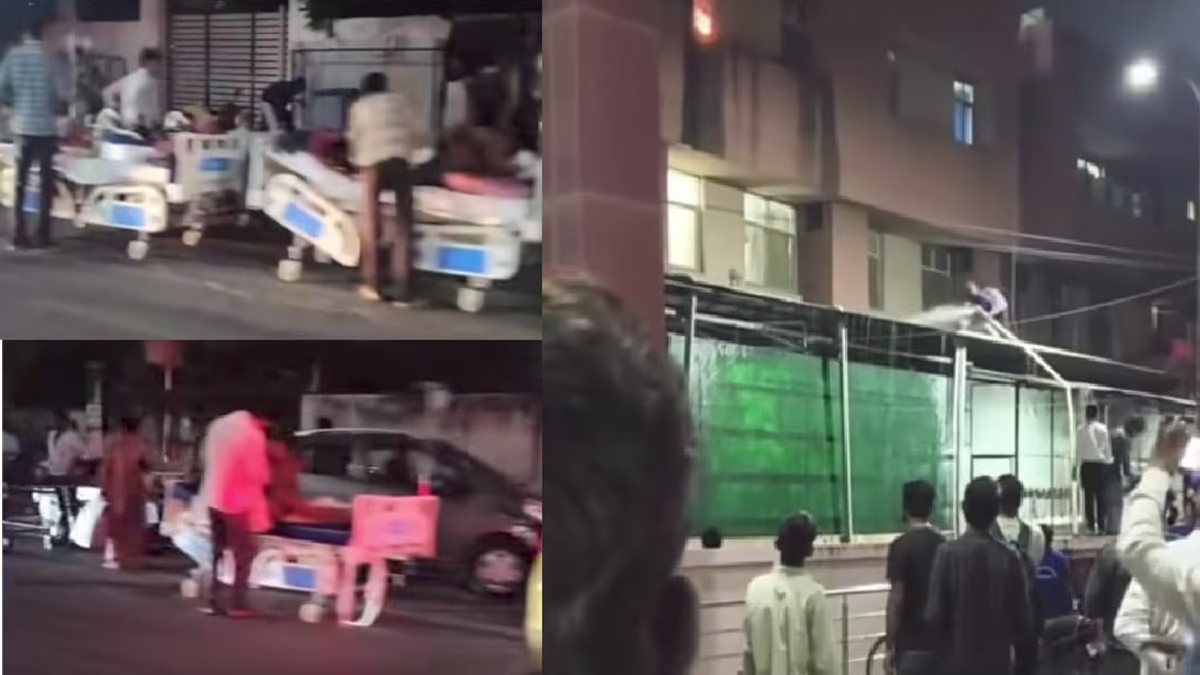
About four months ago, a horrific fire at Rajasthan's largest government hospital, the SMS Hospital trauma center, has become more than just an accident—it's a shocking example of system failure. The investigation committee's report lays bare the escalating truth of that night, where warnings were ignored, decisions deferred, and responsibility avoided.
First Truth:
The fire's warning was first given not by the staff, but by patients' families. Around 11:30 PM, suspecting a short circuit in ICU-2, families repeatedly informed the staff, but no action was taken. Despite mentioning it several times, silence prevailed until smoke began billowing from the storeroom, jolting the system into action.
Second Truth:
The location of the fire proved to be the biggest threat. Investigations revealed that ICU-2 was initially planned for 12 beds, but with bed number 12 removed, a storeroom was created nearby. This storeroom, adjacent to patient beds, stored flammable items like medicines, cotton gauze, and spirit, which fueled the fire.
Third Truth:
The search for the 'key' went on for thirty minutes, allowing the fire to spread. The storeroom was locked, and despite rising smoke, the staff spent nearly 30 minutes looking for the key. Incharge and second incharge, Deendayal Agarwal and Kamal Kishore Gupta, had locked it and didn't inform anyone where the key was. Shockingly, even the investigation committee didn't find the key.
Fourth Truth:
Fear replaced duty. As the fire spread through the false ceiling, lights melted. Meanwhile, nursing officer Udaysingh instructed ward boy Amit to break the lock and left the ICU with his black bag from the nursing station. The committee described this behavior in an emergency as unexpected.
Fifth Truth:
Patients were rescued by their families, not the staff. A relative of Kanak Saini, admitted on ICU bed number 7, got a call about the short circuit at 11:40 PM, rushed to the ICU, and carried the patient out. Meanwhile, nursing staff Yogesh ran outside. Both Yogesh and Uday abandoned their duty points as the fire worsened.
Sixth Truth:
CCTV captured what words couldn’t express. At 11:49, ward boy Amit was seen conversing at the ICU door. At the same time, patient Sheila was being dragged out by her husband, Prem Singh. Seconds later, another patient was wheeled out with a bed. Twenty-nine seconds later, the fifth patient emerged on a trolley, but throughout this time, the ward boy is not seen assisting any patient.
Seventh Truth:
Alarms existed but didn’t ring. Systems were in place but not operational. Fire alarms and smoke detectors were installed in the ICU. However, according to staff, alarms did not sound that night. The responsibility for checking the fire-fighting system lay with the nursing superintendent, who, it was revealed, never inspected internal systems, merely checking external pressure points to fulfill formalities.
The report, released four months later, made it clear that the fire spread not just due to a short circuit, but due to negligence, disorganization, and a mindset of shirking responsibility, leading to the tragic deaths of six people.