Whenever the history of Bihar politics is penned down, Nitish Kumar’s name will not be confined to a single chapter. He is like the cover of the book that has held together the scattered pages of Bihar for the past two decades. From being hailed as 'the Administrator' to the 'Chanakya' and ‘Paltooram’, his personality showcases various hues. His decision to transition from the Chief Minister's office to the Rajya Sabha is not merely a leadership change but a major shift in Indian politics.
The roots of Nitish Kumar's politics are embedded in the fertile grounds of the JP movement in 1974. He not only learned about the principles of Ram Manohar Lohia and Karpoori Thakur but embraced them wholly. Initially, his quest was more for social justice rather than power. After the Emergency, he began his political journey with the Janata Party in 1977. While Lalu was a crowd-puller, Nitish excelled in making deep connections. During the chaotic casteism and lawlessness under Lalu in the '90s, Nitish chose a different path, realizing that true socialism wasn't just about giving voice to the backwards but integrating them into the mainstream development path. Thus started his political framework of 'Justice with Development' and in 1996, he allied with BJP, marking his journey into the heart of Indian politics. Under the stewardship of Atal Bihari Vajpayee's NDA government, he gained goodwill, establishing himself as a natural option for Bihar.
Good Governance: Building Hope Among Ruins
When Nitish took charge of Bihar in 2005, challenges looked as mighty as mountains. Roads were missing, and lawlessness was rampant. One of his first steps was to reestablish the authority of governance. Liberating the police and administration, he fast-tracked trials to imprison criminals. 'Good Governance' became more than just a slogan; it was a palpable change in people's lives — with roads stretching across the state and schools employing more teachers.
Source: aajtak
Pro-Women Politics: A Silent Revolution
The most vibrant and magical aspect of Nitish Kumar’s politics is his 'silent voter' base, which is primarily composed of women in Bihar. Recognizing early on that a stable grip on power can only be achieved by incorporating half the population, he excelled beyond caste-based politics.
Bicycle Scheme: Providing schoolgirls with bicycles was a masterstroke. This move enhanced educational standards and boosted the confidence of young girls.
Panchayat Reservation: By granting 50% reservation, he handed over control of village governance to women.
Liquor Ban: Despite significant revenue losses, he implemented a liquor ban in Bihar, emerging as a messiah for women from impoverished backgrounds.
'Paltooram' or Strategic Mastermind? The Skill of Taking Risks
The frequent change in political alliances has been the focal point of criticism against Nitish Kumar. Dubbed 'Paltooram' by opponents, his adaptability is seen as essential for survival. He never hesitated to switch alliances to maintain power — juggling a secular image with Hindutva politics while governing effectively even amidst accusations during the 'Jungle Raj'.
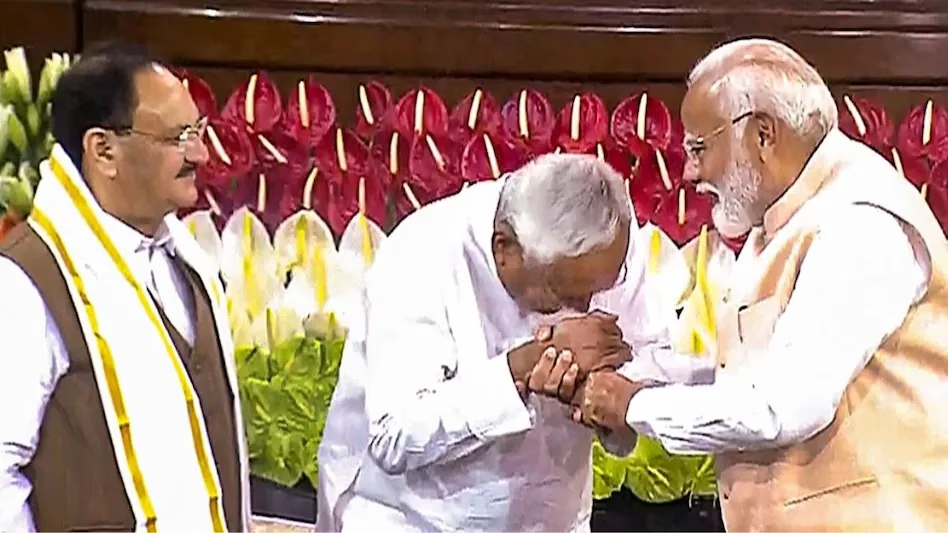
Nitish has shown he isn’t afraid to play risky political games, whether it was leaving NDA in 2013 when Narendra Modi was announced as the PM candidate or rejoining BJP in 2017 after temporarily allying with the RJD. His actions always align with his terms, knowing when to bend and when to snap back. Despite constant shifts, he has remained the core around which Bihar’s politics revolves. He is a player who maintains relevance with every move.
Source: aajtak
Why is Nitish Kumar a Unique Leader?
Nitish Kumar is a 'unique' figure in Indian politics. His simplicity, administrative prowess, and zero tolerance for corruption set him apart from other regional titans. He doesn’t command a large caste-based electoral bank; the Kurmi population is limited. However, his work ethic, trust with women, and strategic intelligence are his strengths, making him an adaptable socialist moving in stride with modern administration and technology.
Moving to Rajya Sabha: A New Chessboard in Delhi?
Nitish Kumar's Rajya Sabha transition and stepping down as Chief Minister is not a simple retirement. There's a deep strategic framework affecting both central and state politics. He is a politician adept at quietly creating storms, with significant decisions always hiding a profound 'why'. His shift from the Bihar CM role prompts the question: why transition to Rajya Sabha? While some speculate this might be his final innings, others see it as a new and more influential beginning.
In the current NDA government, JD(U) is an essential pillar. With Nitish in Delhi, the party's stature will grow nationally. So far, Nitish controlled his party from Patna, but his presence in Delhi will increase leverage within alliances. There’s speculation he might become a governor or possibly even president in the future.
In the past, Nitish was a rebel leader; today, he is a mature administrator. On the national stage, he may emerge as a future guide. Meanwhile, in Bihar, politics has reached a turning point where the 'Nitish era' is concluding gracefully.