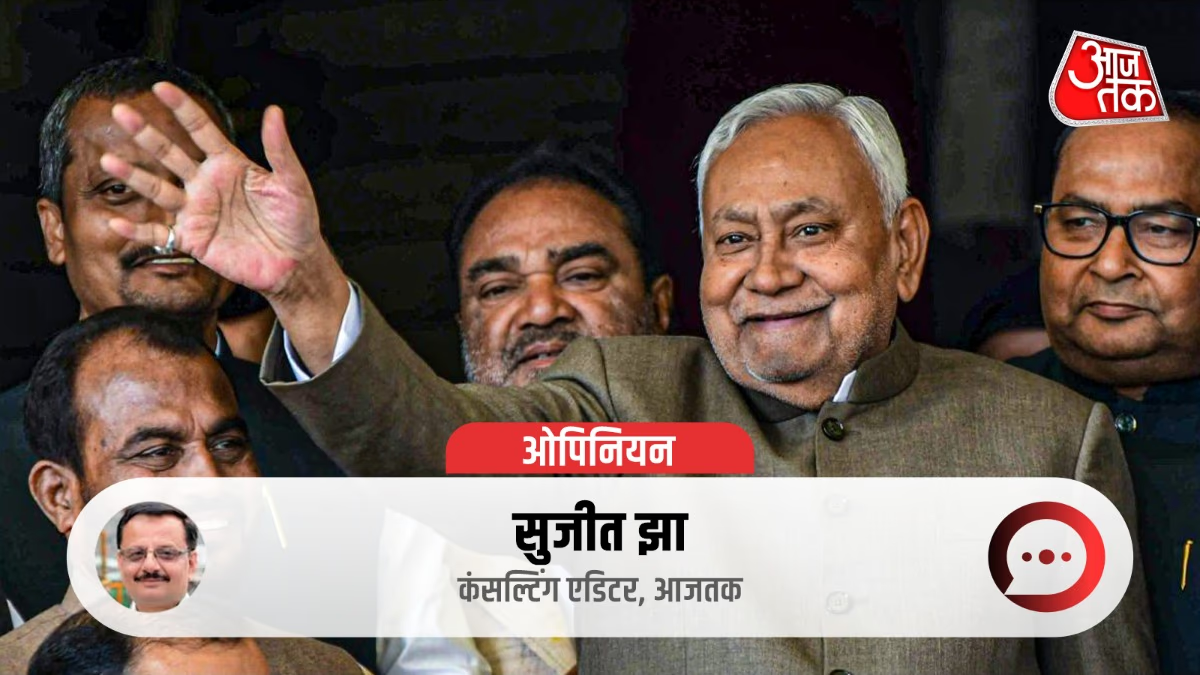
"I want to assure you with utmost sincerity that my association with you will continue, and together, we will remain committed to building a developed Bihar. I will provide full support and guidance to the new government." These are the words of Bihar's Chief Minister, Nitish Kumar. In these lines shared on social media, you can sense the dawn of a concluding chapter in Bihar's political narrative.
Chief Minister Nitish Kumar is set to leave Bihar's soil to grace the Rajya Sabha. He posted at 10:54 AM: "For more than two decades, you have continuously placed your trust and faith in me, allowing us to serve Bihar and its people with dedication.
Your support and belief have empowered Bihar to achieve new dimensions of development and respect. I have expressed my gratitude in the past, and now, it's my aspiration to be a member of both houses of Bihar's legislature and the Parliament. Hence, I seek to become a member of the Rajya Sabha in the upcoming elections."
The Trio Born from JP's Movement
After Chief Minister Nitish Kumar's statement on social media, all political speculations ceased. Now, the era of Lalu Yadav, Ram Vilas Paswan, and Nitish Kumar comes into a singular frame of history in Bihar's political soil, which has produced leaders like Jayaprakash Narayan (JP). The trio emerged from the student movement of the 1970s—Lalu Prasad Yadav, Ram Vilas Paswan, and Nitish Kumar.
Together, they have ruled Bihar's power and social fabric for the past five decades. But today, standing on the threshold of 2026, the 'socialist chapter' of Bihar's politics is penning its last pages. This end is not just a shift in power but also a decline of the ideology that shouted, "There won't be heirs from kings and queens."
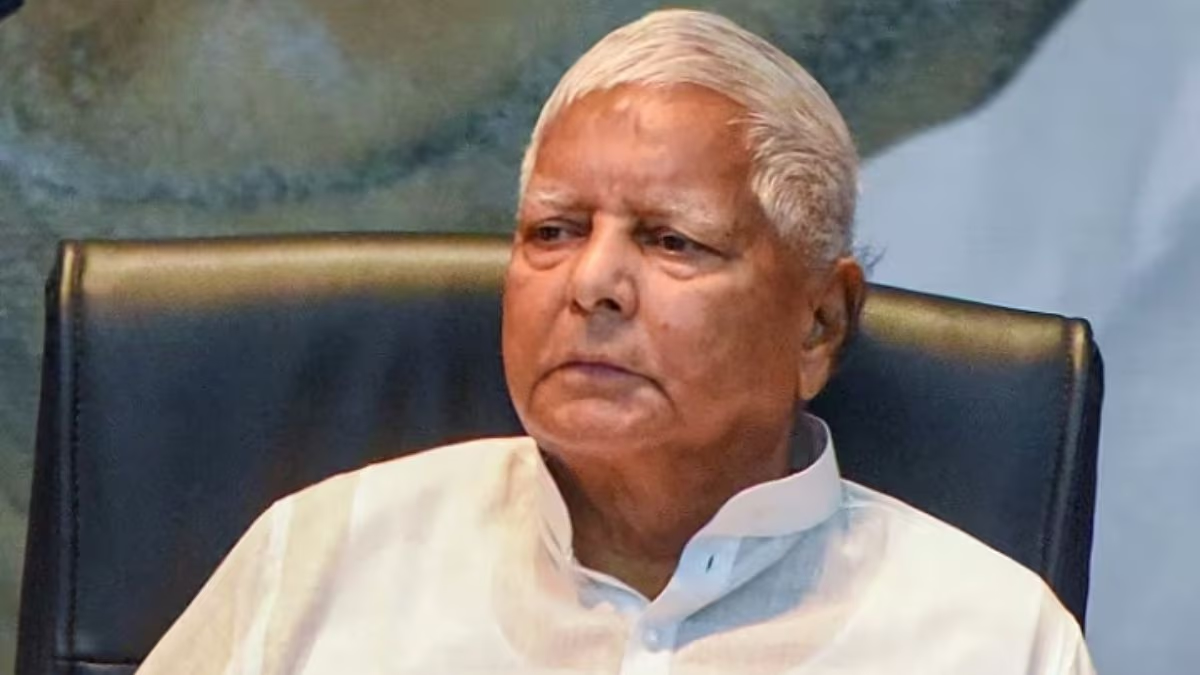
Let's take a walk back to the time when this story began on March 10, 1990, when Lalu Prasad Yadav first took the oath as Bihar's Chief Minister. It was an era of change. Lalu gave a voice to marginalized and ignored communities. His initial governance years were seen as the pinnacle of social justice. However, the intoxication of power and allegations of corruption (fodder scam) brought this hero into the clutches of law. In 1997, when faced with the prospect of jail, Lalu turned to the same familial nepotism he once opposed, appointing his wife, Rabri Devi, as the state's Chief Minister.
Source: aajtak
Old newspaper clippings are evidence that Nitish Kumar had then remarked with satire, "After Rabri Devi's appointment, I lost my interest in this position." This statement was emblematic of Nitish's ideals at the time. However, Lalu's nepotism didn't stop there. His legacy now encompasses his sons (Tejashwi and Tej Pratap) and daughters (Misa Bharti and Rohini Acharya). While Tejashwi Yadav today presents RJD as a new, youthful entity, the party's reins still reside with the 'Lalu family.'
The second pillar of this trio was Ram Vilas Paswan. He integrated Dalit consciousness into mainstream politics and was known as the 'weather forecaster' of central politics—adept at changing alliances with the shifting winds. Paswan too made public pronouncements against familial nepotism but practically facilitated a rise for his brothers and later his son Chirag Paswan in politics. In 2020, after his passing, LJP saw a split, yet his family's dominance remained intact. Chirag Paswan today stands as an essential pillar of NDA, carrying forward his father's legacy as a 'Hanuman' figure.
The Era of Governance and Development Politics
Now, we turn to Nitish Kumar, known as the 'Governance Man.' He fought against Lalu's 'Jungle Raj' and gave Bihar a new identity in terms of infrastructure, roads, and electricity. Nitish's politics always relied on claims of 'policy and intent.' He maintained a distance from nepotism for a long time. His son, Nishant Kumar, an engineering graduate, lived a spiritual and private life away from the political limelight. Now, as Nitish Kumar heads to the Rajya Sabha,
his son Nishant is actively meeting leaders. Meanwhile, BJP's strategy resembles its past approach. Recall, in 2022, there was talks of making Nitish Kumar the Vice President through the Rajya Sabha, marking a definitive nod to his move to Delhi with BJP at Bihar's political center. But at the crucial moment, Nitish Kumar chose the Grand Alliance and became Bihar's Chief Minister.
Simultaneously, BJP’s strategy is clear—give Nitish a respectful exit to the center while aiming for their Chief Minister in Bihar's 243-seat assembly. If Nishant Kumar were to become Deputy Chief Minister, it would be Nitish's ultimate move to secure a political foothold for his son. The current transitional period in Bihar is the most significant political turn since the Mandal Commission era. Lalu, Paswan, and Nitish used caste as their strength. Lalu mobilized the Yadav, Nitish the Kurmi and EBC (Extremely Backward Classes), and Paswan the Dalits. But Bihar of 2026 is changing.
Source: aajtak
Prashant Kishore and the New Political Narrative
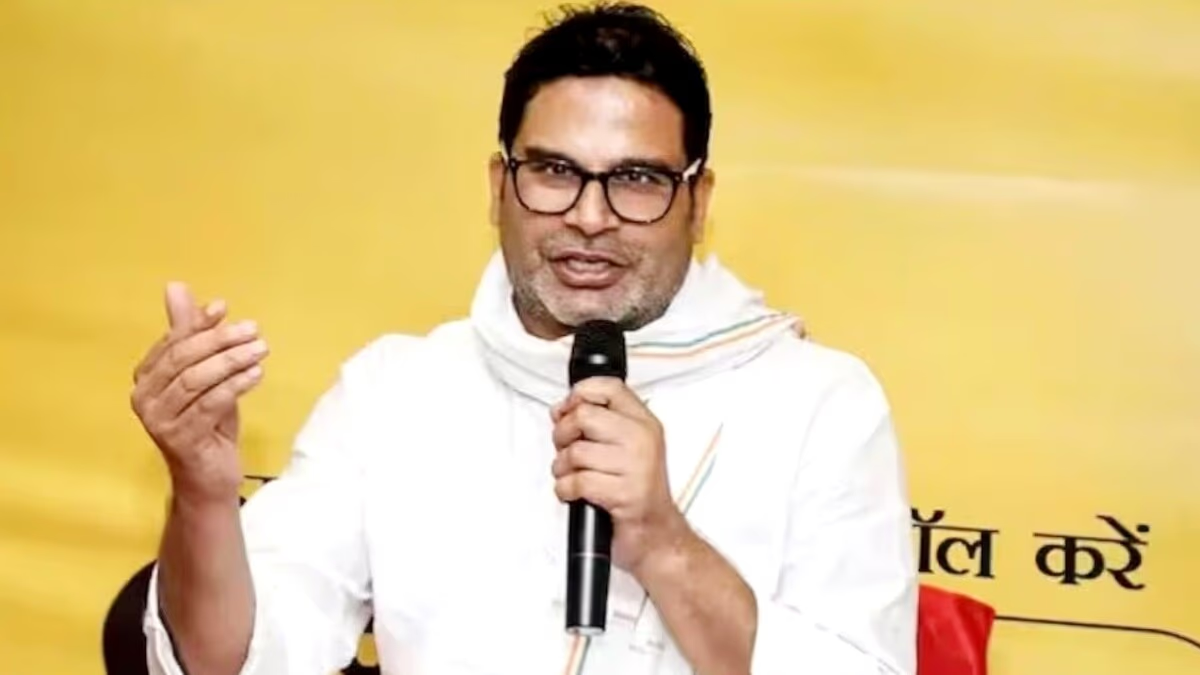
Amit Shah and PM Modi are attempting to break these caste barriers through Hindu unity and development. Their move to confer Bharat Ratna to Karpoori Thakur is a calculated bid to infringe upon Nitish's EBC vote bank. Tejashwi Yadav now speaks not only of caste but of 'jobs' and 'economic justice.' Through 'Jan Suraj,' Prashant Kishore is trying to inform Bihar's youth about the consequences of the 35-40 years under Lalu-Nitish, highlighting that it resulted in hardly anything but backwardness.
Lalu's 1990 oath-taking ceremony marked the dawn of a revolution which now lingers stagnant in the swamp of familial oligarchy. Nitish Kumar's move to the Rajya Sabha and Nishant Kumar's emergence testifies that the old lions of Bihar politics have grown weary. Their eyes are now more set on securing their children's futures than on realizing dreams of social justice. This marks the end of a grand chapter in Bihar's political history.
In the coming years, Bihar will witness a new battle of 'caste vs. development.' Will Bihar's people still opt for the progeny of familiar names, or a new ideology? This question remains in the womb of the future, yet it is clear that the Lalu-Paswan-Nitish trio, who commanded Bihar for decades, is transitioning to history's pages.