The voyage of the International Space Station (ISS) will conclude by 2030-31. Following this, Russia and India have resolved to position their future space stations in the same orbit. Roscosmos chief Dmitry Bukanov made this announcement during his trip to New Delhi, accompanied by President Vladimir Putin.
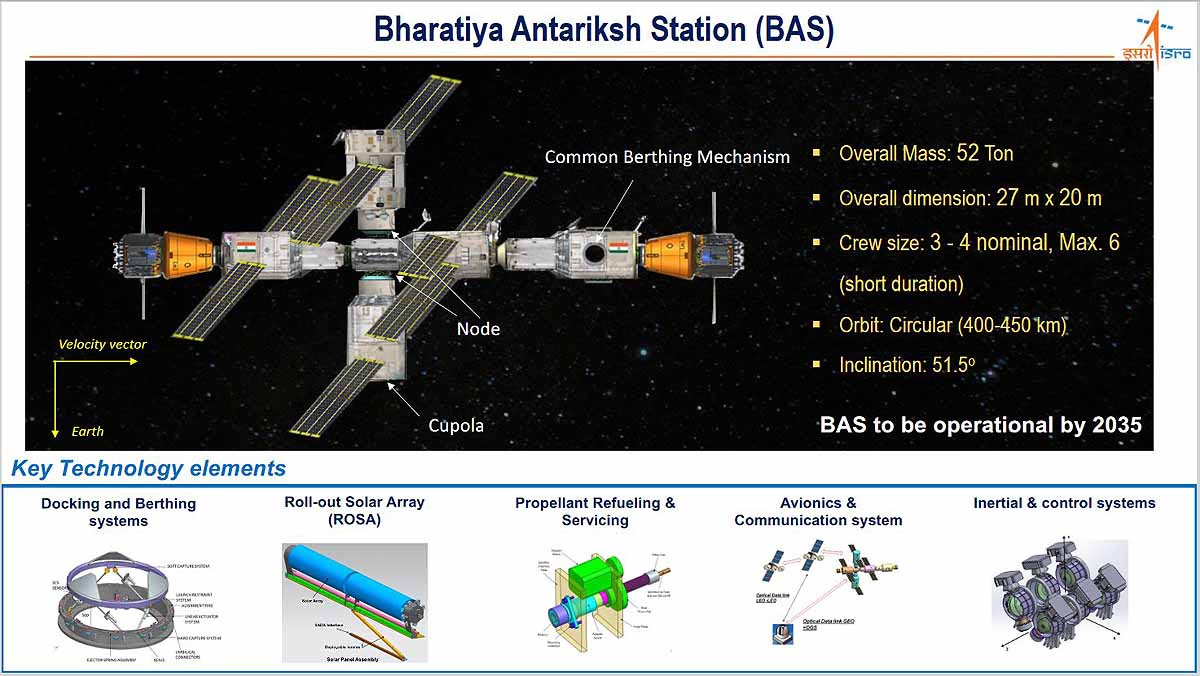
Both stations will revolve in the orbital path with a 51.6-degree inclination. This is the same inclination that the ISS currently uses. This alignment will enable astronauts from both countries to visit each other’s space stations effortlessly, conduct scientific experiments, and offer assistance in emergencies.
Explore Further: Alaknanda in Space... Indian Scientists Unearth a New Galaxy with JWST's Help
Bukanov highlighted that this decision is mutually beneficial. Initially, Russia intended for its Russian Orbital Station (ROS) to be in an orbit with a 96-degree inclination, but now both countries have agreed on 51.6 degrees.
Russia's ROS: Designed by the Russian Space Center Energia, ROS will serve as a base for crafting and launching spacecraft destined for deep space. Its modular design ensures enduring functionality.
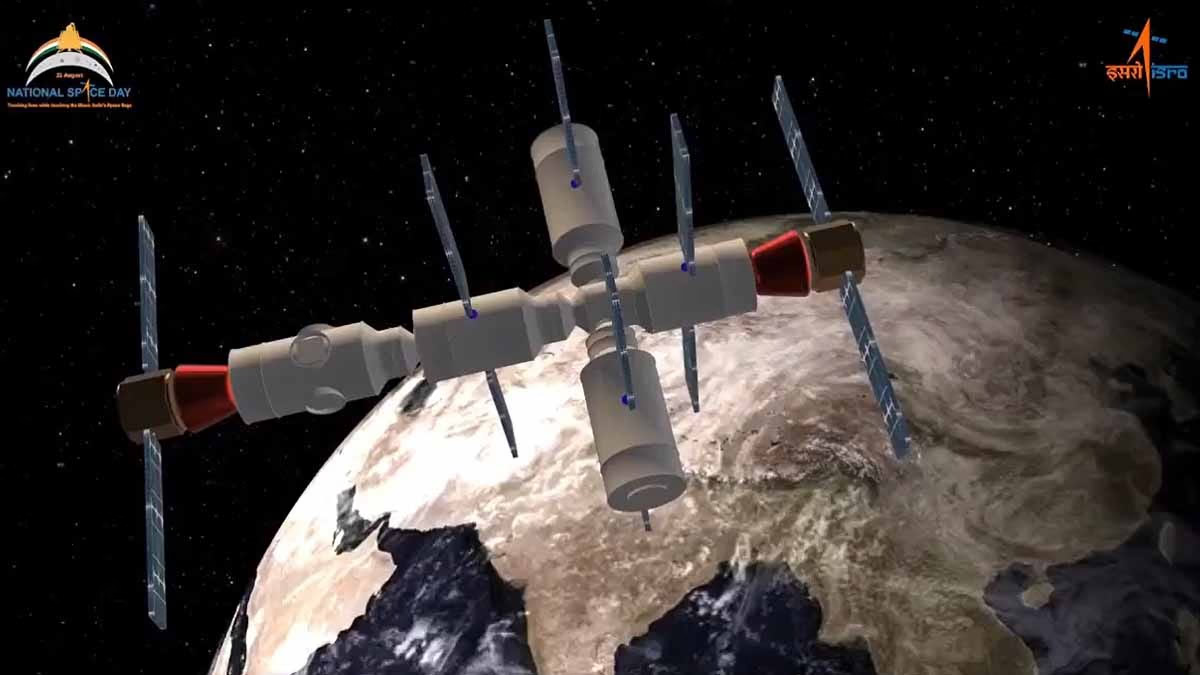
India's BAS: The Indian Space Research Organization (ISRO) aims to complete this by 2035. Prime Minister Narendra Modi announced it following the successes of projects like Chandrayaan-3, before the centenary of India's independence in 2047.
Why the same orbit? The 51.6-degree inclination mirrors that of the ISS, covering 51.6 degrees north-south latitude of Earth. This facilitates seamless docking for Russia’s Soyuz rockets and India’s Gaganyaan missions, thereby boosting international collaboration.
According to the Russian news site
, Russia's First Deputy Prime Minister Denis Manturov stated that we are progressing on parallel paths. The 51.6-degree inclination is confirmed for ROS and India is considering the same for its station. Bukanov mentioned in an Izvestia interview that areas of cooperation include engine manufacturing, manned flights, training, rocket fuel production, and national station development.
Also Read: Stars Torn asunder in Space Incident! An 'Eternal Spirit' Lives Even After 10 Billion Years
Construction of ROS: The first scientific and power modules will launch in 2028, with four main modules by 2030. Additional modules will be added from 2031-33. Khrunichev Center has received orders for Angara-A5M rockets for three modules.
Construction of BAS: ISRO aims to complete it by 2035. Following the success of the SPADEX satellite docking, India has become the fourth country with this technology, joining Russia, the USA, and China.
End of the ISS: Both countries will part ways with the ISS by 2030-31. Russia has already declared it will not support the ISS alongside the USA anymore.
Source: aajtak
Smooth Transfers: Astronauts can move between stations with minimal fuel usage.
Strengthened Collaboration: Russia will train Indian astronauts, providing India with engines and technology.
Emergency Assistance: If one station encounters issues, the other can dispatch rescue operations.
Scientific Gains: Joint experiments will enrich missions to the Moon, Mars, and asteroids.
Economic Benefits: Engine sales and technology transfers from Russia will empower India's self-reliance.
India launched its first satellite, Aryabhata, with Russian assistance. Russia also supported Chandrayaan-2. For the Gaganyaan mission, Indian astronauts received training in Russia. President Putin's visit occurred after the BRICS summit, where space cooperation discussions unfolded. Bukanov stated that Russia will share its advanced technology with India.
Experts assert that this agreement provides Russia a new partnership post-ISS while aiding India in balancing relations between the USA and China. If all goes well, the 2030s will witness the emergence of a Russian-Indian space corridor.