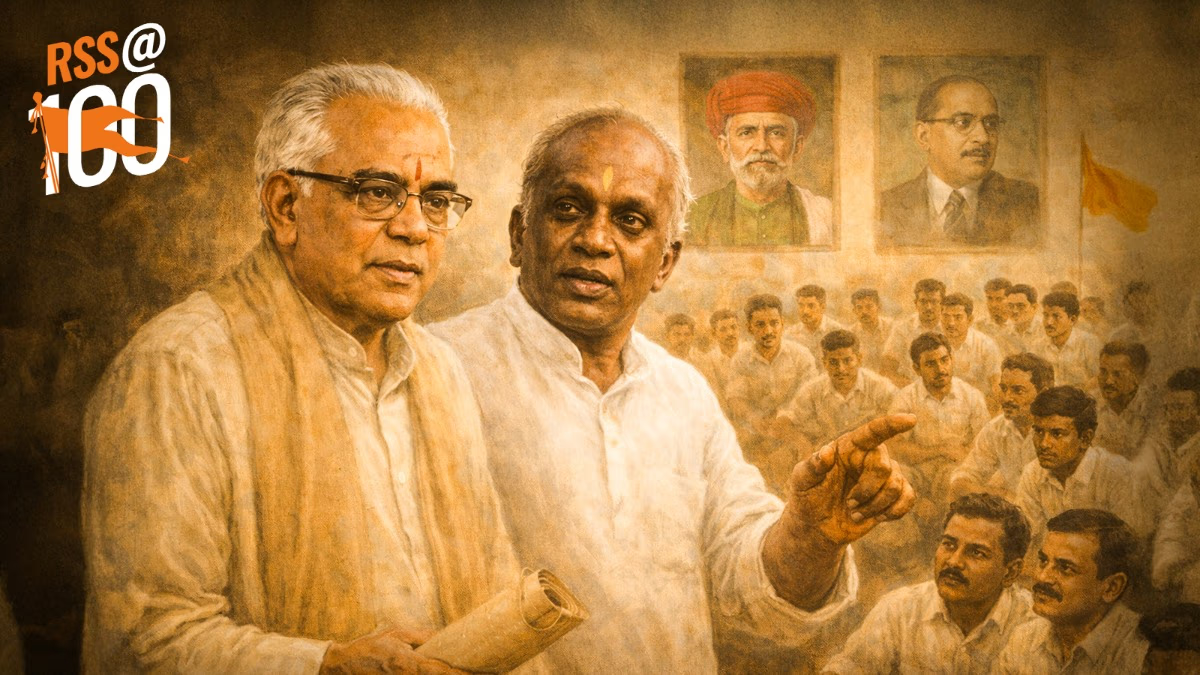
When Balasaheb Deoras assumed the mantle of the third Sarsanghchalak of the RSS, he made several key gestures indicating his strong desire to broaden the organization's ideological reach. Before taking up the position, Balasaheb offered flowers at the statue of Mahatma Phule, underscoring the RSS's long-standing opposition to caste discrimination. Even Mahatma Gandhi once noted, after visiting an RSS camp, that people from various castes lived and dined together without discrimination. Interestingly, Gandhi had previously remarked on the separate kitchens for different castes at the 1901 Congress session. Despite this anomaly, Balasaheb signaled that the RSS would place greater emphasis on the Dalit and marginalized communities.
The Discontent of Madhukar Deval Addressed After 23 Years
Balasaheb's strategy was clear: to unify not only discontented members but also alienated sections of Hindu society and the organization. He made this intention known by meeting Madhukar Deval. Both shared the name Madhukar, and Deval was once a senior RSS worker. Due to ideological differences, Deval had distanced himself from RSS activities, while Balasaheb and his brother, Bhaurao, had also been inactive but returned at the insistence of their leader, Guruji. Madhukar Deval, despite separating from the RSS, continually warned the organization whenever he believed it was erring, although he retained the heart of an RSS man, which Balasaheb well understood. However, while Guruji was alive, Balasaheb never attempted to bring Madhukar Deval back into the fold.
Once Sarsanghchalak, Balasaheb realized the importance of reconnecting with dedicated workers who had drifted away over minor issues. He too had been inactive for five years, so he resonated with their sentiments. Whether it was about integrating Dalits on a large scale or reconnecting with former workers, Balasaheb gave clear initial indications.
Creating a Platform for Unrestrained Expression
Balasaheb initiated another significant move by infusing some flexibility into the RSS's famously stringent internal discussions, emphasizing democratic traditions. In his memoirs, Dattopant Thengdi described this process, which developed during Balasaheb Deoras’s tenure. He conducted an experiment, later successfully incorporated into regular procedures. Thengdi recounted the first experiment in 1945, during a day-long 'Open Forum' held at Nagpur's Rajabaghsha Maruti Temple courtyard, where everyone was invited to share their ideas without the constraints of position or hierarchy. Some hesitated or struggled, while others were forthright.
In the subsequent week, a similar program was orchestrated at the Nagpur home of local leader Baba Saheb Ghatateji, leading to a novel initiative. Sarsanghchalak Guruji listened as participants voiced their thoughts. It was indeed an unprecedented event where volunteers voiced opinions usually held back by discipline or hierarchical inhibitions because the Sarsanghchalak himself was listening attentively. Knowing that expressing their views, even if unfavorable, would not cause displeasure among seniors was liberating.
In fostering a solution-oriented approach through dialogue while avoiding factionalism, Balasaheb integrated this methodology within the organization, which has endured due to its historical significance. In the book ‘Our Balasaheb Deoras,’ Baburao Chauthaiwale, Balasaheb’s former secretary, elaborates on an event from 1947 detailing how the RSS aimed to resolve whether training class formats should be standardized nationally or diversified by state. Amid heated debates, Balasaheb intervened from a silent watcher's position, proposing a resolution through a consensus-driven vote, establishing that, wherever possible, decisions should be collaborative.
The Lifeline Provided to Govindacharya
Several historians chronicling the RSS’s history assert that without Balasaheb Deoras’s leadership, K.N. Govindacharya might have faced repercussions for his vigor in the Bihar movement, a situation caused by his fervor leading him to overlook his duties and overstep boundaries. At the time, Govindacharya served as the RSS's regional propagator. The RSS maintains a tradition where political movement participation is duty-free. Dr. Hedgewar himself relinquished leadership temporarily to join the civil disobedience campaign. Such standards prevented one holding responsibility within the RSS from joining political movements without first relinquishing duties. Contrarily, Govindacharya actively participated on the frontline without this procedural release, receiving post-facto permission months later.
L.K. Advani in his autobiography, 'My Country, My Life,' notes encountering K.N. Govindacharya during the Bihar student movement, admiring his activism, and later incorporating him as BJP’s general secretary. Though not a leader for the student council at the time, Govindacharya was the RSS Patna division propagator. His activism led some RSS officials to disapprove, believing he might be banished to a punitive location had Balasaheb not intervened.
The book ‘Our Balasaheb Deoras,’ by renowned journalist Ram Bahadur Rai, mentions Govindacharya was under scrutiny from his own peers. However supportive and ready to explain himself, he wasn’t confronted directly. This silence led to internal turmoil and questions about his contributions and methods. Then Balasaheb Deoras arrived in Patna, releasing a statement discerning Bihar’s struggle beyond a law-and-order issue to involve moral injustice, propelling Govindacharya’s justification and direction.
However, the organizational structure kept interrogating him, advised to meet Balasaheb Deoras amidst evading police capture. By June 1974, summoned to Nagpur, all top RSS leaders gathered including Balasaheb. Govindacharya describes feeling under trial at the assembly where Balasaheb Deoras requested him to narrate events comprehensively, which he did over two hours. The core debate centered on the RSS's role in the Bihar movement. Post-discussion, Balasaheb reassured there was no need to panic over unprepared ventures as ways would be devised while exonerating Govindacharya from disciplinary infractions.
Balasaheb later held a private conversation with Govindacharya, inquiring about the movement’s aspirations. Govindacharya expressed aspirations for systemic reform, to which Balasaheb pragmatically responded about potential corruption curtailment and improving governance through societal pressure. Yet, the threat looming over Govindacharya had been nullified, paving his gradual ascent among circles, bolstered by Balasaheb’s policy recognizing dissenting voices within the organization as vital to its broader understanding.
Previous Story: