The situation for minorities in Bangladesh is increasingly precarious. The violence initially targeting Hindus on accusations of blasphemy has spilled over to the Buddhist community. A leaflet found in the Chattogram district suggests a conspiracy against Buddhists. While Hindus were becoming a familiar subject in Dhaka, it raises the question of how and when the Buddhist population arrived and how they are sustaining themselves now?
What's the Current Situation?
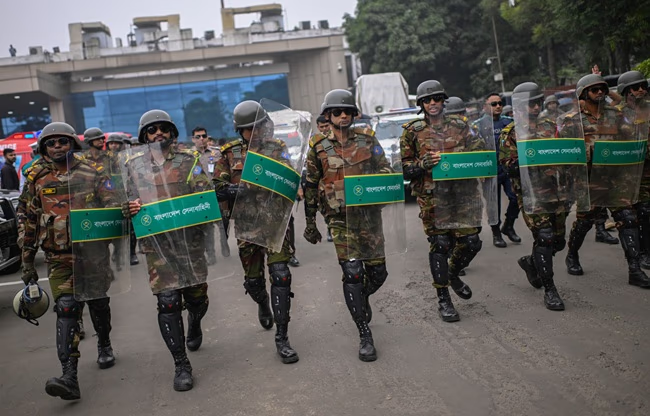
Tensions escalated in the Raozan area of Chattogram when an inciteful banner was discovered, threatening around 200,000 Hindus and Buddhists. This is the same region where several Hindu homes were recently set ablaze. The police have taken the banner into custody and initiated an investigation.
How Many Buddhists Are in Bangladesh and What Do They Do?
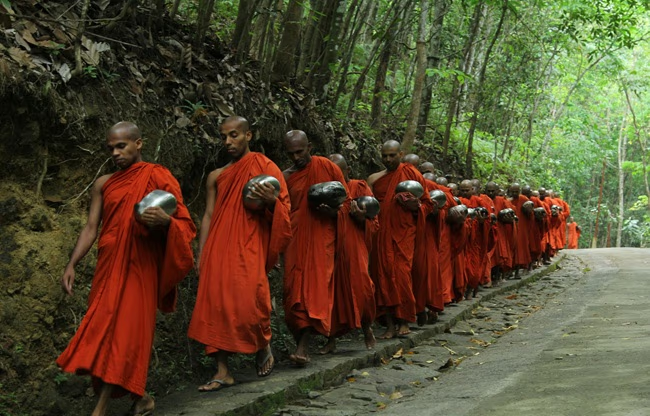
The Buddhist community makes up about 0.5 to 0.6 percent of the population, approximately 1 to 1.2 million people. Most reside in the Chattogram Hill Tracts, which include the Rangamati, Khagrachari, and Bandarban districts, mainly from indigenous backgrounds. A few Buddhist families also live around Chattogram city.
Despite their small numbers, Buddhists have a historical connection to Bangladesh. Buddhism spread in the region long ago, during the Maurya and Pala periods. Later, Islam expanded, and the Buddhist population dwindled.
Source: aajtak
Predominantly engaged in agriculture, Buddhists in the Chattogram Hill Tracts cultivate rice, vegetables, and fruits, with some practicing jhum cultivation, typical in hilly regions. Many sustain themselves through forest resources like timber, bamboo, herbs, and fishing. Education and job opportunities have increased, with some involved in religious and social work in monasteries.
While Hindu numbers in Bangladesh have declined rapidly, the Buddhist demographic has remained static, indicating a form of attrition.
- During and after Bangladesh's 1971 independence struggle, Chattogram Hill Tracts witnessed prolonged violence, military intervention, and insecurity. As a result, many Buddhists, particularly from Chakma and Marma communities, migrated to India, where their kin reside, such as in Arunachal Pradesh, Mizoram, and Tripura.
- Government resettlement schemes in the hilly areas led to the dispossession of indigenous Buddhist lands. As a minority among minorities, they were unable to effectively resist land grabs, prompting emigration.
- Buddhists possess relatively higher education levels, impacting birth rates and leading to smaller family sizes, further diminishing their percentage.
Source: aajtak
When Has Violence Occurred?
- Like other minorities, Buddhists suffered violence, notably in Chakma and Marma tribal regions, experiencing murder, village raids, and sexual violence.
- From the 1970s to the 1990s, indigenous groups and the Dhaka government clashed, leading to land-related assaults and military operations, causing mass migration.
- The 2013 Ramu violence is often recalled, where alleged blasphemy on Facebook led to attacks on Buddhist monasteries and homes, destroying numerous religious sites and homes.
Is the Buddhist Community Relatively Safer?
Recently, targeted attacks on Buddhists have decreased in discussion, yet threats and land grabs remain frequent concerns. It often surfaces why Hindus face more significant violence in Bangladesh when other minority communities exist.
The straightforward reason is that Buddhists reside in difficult-to-access hilly terrain, unlike Hindus who are widespread in cities, making them easily accessible. Hindus are often seen through political lenses and cross-border politics with India. In contrast, Buddhists are too few to be considered a vote bank or political tool. However, the 2012 Ramu violence underscores that if extremism dominates Bangladesh, no minority is truly safe.