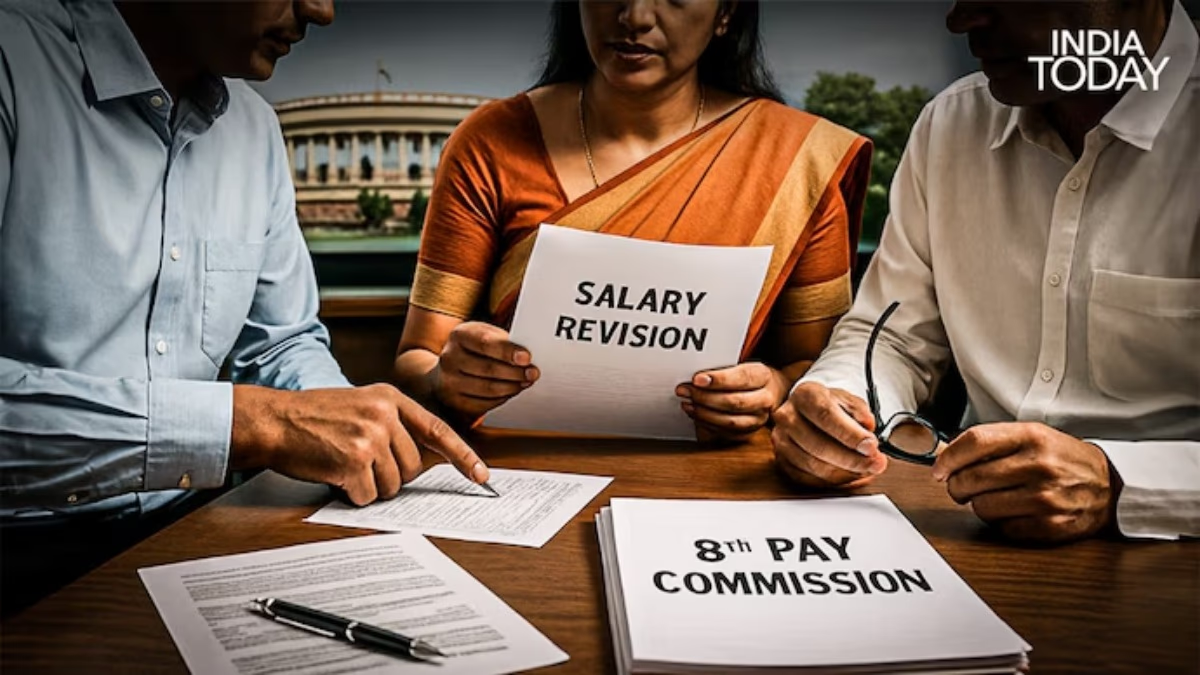
The year 2025 is nearing its end and in just two days, the New Year (2026) will begin. Central Government employees are eagerly anticipating this moment, as from January 1, 2026, significant regulation changes are expected along with the implementation of the 8th Pay Commission. Central employees and pensioners are keen to discover the potential salary hikes, the expected changes in the Dearness Allowance (DA), and the schedule for payment of pending arrears. Let's explore the predictions from experts surrounding these expectations.
8th Pay Commission from January 1
The year 2026 promises significant changes for central government employees. The currently implemented 7th Pay Commission concludes on December 31, 2025, with the Government-approved 8th Pay Commission set to be enforced from January 1, 2026. Although official recommendations are awaited, discussions are rife. While these figures are estimates until the final report is released, they provide insight into the expected modifications post-implementation.
How Much Will Salaries Rise in the 8th Pay Commission?
The salary increase with the implementation of the 8th Pay Commission for central employees will depend on numerous economic and financial factors. According to Pratik Vaidya, MD of Karma Management Global Consulting Solutions Pvt Ltd., expectations are typically influenced by past trends and current economic conditions.

Source: aajtak
Vaidya further mentioned that the 6th Pay Commission saw an average salary hike of approximately 40%, whereas the 7th Pay Commission resulted in 23-25% increases. Preliminary estimates for the 8th Pay Commission suggest salary hikes between 20% to 35%, contingent on the crucial Fitment Factor, which could range from 2.4 to 3.0.
What Changes Might Occur in DA?
After discussing salary hikes, let's address changes regarding the Dearness Allowance - Dearness Relief (DA-DR) post-implementation of the 8th Pay Commission. To safeguard employees from inflation, the allowance is adjusted periodically, typically twice a year. When a new pay commission is implemented, DA is recalibrated to be integrated into the basic salary.
Experts under the 8th Pay Commission project the DA Calculation to be restructured considering inflation levels circa 2026. This could impact both take-home salaries and future DA hikes.

Source: aajtak
What About Pending Arrears?
Upon the implementation of a new pay commission, the payment of arrears typically follows the pattern set by the previous one. Employees might receive the revised salaries post-implementation, but calculations align with the commission's effective date.
According to Manish Mishra, founder of GenZCFO, arrears calculations will likely commence from January 1, 2026, marking the 7th Pay Commission's concluding date, with actual payments following post-approval of commission recommendations.
When Will the Increased Pay Arrive in Accounts?
An additional query arises: Will the increased pay be promptly credited when the 8th Pay is implemented? Experts foresee potential delays in real wage revisions and arrears release, with employees and pensioners advised to prepare for possible waits akin to previous pay commissions.
Pratik Vaidya notes that although the 7th Pay Commission was enforced from January 2016, cabinet approval materialized in June of the same year, with arrears disbursed subsequently.