The Islamic Revolutionary Guard Corps (IRGC) of Iran is one of the most renowned and contentious military forces globally. It operates independently from Iran's regular army, the Artesh, answering directly to the Supreme Leader. The IRGC is also referred to as the Sepah or Pasdaran.
Not only does it safeguard Iran, but it also plays a pivotal role in advancing Iranian interests abroad and confronting adversaries. The question is, just how mighty is it? What arsenal of weapons and missiles does it possess? Can it withstand an attack from the U.S. military?
According to Reuters, the Institute for the Study of War (ISW), and Critical Threats, following the 12-day conflict with Israel and the U.S. in June 2025, the IRGC has fortified its strength, albeit with numerous vulnerabilities.
IRGC's Strength
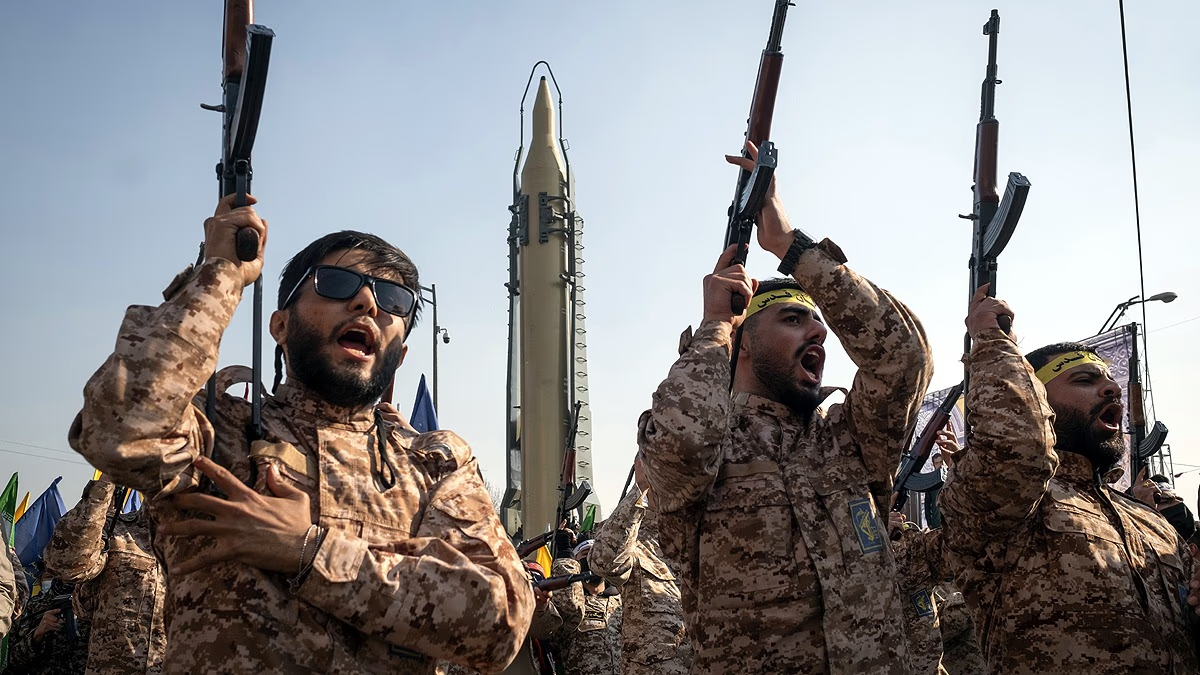
The IRGC is Iran's largest and most influential military force, comprising approximately 200,000 personnel, including ground forces, navy, aerospace force (missiles and drones), Quds force (for overseas operations), and Basij militia (local fighters). It defends the Iranian revolution and supports regional groups like Hezbollah (Lebanon), Houthis (Yemen), and Iraqi militias.
The 2025 conflict exacted a heavy toll on the IRGC, with major commanders killed and missile factories and nuclear sites targeted. By January 2026, the IRGC claimed to be at peak readiness, with missile stocks replenished.
Iran boasts the largest ballistic missile stockpile in the Middle East—roughly 2,000 to 3,000 missiles. However, in conventional warfare, it is inferior to the U.S. Its strength is in asymmetric warfare, meaning covert attacks, such as those using drones or proxy groups.
Currently, protests are ongoing in Iran, and the IRGC is engaged in suppressing them, seeking assistance from Russia with helicopters and vehicles. Former President Trump has expressed support for the protestors, escalating tensions.
IRGC's Arsenal
The IRGC's aerospace force primarily manages missiles. Post-2025, production has ramped up. Key weapons include:
Short- and medium-range ballistic missiles: Fateh-110, Zolfaghar, Qiam, Shahab-1/2/3, Qadr, Emad, with ranges from 300 to 2000 km, capable of targeting Israel or U.S. bases.
Advanced solid-fuel missiles: Khaibar Shikan (1450 km range), Haj Qasem (1400 km), Qasem Basir (enhanced version).
Hypersonic missiles: Fateh and Fateh-2 (with speeds of Mach 13-15 and ranges of 1400-1500 km), which can outmaneuver defense systems.
Cruise and anti-ship missiles: Soumar, Hoveyzeh, Qadr-380 (1000+ km, attacks on ships).
Other weapons: Cost-effective drones like Shahed-136, speedboats, marine mines. Reports suggest the IRGC is working on chemical and biological warheads for deterrence.
Underground bases: Secret sites, known as missile cities, where missiles are concealed. Launches from mobile launchers made easier.
Overall, the IRGC possesses thousands of missiles. In the 2025 conflict, over 300 missiles were launched, but many were intercepted. Stocks are being rebuilt.
Can the IRGC Withstand a U.S. Military Attack?
Not fully. The U.S. military is the most formidable globally, with aircraft carriers, stealth bombers (B-2, B-21), F-35 fighter jets, Tomahawk cruise missiles, and electronic warfare capabilities. In 2025, Israel (aided by the U.S.) damaged the IRGC's command structure, missile launchers, and nuclear sites. If America were to attack, it could swiftly neutralize a large portion of the IRGC—without deploying ground forces.
IRGC's Counter Strategy...
Missile or drone strikes on U.S. bases (Iraq, Syria, Gulf).
Closing the Strait of Hormuz (halting oil supplies).
Indirect attacks via proxy groups.
However, in a prolonged conflict, the IRGC would struggle to endure. The U.S. could debilitate the IRGC through targeted assaults, yet Iran's retaliatory actions could destabilize the region. Iran’s strategy isn’t about winning but surviving and inflicting damage. Demonstrations are currently undermining the IRGC's power.
Defensive Capabilities Against U.S. Missiles?
The IRGC has some air defenses, yet they falter against advanced U.S. missiles (Tomahawk, stealth cruise), especially during saturation attacks and electronic jamming. Key systems include:
Bavar-373: Iran's indigeneously developed system akin to S-300/S-400. The upgraded version (Bavar-373-II) has a range of over 300 km. It can track 200-300 targets but engage only six simultaneously.
S-300: A Russian system, most destroyed in the 2025 conflict. Some are integrated with Bavar.
Others: Khordad-15, Arman, Majid (medium/short-range, effective against drones and aircraft).
These systems can intercept some missiles but succumb to U.S. stealth technology, mass missile onslaughts, and electronic interference. In the 2025 conflict, Iran's defense failed. If the U.S. strikes, Iran's defense may prove limited. Iran is acquiring HQ-9Bs from China and S-400s from Russia, but these don't offer complete protection.
What Lies Ahead?
The IRGC is formidable in regional intimidation and covert attacks but could falter against direct U.S. assault. Lessons from the 2025 conflict drive Iran to bolster missile production, yet economic woes and protests exert pressure. The Trump administration considers striking Iran, triggering retaliatory threats from Iran.
A potential conflict could trigger a major Middle East crisis, escalating oil prices, and impacting millions. Iran avers it does not seek war, but vows retaliation if attacked. Global attention focuses on Trump's decision—will peace prevail, or will a new conflict ignite?