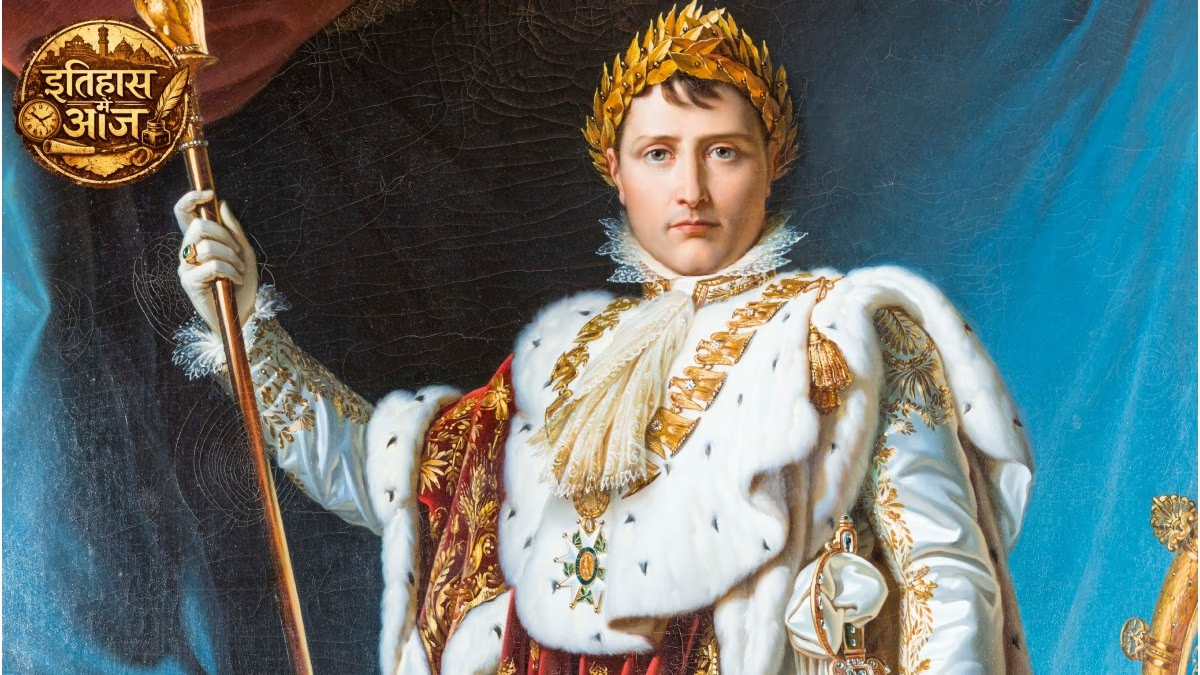
On this day, Napoleon made his daring escape from Elba Island. On February 26, 1815, he set forth from the island, advancing toward France to reclaim his strength. As he drew closer to Paris, the number of soldiers joining him increased, and so did his prestige. Reclaiming his throne, he also embraced the name Bonaparte, meaning 'good part'.
Napoleon Bonaparte is celebrated as one of history's greatest military leaders. His rise during the French Revolution (1787-99) led him to serve as Emperor of France from 1804 to 1814, and again in 1815, until his defeat at the Battle of Waterloo on June 18, 1815.
In 1800, Napoleon claimed victory over the Austrians at Marengo. By 1802, he declared himself Consul for life, and just two years later, he became Emperor of France. After 1810, the tide began to turn against Napoleon. France faced several military defeats, culminating in Napoleon's disastrous invasion of Russia in 1812, forcing a retreat.
By March 1814, Paris was seized, and Napoleon was exiled to Elba Island, where he was granted sovereignty. His wife and son moved to Austria. Elba, just six miles from Tuscany's coast, seemed inadequate for a man of his stature, yet few imagined his escape would follow nor that his return would be so impactful.
According to BBC's HistoryExtra, Napoleon treated the island as his own small kingdom. He ruled dictatorially and even trained his own army. Plans for his escape were set on a night when his allies were sure British and French patrols were preoccupied elsewhere.
On February 26, 1815, after a day spent in prayer and dining with his mother and sister, Napoleon read a biography of Holy Roman Emperor Charles V, someone whose grandeur rivaled his. Inside, he was brimming with excitement, knowing this was the day he would attempt to reclaim his throne.
As they marched towards the harbor where the brig Inconstant awaited, local villagers lined the streets, cheering, their hats in the air. Accompanying him were 600 Old Guard Grenadiers and several allies – former Generals Bertrand, Drouot, and Cambronne, along with a doctor, a pharmacist, and a mining inspector.
Dominic Sandbrook writes that as the ship carried them towards the French coast, Napoleon strolled confidently on deck, engaging with both soldiers and sailors. One of his soldiers recounted how, whether lying down, sitting, or standing, he consistently asked questions, responding without anger or impatience.
At the end of February 1815, slipping away from Elba, he landed on the Côte d'Azur on March 1. Though only 600 strong and quite a distance from Paris, history was being made. Near Grenoble, a battalion initially blocked his way. To prevent civil war, Napoleon approached alone. The soldiers discarded their Bourbon white cockades, rejoining their Emperor. One of his old commanders, Marshal Ney, had vowed to capture Napoleon but his men too joined the Emperor.
As he approached Paris, and more troops rallied under his banner, his esteem grew, something evidenced by the changing narrative in 'Le Moniteur'. Initially labeled a monster, tyrant, and usurper, soon he was acknowledged as 'Bonaparte', signifying a man with a noble aspect. By March 22, the paper announced His Majesty's return to Paris. By then, Louis XVIII had fled to the Netherlands. Napoleon claimed his sole intent was to restore glory and prosperity to France and peace with its neighbors. Thus, he became Emperor Napoleon Bonaparte once more.