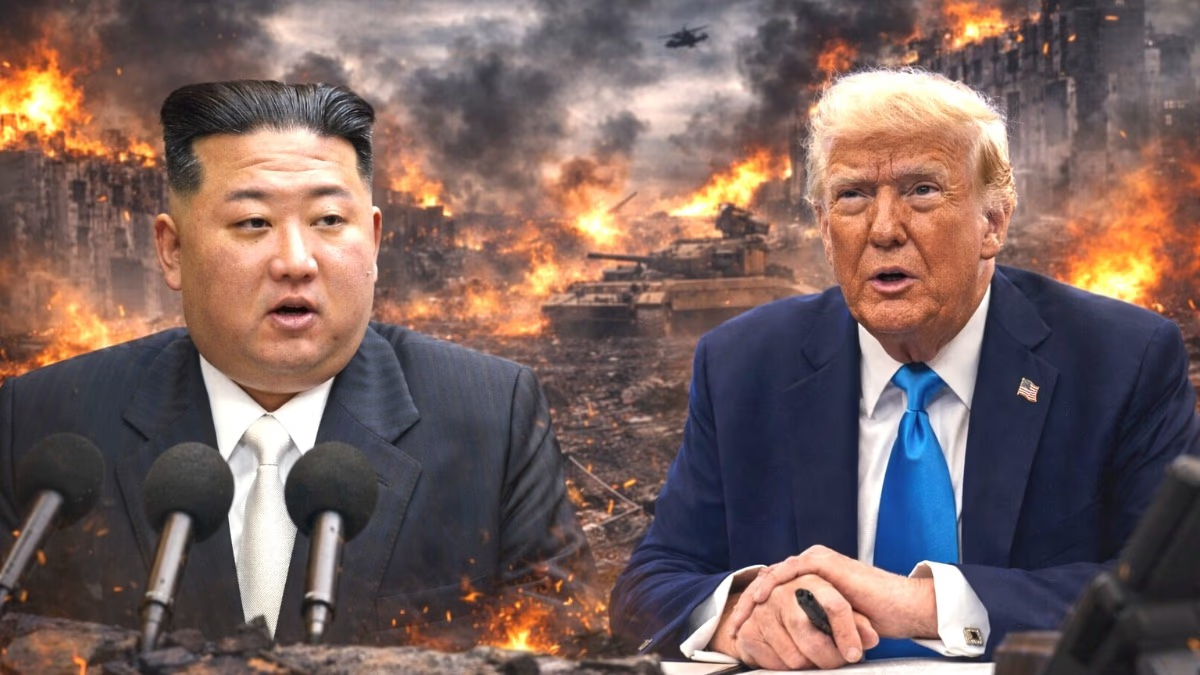
The recent airstrikes by the US and Israel on Iran have resulted in the death of Iran's Supreme Leader Ayatollah Ali Khamenei. This event has ignited a fresh global debate on nuclear policy. Experts suggest these attacks will influence North Korean leader Kim Jong Un's nuclear ambitions, and it remains to be seen if he chooses to pursue diplomatic talks once again with US President Donald Trump.
According to Reuters, discussions are intensifying in Seoul regarding how Pyongyang might alter its strategy amidst rising global tensions. Yang Moo-jin, Chair Professor at the University of North Korean Studies, commented that Kim Jong Un might be under considerable psychological pressure. Externally, he presents himself as the leader of a nuclear-armed nation but will practically bolster security measures, be it in summit meetings or public engagements.
The Intensified Debate on Nuclear Weapons Post-Iran Attacks
Yang Moo-jin also mentioned that the possibility of talks has not completely vanished. If Kim leverages his personal rapport with Trump to gauge Washington's stance and simultaneously takes time to advance nuclear capabilities, a window for negotiations could open.
However, North Korea faces a strategic dilemma: should it accept the US's offer for unconditional talks or prioritize gaining recognition as a nuclear-armed state? According to Yang, this conflict could place Pyongyang in a challenging position.
Kim Jong Un's Diplomatic Crossroads
Unlike Iran, North Korea has enshrined its nuclear policy in law and constitution, possessing advanced weapons technology. Yang states, 'In that sense, North Korea holds the nuclear button.'
Analysts opine that Kim might feel reassured by his ties with China and Russia. In September, Kim traveled to Beijing aboard an armored train, where he was seen at a military parade alongside Chinese President Xi Jinping and Russian President Vladimir Putin.
Will Trump Talks Resume?
Yang Wook, a researcher at the Asan Institute for Policy Studies, remarked that a single television image elevated North Korea to a symbolic status as a nuclear-armed authoritarian state standing shoulder to shoulder with Russia and China.
According to him, North Korea's core aim is singular: recognition as a nuclear power by the US. If talks do occur, they should manifest as arms control negotiations among nuclear powers.