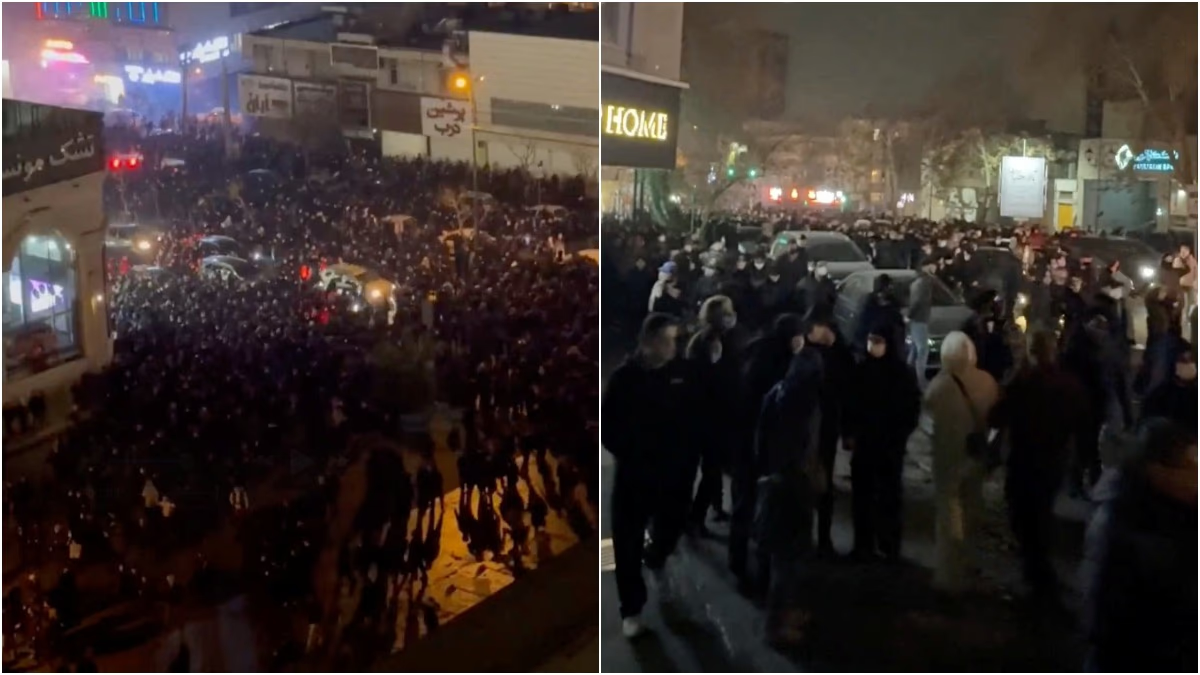
On December 28 in Tehran, merchants shuttered their shops in protest. When security forces arrived, the first chants echoed in the streets: 'Esteemed merchants, support, support!' As the sequence progressed, cries like 'Fear not, fear not; we're all in this together' erupted. Initially, this was an economic protest. Gradually, the tone and wording of these slogans morphed into a broad political agitation.
This movement has spread beyond Tehran, engulfing the entire nation. Every day, hundreds of demonstrations are visible across numerous locales. Fires blaze at some places, vehicles are set alight at others, and confrontations with police are frequent. Amongst all this chaos, the chants that have become the voice of this movement starkly reveal the reality of Iran's situation. Let's delve into what slogans are chanted and what stories they convey amidst the protests.
Iran International has been closely monitoring the public movement that started in Iran. They have documented a report on the first ten days of dissent, where slogans became a medium of resistance for the Iranians, capturing the changing trajectory of the movement.
According to Iran International, during the rebellion's initial 10 days, 463 clips covering 91 cities, towns, and villages were reviewed. They compiled footage where slogans were clearly audible. A total of 641 slogans were recorded, 93 of which were distinct.
The slogans captured in these clips indicate a significant shift. From calls for strikes and solidarity to demands for the rejection of the Islamic Republic and the return of Reza Shah, the journey of these slogans tells it all. A trade strike in the capital sparked the protests, quickly evolving with slogans like 'Death to Dictator' seeking the overthrow of Islamic governance. Subsequently, chants like 'Reza Shah will return' began to emerge.
Throughout the first 10 days, protest chants persisted endlessly. A comprehensive analysis of 453 videos, which comprised 641 slogans, was aimed to present the shifting dynamics of the entire movement through this data.
The limited footage from the first day included a clip from the Shush Bazaar, where merchants shouted, 'Prezeshkiyan, have some shame, resign the presidency'. Aside from a few slogans outside the merchant community, little was aurally clear in those videos. On the second day, strike slogans like 'Close, close down' continued to echo in the markets, but the protest's vocabulary had decisively shifted to an open confrontation with the Islamic Republic.
In Tehran, slogans like 'Until the mullah is buried, this motherland won’t become one' and 'Cannons, tanks, fireworks, mullahs must go' signaled a shift from commercial to political rejection protests. On the tenth day, a slogan emerged that defined the first 10 days of dissent - 'This is the final battle; Pahlavi will return.'
Rebellion chants had shifted from being about mere pressure or protest; they were now about power. People, through their slogans, were expressing their desire for a change in authority and hinting at who should replace it.
In universities, pro-Pahlavi slogans were also heard. At Allameh Tabatabai University, students shouted, 'Neither Pahlavi, nor Supreme Leader, freedom and equality.' At Beheshti University, a line from the 2022 women's life freedom movement echoed: 'You are a thug; you are a whore, I am a free woman.'
As days passed, the movement geographically expanded throughout the country, from Tehran to smaller towns and cities like Kouh-e Chenar, Farsan, Asadabad, and Joneghan. Protests continued not only on campus but also on the streets.
The clarity that arose was not just in how broad the protests had become, but in how slogans expressed public sentiment towards two primary political poles – the rejection of the Islamic Republic and support for the Pahlavi family.
Over ten days, against the backdrop of rebellion, one could sense a tone of mourning in the slogans. The chants weren’t merely spirited proclamations but also lamentations. In Kouhdasht, mourners chanted, 'This flower has broken, it’s become a gift for the homeland.' They also repeated prevalent street slogans like 'Pahlavi will return' and 'Death to a dictator'.
In Fooladshahr, during the funeral of Dariyush Ansari, mourners chanted, 'Death to Khamenei'. Dariyush Ansari was among the first protesters to be killed during this unrest. In Marvdasht, at the funeral of Khodadad Shirvani Monfared, chants of 'Long live the Shah' echoed.
Focusing on the slogans of the movement reveals that the rebellion has multiple tones: anger, grief, and rejection, sometimes entwined in myths related to the return of the old monarchy. In Zahedan, after Friday prayers, chants of 'Allahu Akbar' and 'Death to Khamenei' were recorded. In a village in Hamedan Province, another chant was heard: 'Wail Khamenei, Pahlavi is coming.'
At Shiraz University’s dormitory grounds, students chanted, 'The Shah is returning, Zahhak’s coup will fall.' Mythical tyrant Zahhak was used metaphorically to depict Khamenei in the chants. During the funeral ceremonies in Ilam Province’s Malekshahi for Latif Karimi, Reza Azimi, and Mehdi Imami-Pour, chants like 'I will kill, I will kill who killed my brother' resounded.
In a video clip during an attack on a hospital in Malekshahi, citizens were heard chanting 'Support the police force'. As the movement escalated, the political landscape became clearer. In footage from eight cities and villages, three slogans prominently echoed: 'Long live the Shah', 'Death to the dictator', and 'Not Gaza, not Lebanon; my Iran only'.
In the largest village of Chenar-Sheikh (Chenar Sofla) in Hamedan Province, an eye-catching chant emerged during ongoing protests: 'Khamenei is a murderer'. In 19 cities, when protests simultaneously broke out, slogans against the 'dictator' and in support of 'Pahlavi' stood prominent.
Thus, the chants from the ongoing movement in Iran present a clear picture of the changing situation. The protest, which started as a traders' strike against inflation, has now culminated in demands for Khamenei's resignation. People are now taking a step further, calling for the ousting of the dictator and the return of Reza Pahlavi.