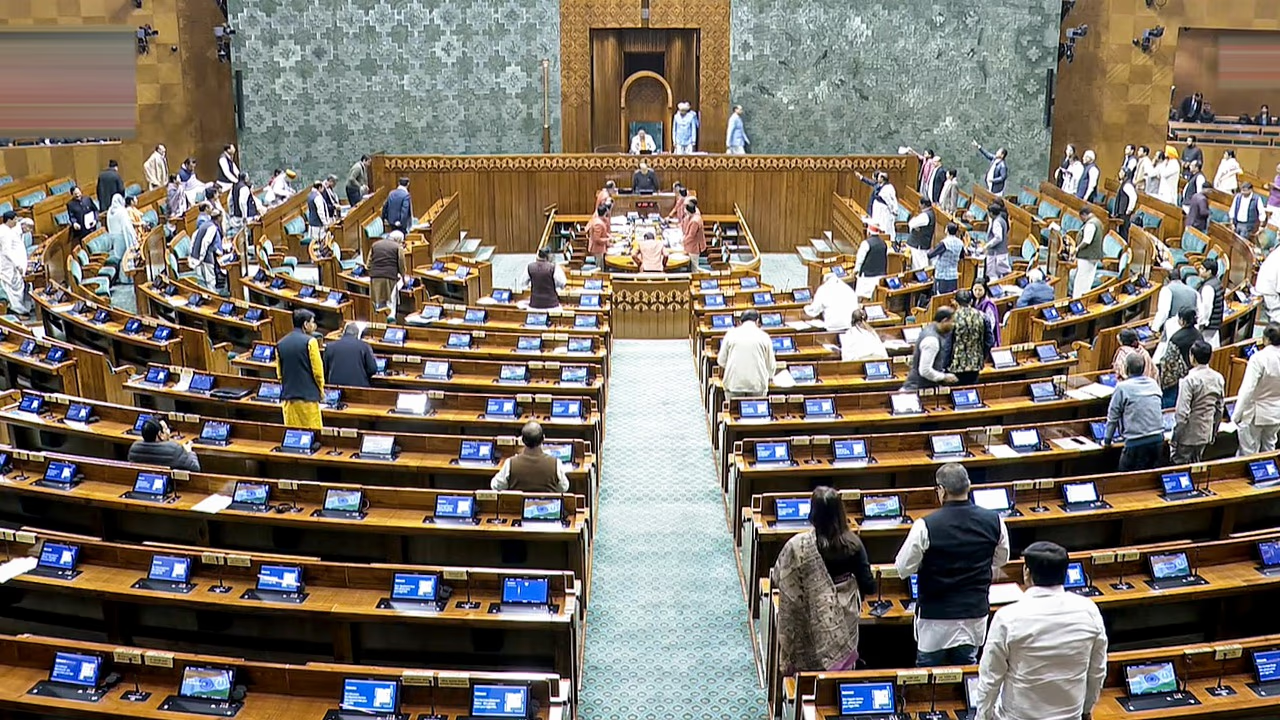
The Standing Committee on Foreign Affairs in Parliament has delivered an exhaustive report on the intricacies of India-Bangladesh relations. Chaired by Congress MP Shashi Tharoor, the committee's 9th report, ‘The Future of India-Bangladesh Relations,’ clearly outlines the strategic, security, and diplomatic challenges that India currently faces following developments in Bangladesh since August 2024. The committee emphasized that India needs sustained diplomatic exchanges, precise strategic communications, and strengthened institutional collaboration to navigate these challenges.
This report, adopted on December 16, 2025, follows multiple briefings from the Ministry of External Affairs (MEA), including in-depth discussions with the Foreign Secretary on December 11, 2024. Further consultations with experts were also conducted during the 2024–25 and 2025–26 sessions of the 18th Lok Sabha.
The Legacy of 1971... The Moral Foundations of Our Relationship
The committee underscored that the 1971 Liberation War is the moral and historical cornerstone of India-Bangladesh relations. It symbolizes mutual sacrifice, trust, and solidarity. The report highlighted India's role in Bangladesh’s independence and the ongoing support like scholarships and medical aid to freedom fighters as contributors to the legitimacy of this bilateral relationship.
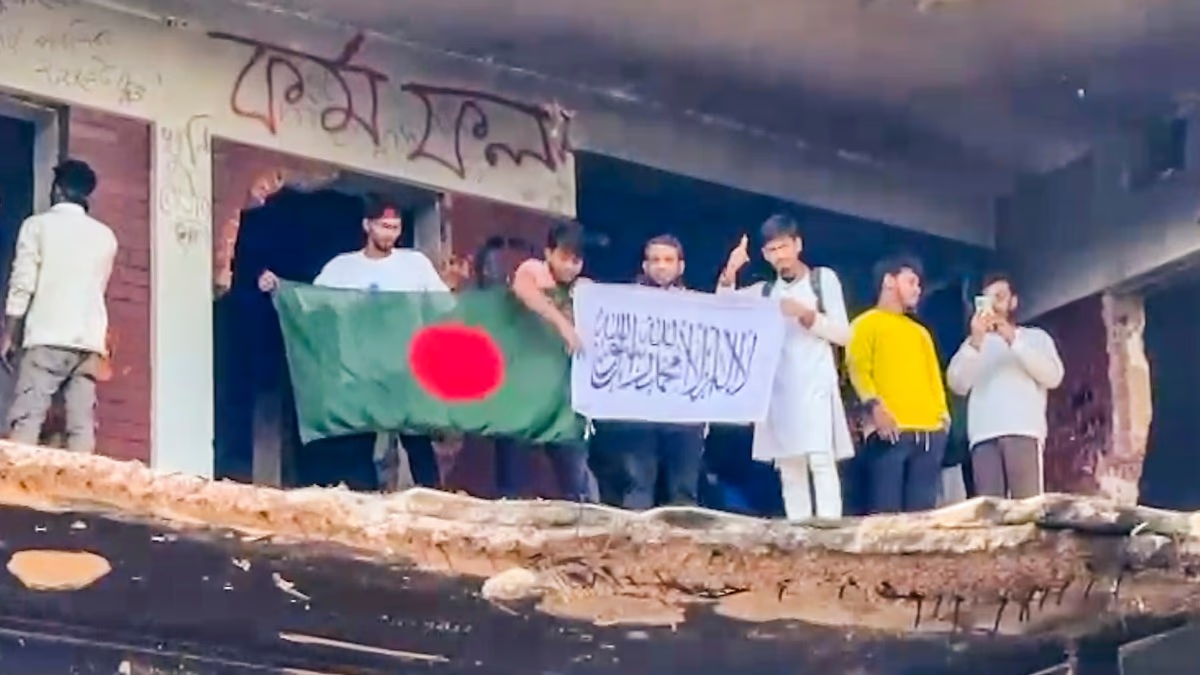
However, the committee expressed worries over emerging revisionist thoughts in Bangladesh and the dwindling awareness among the younger generation about India's role in 1971. The committee has urged the Ministry of External Affairs to invigorate the spirit of 1971 through strategic public diplomacy, educational exchanges, cultural programs, and enhanced people-to-people connection.
Recalling Sheikh Hasina's Stay in India
The report addressed the sensitive issue of former Bangladesh Prime Minister Sheikh Hasina’s stay in India. The committee stated that India's stance is deeply rooted in its civilizational traditions and humanitarian values, offering refuge during severe crises or existential threats.
Additionally, it acknowledged India's firm adherence to the principle that Sheikh Hasina's presence in India should not be used for political activities against third countries. The committee recommended the government maintain a humane and principle-based approach, handle the situation sensitively, and keep Parliament informed about Bangladesh's extradition request following the death sentence handed down to Sheikh Hasina in her absence.
The Diplomacy Framework and the Dialogue
There are over 40 structured bilateral mechanisms in place between India and Bangladesh, including platforms like the Joint Consultative Commission (JCC), Foreign Office Consultations (FOC), and the Joint Rivers Commission (JRC). These mechanisms have facilitated significant achievements like the Land Boundary Agreement (LBA), maritime boundary resolutions, and cross-border electricity and connectivity.
The committee emphasized the necessity for regular and active engagement of these mechanisms during politically uncertain times to avoid mistrust and safeguard previous gains.
The Safety of Minorities: An Alarming Scenario
Post-August 2024, the situation in Bangladesh has presented India with its most significant strategic challenge since 1971. The report pointed out deeply concerning issues like political instability, uncertainty surrounding democratic elections, attacks on minorities, and social unrest.
By May 2025, 2,446 incidents involving attacks on minorities and religious sites were documented. India has consistently raised these issues at high levels, yet the committee expressed dismay over Bangladesh officials’ attempts to downplay these incidents as 'political killings' rather than 'communal violence.' The committee has called for making minority protection the focal point of India's diplomacy, with swift action against perpetrators.
The Committee's Stance on Border Security
India and Bangladesh share a 4,096-kilometer international border spanning five states and challenging geographic areas. Of this, 3,231 kilometers have been fenced, leaving about 864 kilometers unfenced, with 175 kilometers considered extremely challenging.
The committee noted concerns about issues like illegal immigration, smuggling, radicalization, and cross-border crimes exacerbated by socio-economic vulnerabilities in border areas. The report recommended speeding up the border fencing process, resolving land acquisition issues, and adopting advanced technical measures like floating fences, laser-based surveillance systems, and smart sensors in riverine regions.
The necessity for regular Director-General-level talks between BSF and BGB, joint task forces, and enhanced surveillance means was also emphasized.
Coordination Between the Center and States
The committee asserted that developments related to Bangladesh directly impact Northeast India's security; thus, better coordination between the center and border states is crucial. The report mentioned that improved synchronization after December 2024 led to the arrest of 14 Ansarullah Bangla Team terrorists in Assam and significant narcotics recoveries.
The reactivation of the North Eastern Council (NEC), the chief ministers' subgroup of the NITI Aayog, and the States Division of the Ministry of External Affairs was recommended.
The Economic and Trade Dynamics Explained
Bangladesh is South Asia's largest trade partner with India. In 2024–25, bilateral trade reached $13.46 billion. Despite this, the committee pointed to structural issues like infrastructure shortages, tariff and non-tariff barriers, congestion at land ports, and weak logistics.
Recommendations included modernizing Integrated Check Posts, enhancing the use of road, rail, and inland waterways, and boosting digital trade facilitations. Concerns over Chinese goods being dumped into India via Bangladesh under SAFTA were raised, calling for strict rules of origin checks and elevated-level talks with Dhaka.
Challenges After Exiting the LDC Category
After Bangladesh exits the Least Developed Country (LDC) category in 2026, the trade structure will transform. The committee stressed the urgency of completing the Comprehensive Economic Partnership Agreement (CEPA) between India and Bangladesh by the end of 2026 to protect Indian domestic interests while supporting Bangladesh’s transition.
China’s Expanding Role in Bangladesh
The committee also warned about China’s expanding influence in Bangladesh, mentioning projects like the Mongla Port expansion and the development of Lalmonirhat airbase near the Indian border.
In response, India has undertaken initiatives such as the Khulna-Mongla Railway Line and transit access to Chattogram and Mongla ports. Nevertheless, the committee stressed the need for stringent monitoring of foreign military-linked infrastructure projects and reinforcing India’s position as a dependable development partner.
Connectivity, Development Partnerships, and BBIN...
India has committed nearly $10 billion in development aid to enhance connectivity, power, and infrastructure in Bangladesh. Acknowledging delays due to security and logistical hurdles, the committee emphasized the need to complete projects timely.
The BBIN Motor Vehicles Agreement was identified as a pivotal pillar for sub-regional collaboration. Finalizing the pending protocols and initiating seamless movement of goods and people were prioritized.
The committee further suggested that shared cultural heritage and civilizational ties are powerful means for rebuilding trust. Recommendations included conducting joint cultural programs annually, establishing ICCR satellite centers beyond Dhaka, and promoting youth exchanges, tourism, and border haats.
The significance of visa facilitation was also highlighted. In 2023, India issued over 1.6 million visas. After service reductions in August 2024, the committee advised gradual normalization based on the security situation.
Mention of Water Sharing, Climate, and Environment...
India and Bangladesh share 54 common rivers, where water cooperation is sensitive yet indispensable. With the Ganges Water Treaty expiring in 2026, the committee recommended initiating timely negotiations based on updated hydrological data with close consultation from states like West Bengal and Bihar. For unresolved rivers like Teesta, a fresh resolution perspective was advised.
On climate change, joint adaptation projects in the Sundarbans region, advanced flood forecasting technology, and an extensive bilateral framework for river and ecosystem management were deemed essential.