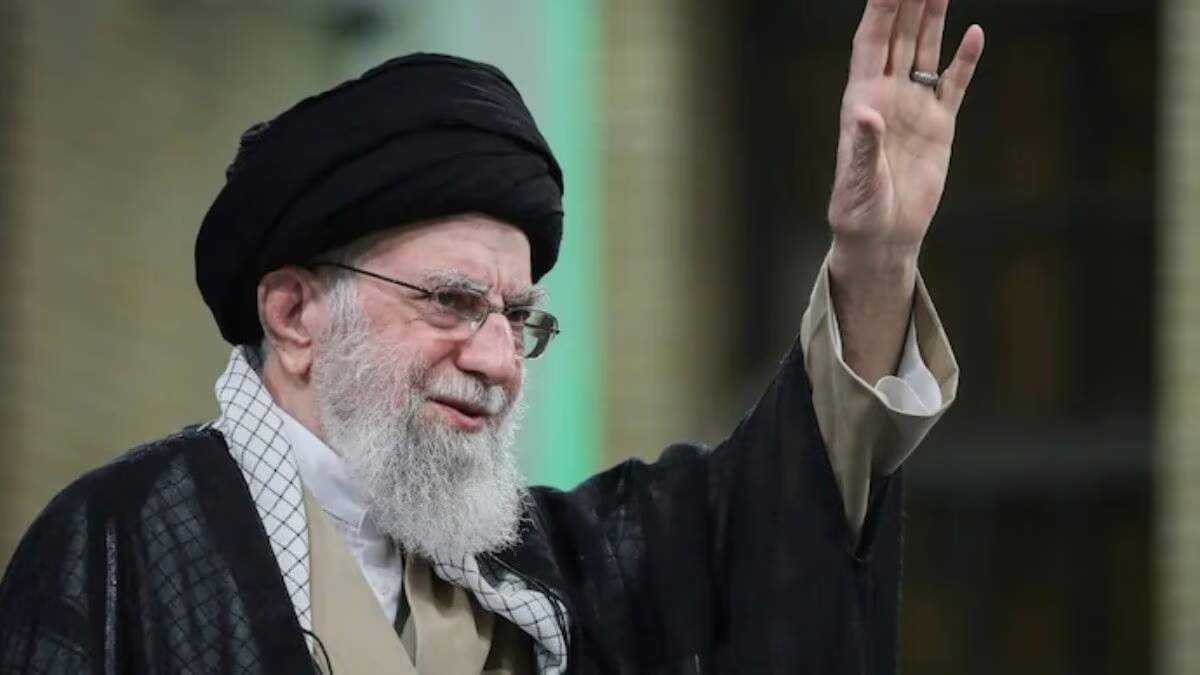
The recent attack on Iran by the United States and Israel led to the demise of Iran's Supreme Leader Ayatollah Ali Khamenei. For 36 years, Khamenei held the reins of the nation. Amidst rising tensions in the Middle East, the pressing question arises: how is the location of any significant leader determined? Is it through satellites, phones, or internal informants?
Modern warfare has outgrown missiles and tanks. The true strength now lies in intelligence and technology. Leading global agencies, such as the CIA, Mossad, and NSA, operate on various levels.
The first tool is satellite surveillance. High-resolution imaging satellites are so powerful today that they can track the movement of vehicles on the ground. Continuous monitoring provides insights into where vehicles are headed, and which buildings exhibit unusual activity.
The next major arsenal is Signal Intelligence. Monitoring phone calls, radio signals, internet traffic, and encrypted communication. Advanced systems can decipher metadata to find out who’s communicating with whom and detect when devices in a region suddenly turn on or off.
Another approach involves drones and surveillance stealth aircraft. These drones often hover over regions, capturing motion through thermal cameras, night vision, and radar systems.
The fourth, and probably the oldest method, is human intelligence. Ground sources: insider information, vulnerabilities in security chains, or leaks from close networks. Often, it's the blend of technology and human sources that provides precise intel.
Reports suggest that after months of surveillance, movement patterns are understood. Major leaders frequently change locations for security reasons. Yet, every movement creates a pattern. Data analysis and AI systems can detect these patterns.
AI is playing an increasingly important role in modern warfare. It’s not humans but algorithms that first scan the vast amounts of satellite images, call records, and digital data. If suspect patterns are found, they're forwarded to agency analysts.
However, the truth remains that such valuable information rarely becomes fully public. Official agencies don't share the intricacies of operations. The available information is often based on media reports and analyses.
Cyber surveillance is another crucial aspect. Smartphones, internet connectivity, and digital devices have become significant security risks. Many national agencies are alleged to employ spyware, malware, or network tracking tools.
In summary, tracking any high-profile target isn't a task accomplished in a day. It's a blend of months of surveillance, technology, data analysis, and human resources.
Today's battlefield is as much digital as it is physical. Data moves before missiles are ever launched. Those who master data gain the upper hand.