In October 2025, while addressing journalists in Bagalkot, Karnataka, Chief Minister Siddaramaiah stated, "Priyank Kharge has written to say that RSS activities are being conducted on government land and demanded a ban akin to Tamil Nadu. I have instructed the Chief Secretary to investigate the steps taken by Tamil Nadu in this regard." Reflecting on the opposition's mention of the 'Tamil Nadu model' as an anti-Sangh exemplar, it is noteworthy that on March 2, 2025, at a 'Karma Yogini Samagam' event in Kanyakumari commemorating the 300th birth anniversary of Rani Ahilya Bai Holkar, 60,000 women participated.
This clearly indicates that the Sangh has now risen as a formidable force within Tamil Nadu. However, the journey wasn't easy; the initial two Sangh pracharaks dedicated their lives, day in and day out, to this cause, ultimately committing themselves entirely to Tamil Nadu, with one even donating his body upon his passing.
The First Pracharak Dadarav Slept by Beaches, Dined in Temples
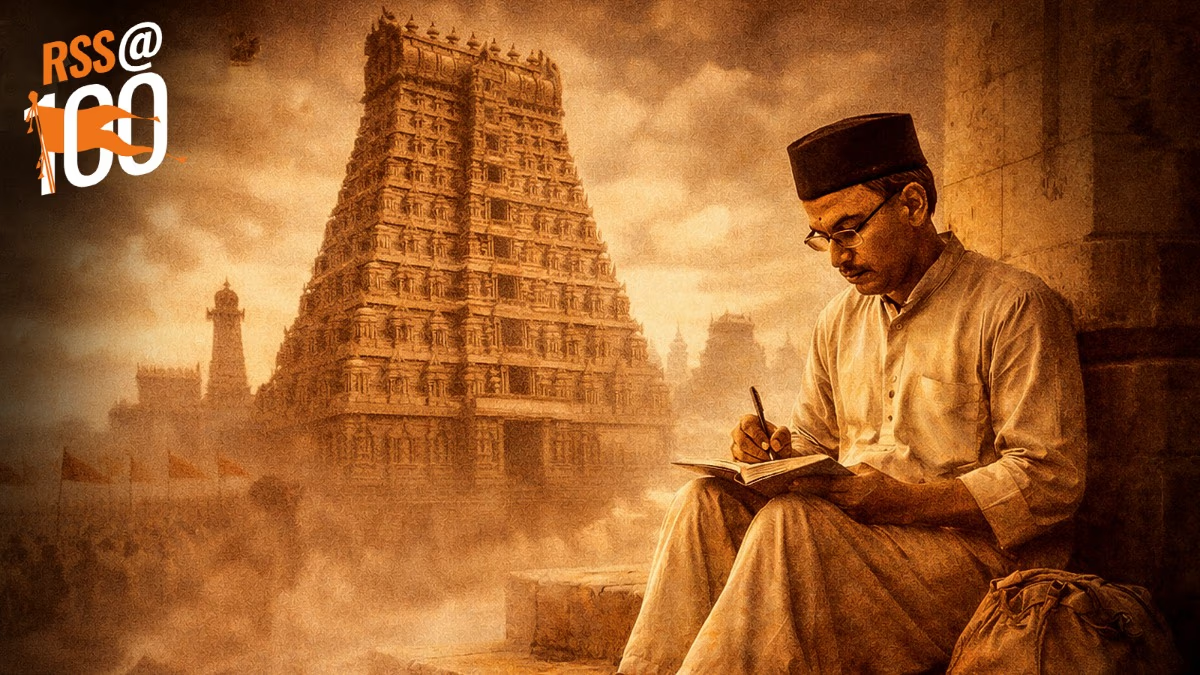
The RSS's roots in Tamil Nadu trace back to 1939, when Dr. Hedgewar sent Dadarav Parmarth (1904-1963) from Nagpur. Armed with a letter for an eminent lawyer and a sum of 20 rupees for initial expenses, Dadarav's mission was to launch branches, forge connections, and establish the Sangh, all while managing his daily sustenance. He spent nights by the seashore, dined in temples, and persevered through language barriers for months.
Known as Govind Sitaram Parmarth from Nagpur, Dadarav vented against the British in his 10th-grade exam, leading teachers to fail him, after which he joined Dr. Hedgewar, becoming a dedicated volunteer. Accompanying Dr. Hedgewar during the 1930 Jungle Satyagraha, he was imprisoned and subsequently cared for by Dr. Hedgewar during illness. Besides Tamil Nadu, his noteworthy achievement includes expanding the Sangh's work in the northeast, becoming its first pracharak there after leaving Tamil Nadu in 1946. Post the 1948 RSS ban, Dadarav immersed himself in spiritual pursuits at Aurobindo Ashram, Pondicherry, and in Rishikesh, from where Appaji Joshi eventually brought him back.
A chance encounter with a family led to Dadarav's first friendship. He took a boy, who had fallen from his bicycle and onto him, to his home. Inquiring about the boy's well-being soon built bonds with his family and friends, who gradually formed the nucleus of Tamil Nadu's first branch at Bhagavan Govind Das’s bungalow's open grounds in today’s Royapetta, Chennai. The work gradually expanded, albeit at a slower pace than in other states. Dadarav was among the first four pracharaks, and recognizing the need for more focus in Tamil Nadu, Guruji Golwalkar sought volunteers solely dedicated to its cause.
Senior RSS officials knew the challenges in Tamil Nadu were more than linguistic barriers, with the emerging atheist movement also posing hurdles. While the Sangh isn't inherently religious, its customs and traditions sometimes clashed, hindering expansion efforts.
A Gold Medalist Pracharak Took Charge of Tamil Nadu and Embraced It as Home
The Sangh's second rath charioteer, chosen post-Dadarav, was Shivram Joglekar, born in 1917 in Karnataka’s Bagalkot—the very soil where, decades later, Chief Minister Siddaramaiah suggested adopting Tamil Nadu’s strategies against the Sangh. Stories of Guru Golwalkar’s conversation with young pracharak Shivram Joglekar, featured in several Sangh-related writings, reveal a critical moment in 1943 when Guruji playfully asked about his food preferences, leading to Shivram's reassignment to Chennai for the Sangh.
Stories from RSS's Century-Long Journey
Subsequently, Karnataka native Shivram Joglekar embarked on his Chennai mission soon after earning a gold medal in MSc studies. Compelled by his acquaintance with Dr. Hedgewar during his student days in Sangli, Maharashtra, he joined the Sangh in 1932. Moving to Pune in 1936, he was entrusted as city secretary and contributed significantly, even conducting research on dust particle dynamics as a BSc student. His academic pursuits were influenced by nationalistic teacher Chikodikar, inspiring a stirring speech on Veer Savarkar and ultimately leading to a determined pledge—prompted by Pujya Masurkar Maharaj—to serve the nation indefinitely.
Upon learning of Dr. Hedgewar's death on June 21, 1940, while working in a Pune meteorological laboratory, Shivram resolved to become a full-time pracharak, albeit after completing his higher education as urged by Pune's RSS chief Vinayakrao Apte. His decision surprised both Sangh leaders and college mentors, who envisioned a prosperous career given his gold medal status. Shivram, however, driven by a sense of duty, sacrificed personal aspirations for the larger cause, being his mother's only child.
Streamlining Efforts in Worker Settlements
Initially sent to Mumbai and later chosen for Tamil Nadu, Shivram arrived in 1943 during Madras’ (modern-day Chennai) political climate inciting sentiments against North Indians and Hindi speakers. He spearheaded Sangh operations amongst the working class, establishing service centers addressing water, education, and healthcare needs, gaining credibility and facilitating expansion. Lacking funds, Shivram visited underprivileged communities on foot, also promoting education through newspaper readings and inspiring letter-writing campaigns to editors. Eventually, this effort birthed the 'Vigil' organization, connecting thousands of educated individuals to the Sangh, forming today's robust foundation in Tamil Nadu.
Guruji's Inquiry into Decades of Slow Progress
During the 1972 RSS annual meeting, Golwalkar (Guruji) questioned Shivram Joglekar about Tamil Nadu's stagnation at 50 branches despite a decade's work. Assuring growth despite slow pace, Shivram noted perseverance as their strength. Although Guruji's direct queries impacted Shivram, they reignited his fervor, resulting in a dramatic increase from 50 branches to over 500 in the 1980s. While Guruji didn’t witness these results, Shivram's dedicated training of volunteers ensured sustained momentum, with branch numbers surpassing 2000 by 2022 and nearing 3000 today.
Over time, Shivram's role transitioned from active involvement to guiding presence, having devoted invaluable 60 years to the Sangh cause in Tamil Nadu. Before leaving, he pledged his body to the state's medical college, having mentored strong local volunteers, eventually empowering them to shoulder Tamil Nadu’s Sangh journey independently. Subsequent battles were championed by Tamil Nadu natives rather than external pracharaks, though other state pracharaks remained supportive.
The Story of AK Suryanarayan Rao Steering Tamil Nadu's Sail
Thanulinga Nadar, concerned about Hindu welfare, worked briefly in the army and police, before pursuing law and practicing in district courts. Hailing from Kanyakumari, his displeasure over administrative bias during Hindu-Christian riots under MGR prompted his association with Congress, later switching allegiance to Hindu Munnani's presidency, aiding RSS collaboration. His influence was instrumental in various regions until his death while delivering an address during Dr. Hedgewar's birth centenary celebration in Nagpur, 1987. Followers revered him as a Karmayogi.
Renowned as Suruji, K. Suryanarayana Rao was born on August 20, 1924, in Mysore, joining the Sangh as a volunteer in 1942 in Bangalore. Earning a B.Sc (Hons) in Mathematics, he became a full-time RSS pracharak in 1946. Tasked with organizing the first Karnataka state Hindu Council under Guruji Golwalkar's guidance, a historic resolution was passed unanimously by religious heads, laying groundwork towards eradicating untouchability within the Hindu community.
In October 1970, Guru Golwalkar assigned him South India, anchored in Madras. Serving as Tamil Nadu’s Prant Pracharak from 1971 to 1984, Suruji extended his influence across Andhra Pradesh, Tamil Nadu, Kerala, and Karnataka until 1990, later taking charge of the nationwide service project, making extensive visits across India and abroad, including America, Trinidad, Canada, England, Germany, Holland, Norway, East Africa, Kenya, Malaysia, Singapore, and Nepal to fortify Hindu activities.
Numerous faces contributed to the Sangh's Tamil Nadu odyssey, such as Rangaswamy Thever, close to leader Rajaji and serving as regional president, and Swami Chidbhavananda of Tirupparaithurai Ramakrishna Thapovanam, a friend of Nehru and kin to Maharashtra governor C. Subramaniam. Other notable figures fondly remembered by the Sangh for their input include Justice Krishnaswami Reddy and R. Ramgopal, whose notable contributions remain celebrated.
Defending Historical Narratives
Postulating on Periyar’s legacy, regional leaders continuously incited public sentiment, wielding narratives of Aryan-Dravidian conflict. Nonetheless, archaeological evidence, such as Sanuoli (Baghpat) excavations, disprove theories of Aryan invasion. Presenting ancient Tamil text evidence aligning with Sanatana Dharma further clarifies cultural continuity. Pracharaks enlighten inquisitive Tamil youth about the state’s historical spiritual prominence, aligning Murugan temples, Divya Kshetras, sacred Shaiva abodes, Shakti Pithas, and Alwar, Siddhars, and Nayanars with the rich Tamil spiritual heritage. These efforts counter distorted caste interpretations, and Prime Minister Modi's acknowledgment of Tamil as the world's oldest language reflects sustained respect.
Previous Story: