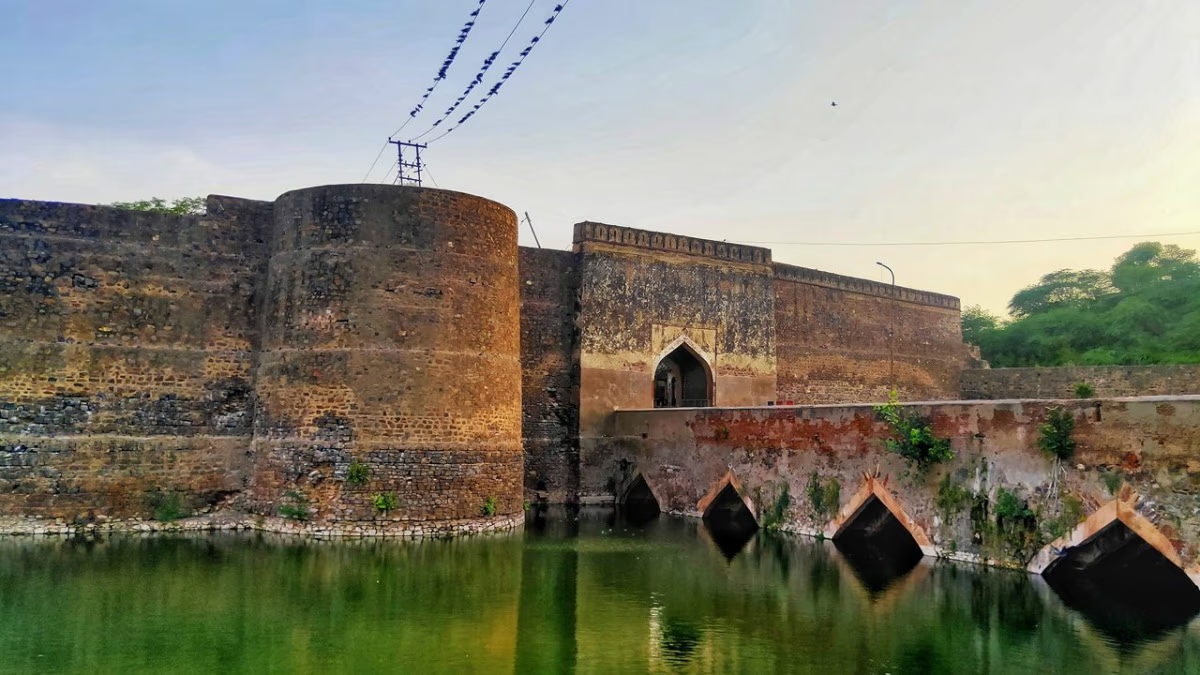
In the annals of history, forts are typically constructed with stone and brick, but in the heart of Rajasthan, one unique fortress stands defiant and enduring—Lohagarh Fort. Crafted primarily from earth, it became an ironclad bastion against invaders, where neither the Mughal might nor the British artillery could prevail. At first glance, one might underestimate this fort's historical invincibility. Yet, delving into its past reveals that strength derives not just from towering walls but also from astute strategy and ingenuity. Let's explore the story of this world-renowned fort whose resilience is legendary.
The Secret Technique that Vanquished Gunpowder
On February 19, 1733, when Maharaja Suraj Mal laid the foundation of this fort, he envisioned a unique strategy for defense. Opting for the flexibility of earth over the rigidity of stone, the fort was enveloped by a 'double fortification'. While the inner walls were made of stone and brick, a colossal outer barricade of compacted earth stretched hundreds of feet wide. Thus, when enemy cannons rained fire during battles, the cannonballs would sink harmlessly into the earthen walls instead of shattering them. This brilliant strategy by Maharaja rendered gunpowder ineffective, earning the fort the name Lohagarh, meaning 'Iron Fort'.
Read also: Hidden in Aravali's Enclave - The Treasure of Kubera Unfound by Mughals or Jats Up to Now.
Maze of Moats and the Unyielding Vigil of Sujan Ganga
Known as the eastern gate of Rajasthan, Bharatpur's security relied not only on its walls but also on a comprehensive watery defense. Surrounding the fort was a deep canal called Sujan Ganga, perpetually filled with water. The moat, impossibly wide and deep, presented a formidable challenge for enemy troops intent on reaching the walls, turning any assault into a perilous endeavor. Moreover, a massive defensive earthen wall encompassed the entire city, allowing entry through twelve grand gates. These gates' security and the moat's encirclement ensured that no foe would dare scale the walls, even under the cover of darkness.
Bharatpur's Earth That Triumphed Over Gunpowder
The history of Lohagarh Fort is marked by the vain attempts of mighty powers seeking its capture. Initially, the Mughal armies, despite repeated campaigns, succumbed to the fort’s ingenious design. The most thrilling chapter followed with the formidable British, for whom Lohagarh became a matter of supremacy. British General Lord Lake launched five successive assaults, driven by sheer force and the destructive power of period artillery, yet every attack was futile. The fort's robust mud walls absorbed each cannonball, rendering them ineffective and forcing the British forces, existing leaders of the world, to eventually retreat—marking one of their most humiliating defeats and establishing Lohagarh as genuinely 'invincible'.
Read also: Discover Maharashtra’s Hidden Treasure, a Perfect New Year's Destination That Changes Travel Perspectives!
Cultural Unity and the Pride of an Invincible Heritage
The historical bond between Bharatpur and Alwar has always been profound. With the formation of the 'Matsya Union' in 1948, the region's administrative and cultural cohesion was strengthened further. The fort today still embodies Maharaja Suraj Mal's valor and stands as a testament to that era’s unparalleled engineering. As onlookers gaze upon the fortifications of Lohagarh, there is a pride in possessing a fortress undefeated by the Mughals, the Marathas, or even the mighty British forces.