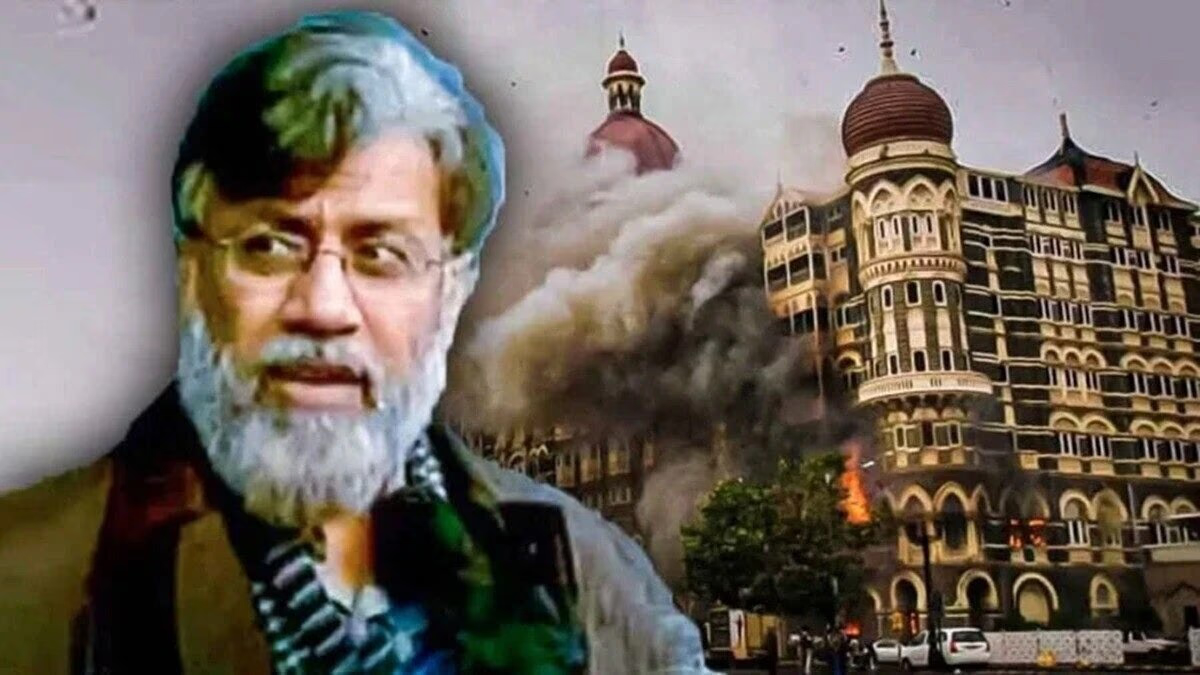
Finally, the mastermind behind the infamous Mumbai attacks, Tahawwur Rana, is being brought to India in a special aircraft. The 64-year-old Canadian of Pakistani descent is being extradited from the U.S. to face charges related to the 2008 Mumbai terrorist attacks.
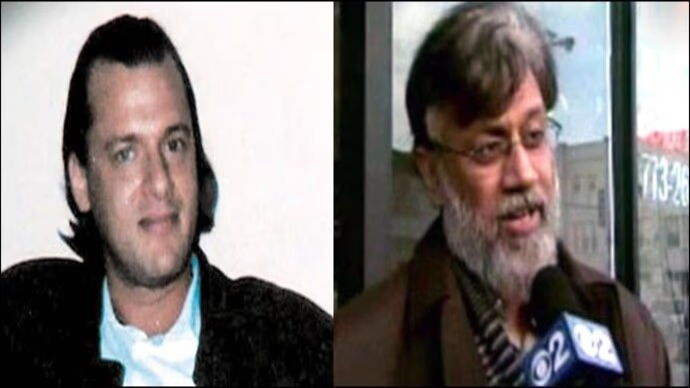
Tahawwur Rana attended Cadet College Hasan Abdal, a renowned military preparatory school where he forged a deep friendship with David Coleman Headley, who later played a pivotal role in the Mumbai attacks' planning. After completing his medical degree, Rana joined the Pakistani Army Medical Corps as a Captain in General Duty Practitioner.
Post-military service, Rana and his wife, who is also a doctor, became Canadian citizens in 2001. Before his arrest in 2009, he lived in Chicago, operating several businesses, including an immigration and travel agency known as First World Immigration Services.
Read More: Tahawwur Rana to appear in NIA court upon arrival in India, headquarters security heightened
In 2006, Rana aided his childhood friend, David Headley, in opening a branch of this immigration firm in Mumbai. The legal business surfaced as a front for his terrorist activities.
The planning of Tahawwur Rana's role in the 2008 Mumbai attacks began around 2005 when he became part of the conspiracy as a member of terrorist organizations Lashkar-e-Taiba (LeT) and Harkat-ul-Jihad-al-Islami (HUJI). Attorneys argued that his immigration firm's Mumbai office was deliberately set up to scout potential terrorist targets in the city.
This claim was corroborated by David Headley, who pleaded guilty to identifying locations for the Mumbai attacks and became a key witness. Rana helped Headley acquire a visa for India and established the 'Immigration Center' in Mumbai, which served as a cover for their operations.
Source: aajtak
Several days before the attacks, from November 13 to November 21, 2008, Tahawwur, along with his wife, Samraz Rana Akhtar, visited several Indian cities including Hapur, Delhi, Agra, Kochi, Ahmedabad, and Mumbai. His early plans had targeted Chabad Houses in various cities.
Evidence revealed that Tahawwur Rana was among the conspirators in the 26/11 attacks and maintained close contact with Pakistan's 'Major Iqbal', believed to be part of Pakistan's Inter-Services Intelligence (ISI) agency. Major Iqbal gave Headley around $1,500 to manage the Mumbai office and approve subsequent plans. Investigations showed that neither Rana nor Headley advanced any legal immigration cases through the Mumbai office, confirming it as merely a front.
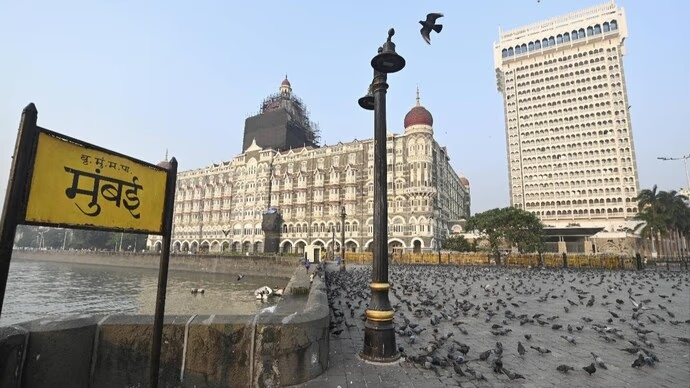
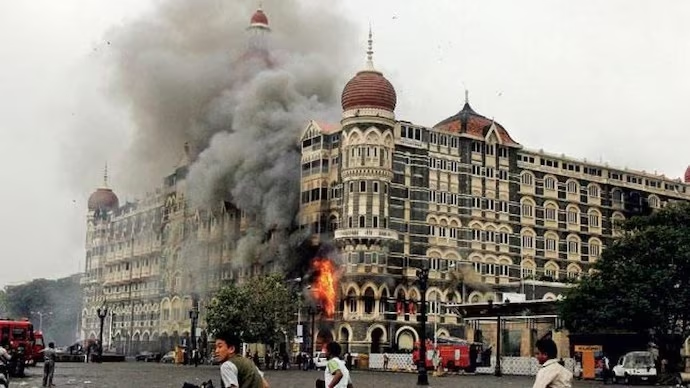
On November 26, 2008, ten Pakistani terrorists attacked Mumbai, targeting locations like the Taj Mahal Palace Hotel, Oberoi Trident, Leopold Cafe, Chhatrapati Shivaji Terminus, and Nariman House (Jewish outreach center). The siege lasted over 60 hours, leaving 166 people dead, including six Americans, and hundreds injured. The attacks were planned with the help of both Tahawwur Rana and Headley, who set and monitored targets.
Read More: Tahawwur Rana extradition: 26/11 attack convict Tahawwur Rana extradited from the U.S., being brought to India by special plane
Between 2007 and 2008, Headley made five lengthy trips to Mumbai for surveillance of targeted locations, receiving instructions from Lashkar members before each trip. After each reconnaissance mission, he would travel to Pakistan to meet Lashkar members and share his findings, including surveillance videos. Tahawwur Rana's immigration business provided the perfect cover for these activities.
Tahawwur Rana grew up in Pakistan and after his medical degree, joined the Pakistani Army Medical Corps. His connection to Pakistan extended beyond his birth and education—he maintained profound ties with Pakistani intelligence services and terrorist organizations. According to investigations, Tahawwur Rana was not just a passive partner but was actively involved with Pakistan-based terrorist group Lashkar-e-Taiba (LeT), responsible for the Mumbai attacks.
Source: aajtak
Evidence presented in court showed that Rana and Headley took deliberate steps to conceal their connections with Pakistan-based conspirators while residing in the USA. After leaving the army, Headley assured Rana of assistance through Major Iqbal, further confirming his links with Pakistani intelligence. The relationship between Rana, Headley, and Pakistan's ISI was so tight that Headley testified that ISI provided both military and moral support to Lashkar.
During his trips to India, Headley regularly communicated with Rana over the telephone—making over 32 calls during his first trip, and similarly during subsequent visits. These conversations exposed the ongoing planning between the conspirators. ISI officer Major Iqbal contacted Rana via telephone and email during Headley's stay in India, deviating from their initial plan to avoid direct contact with the Pakistani conspirators.
After serving in the Pakistani army, Tahawwur Rana and his wife moved to Canada and became citizens in 2001. As a Canadian citizen, Rana was eligible to travel more freely internationally, which played a role in planning his terrorist activities. His Canadian citizenship provided him with a certain level of credibility while setting up businesses in the USA and later in India.
Using his status as a legitimate Canadian businessman, Tahawwur Rana established an immigration consultancy firm in Chicago, which became a foundation for terrorist operations. His Canadian citizenship helped validate his travels and business dealings, which were being used to support terrorist activities.
In October 2009, Tahawwur Rana and Headley were arrested by U.S. authorities for allegedly conspiring to attack the Jyllands-Posten newspaper office in Denmark, which had published cartoons. This investigation led to uncovering his involvement in the Mumbai attacks. In June 2011, after a three-week trial in a U.S. District Court, Rana was convicted for aiding Lashkar-e-Taiba and his role in the failed conspiracy against the Danish newspaper.
Tahawwur Rana was acquitted of direct involvement charges in the Mumbai attacks by a U.S. court, yet he was sentenced to 14 years in prison on January 17, 2013. At sentencing, the judge labeled the conspiracy 'cowardly.' Meanwhile, Headley pleaded guilty to 12 terrorism charges and was sentenced to 35 years. His cooperation with authorities, which included testifying against Rana—helped him avoid the death penalty and extradition.
Source: aajtak
The evidence against Rana was overwhelming. During his trial, recorded conversations were presented, including tapes from September 2009. In other conversations, Rana told Headley that the attackers involved in the Mumbai attacks should receive Pakistan's highest posthumous military honor, indicating his support for the terrorists' actions.
For years, India had been requesting the extradition of Rana to face charges for his role in the Mumbai attacks. In December 2019, India submitted a diplomatic note to the U.S., requesting Rana's extradition, followed by a formal complaint on June 10, 2020, demanding his arrest to initiate the extradition process properly. Success was achieved in February 2025 when then-U.S. President Donald Trump announced during Prime Minister Narendra Modi's visit that his administration had approved Tahawwur Rana’s extradition to India.
Read More: Tahawwur Rana to appear in NIA court upon arrival in India, headquarters security heightened
Tahawwur Rana made numerous attempts to halt his extradition, filing emergency applications in the U.S. Supreme Court to prevent surrendering to India. He argued that extradition would violate U.S. laws and the United Nations Convention Against Torture, claiming he would face torture in India due to his Muslim faith, Pakistani origin, and former membership in the Pakistani military. He also cited health issues such as a heart attack, Parkinson's, and cancer, but the court rejected his pleas, paving the way for his extradition to India.
India has made elaborate preparations to bring Tahawwur Rana to justice. A multi-agency team from India, led by NIA's Inspector General Ashish Batra, traveled to the U.S. to take custody of Tahawwur Rana. The team included Sub-Inspector General Jaya Roy, a senior police officer, and three intelligence agency officers. They departed for the U.S. on Sunday after receiving confirmation of an 'extradition surrender warrant,' under which Rana was handed over to Indian authorities.
Upon arrival in India, Tahawwur Rana will be presented before the NIA court in New Delhi for custody. It is expected that he will be in NIA's custody for interrogation and investigation for the initial weeks. Later, the Mumbai Crime Branch will seek his custody for further investigation of the Mumbai attacks. High-security arrangements have been made in designated jails, including CCTV cameras with in-built bathroom facilities to keep 24/7 surveillance on Rana's activities.