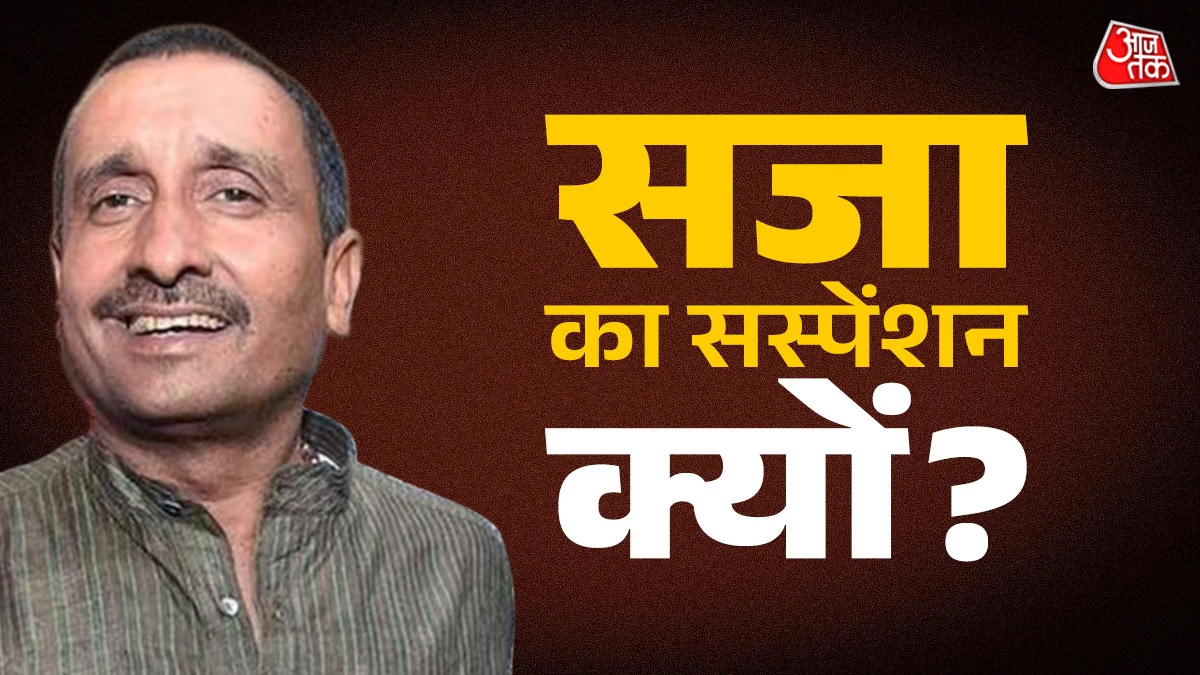
In a significant legal development, the Delhi High Court has opted to suspend the jail term of Kuldeep Singh Sengar, who was convicted and sentenced to life imprisonment in the 2017 Unnao rape case, until his appeal is fully adjudicated. This decision was based on the fact that Sengar has already served over seven years and five months in incarceration. However, despite this reprieve, he remains in prison, serving an additional ten-year term related to the custodial death of the victim’s father, a separate conviction.
Representing Sengar, Advocate SPM Tripathi highlighted that while Sengar was sentenced to life in the rape case, the Delhi High Court’s division bench has allowed his bail, suspending the sentence. Tripathi argued that Sengar was not a public official at the time of sentencing, which, according to their argument, incorrectly influenced the initial verdict.
The primary reason for the court’s decision to grant bail was that, prima facie, the case does not fall under the ‘Aggravated Penetrative Sexual Assault’ category of the POCSO Act. The High Court found insufficient evidence against Sengar under Section 5 of the POCSO Act, which defines aggravated circumstances, particularly as the act considers the role of a 'public servant' in its classification.
The legal defense pointed out discrepancies regarding the victim’s age, noting inconsistent entries across different official records, which they claim undermines the solidity of prosecution evidence. Additionally, the medical reports were not adequately considered during initial trials.
Section 5 of the POCSO Act defines situations where a child's sexual abuse constitutes 'Aggravated Penetrative Sexual Assault'. This includes offenses committed by public servants, police officers, or personnel from armed and security forces, among others, carrying a minimum penalty of 20 years, up to life imprisonment.
The trial court handed Sengar a life sentence based on the belief that he fell under the ‘public servant’ category. It was concluded that misusing the public’s trust, which a public servant is expected to uphold, represents a grievous offense. Thus, Sengar was convicted under Sections 5 and 6 of the POCSO Act.
Divisional Bench Justices Subramanyam Prasad and Harish Vaidyanathan Shankar voiced that Sengar doesn’t fit the definition of a ‘public servant’ under Section 5(c) of the POCSO Act or under IPC Section 376(2)(b). They further stated that Section 5(p), pertinent to persons in positions of trust or authority, also does not apply to him.
The High Court’s order specifies that at this stage, the suspension is based on the court's initial assessment that Sengar doesn't fit under the aggravated assault provision of Section 5 of the POCSO Act, equating to life imprisonment under Section 6. Moreover, since no aggravated assault is identified, the minimum punishment should be seven years, which Sengar has already served.
Delhi High Court’s expansive 53-page judgment notes that Sengar had already completed over seven years and five months in jail. The court highlighted that holding someone in jail for such an extended period while an appeal is pending contradicts Article 21 of the Constitution concerning life and personal liberty. At this juncture, Sengar has served more than the prescribed minimum term for offenses before the 2019 amendment to the POCSO Act.
These proceedings centered around Sengar’s appeal against the life sentence and his plea for suspension. Meanwhile, numerous allegations have been leveled against Sengar regarding the abduction, rape, and subsequent sale of the minor victim between June 11 and 20, 2017, a sequence that led to a series of criminal charges.
In August 2019, the Supreme Court ordered the Unnao rape case's transfer from Uttar Pradesh to Delhi, aiming for expedited hearings. It was mandated that trials occur daily and conclude within 45 days. By December 2019, the trial court deemed Sengar guilty, administering a life sentence, coupled with a separate 10-year term for the victim’s father’s custodial death.
The suspension of a sentence doesn’t equate to exoneration or the nullification of guilt. It implies a temporary halt of imprisonment until the appeal’s final verdict is reached. In this scenario, the Delhi High Court applied the Code of Criminal Procedure (CrPC) Section 389 to suspend Sengar’s sentence, with the stipulation that should the appeal be dismissed, the sentence will resume.
Despite the suspension of his rape conviction, Sengar won’t be released due to concurrently serving a 10-year sentence related to the custodial death of the victim's father, unaccompanied by any bail provision in this regard.
With the suspension of his sentence, several stringent conditions were imposed on Sengar:
Post bail with a personal bond of 1.5 million rupees along with three surety bails of equal amount.
All sureties must be Delhi residents.
A restriction from entering within a 5-kilometer radius of the victim’s residence in Delhi.
No intimidation of the victim or her family.
Must remain in Delhi during the appeal process.
Surrender passport to trial court.
Report every Monday at 10 AM to the local police station.
Immediate revocation of bail upon any condition breach.
The court ensured ongoing CRPF protection for the victim. The Deputy Commissioner of Police for the victim’s region is also tasked with directly overseeing security arrangements. The High Court remarked that continued detention solely on security concerns challenges the efficacy of protective measures.
The victim expressed displeasure over the High Court’s verdict, citing personal responsibilities and concerns over her family’s safety. She questioned the rationale behind easing penalties for such grave offenses after only a few years in prison, decrying the withdrawal of security measures during the trial.
The appeal lodged by Kuldeep Sengar is scheduled for review by a roster bench on January 16, 2026, to determine the continuation or overturning of convictions and sentencing.