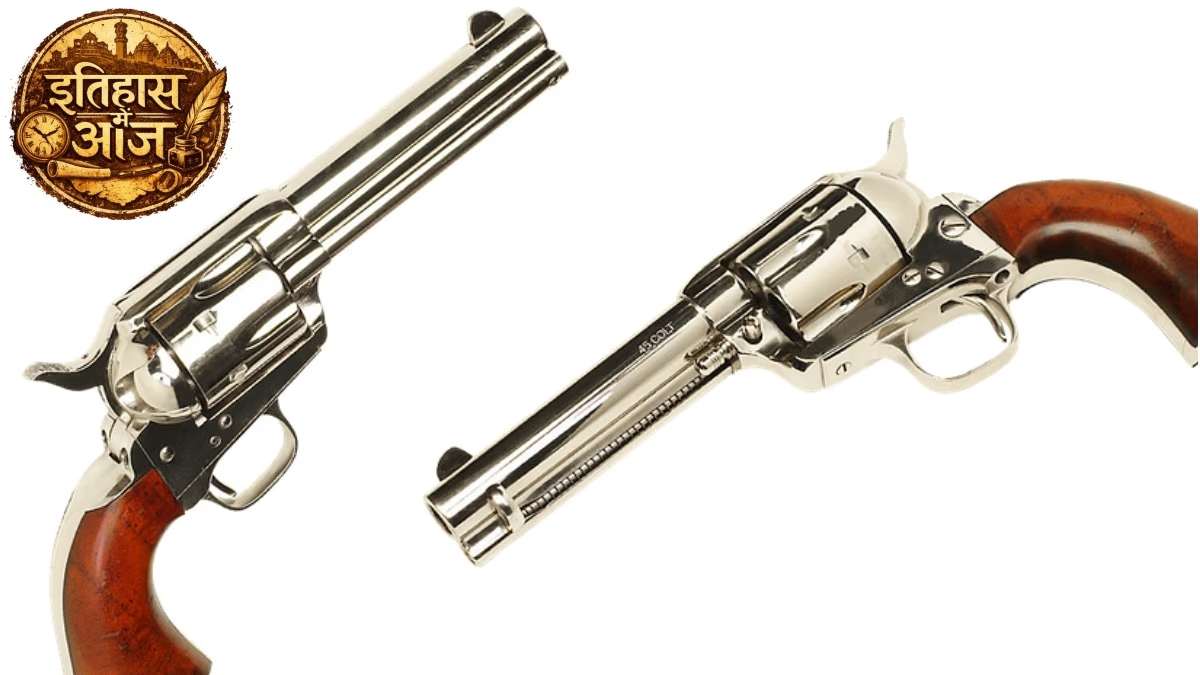
On February 25, 1836, American inventor Samuel Colt was granted a patent for his innovative revolver. His new revolver, featuring a revolving cylinder, was awarded U.S. Patent Number 138 (later 9430X). This momentous creation became famously known as the Colt Revolver.
Born in Connecticut, Samuel Colt (1814-62) devised a handgun capable of firing several shots without the need for reloading. Following this patent achievement, Colt established a company dedicated to producing his revolver design. By the onset of the American Civil War (1861-65), the Colt Revolver had become perhaps the most renowned firearm in the world.
Subsequent improvements were listed in this patent, which included easier loading mechanisms, changes in cylinder weight and position for enhanced stability, and increased firing speed. With financial backing from his family, Colt launched a company to manufacture his innovative firearm. Although initial sales were slow and the business wavered, in 1846 during the Mexican-American War (1846-48), the U.S. government commissioned 1,000 Colt revolvers. By 1855, Colt had opened the world's largest private weapons factory.
Initially, Colt's production included three types of revolving handguns—the Belt Pistol, Holster Pistol, and Pocket Pistol—alongside two rifles. Each model featured a rotating cylinder loaded with powder and shot. Primers were positioned outside the cylinder on a strike plate, with the trigger's pull releasing a hammer onto that plate. This mechanism allowed the weapon to fire up to six rounds before needing a reload.
Learn More: The Historic Battle of Karnal When Nader Shah Defeated the Mughal Army
Some argue that Colt's revolver was not merely an invention but rather a significant innovation or advancement of the already-patented revolving flintlock mechanism (used in muskets and rifles) by Boston inventor Elisha Collier (1788-1856).
Discover More: How Edison's Phonograph Patent Revolutionized the World of Music
Samuel Colt was born on July 19, 1814, in Hartford, Connecticut. As the son of textile manufacturer Christopher Colt and Sarah Colt, his fascination with mechanics was sparked by time spent in his father's mill in Massachusetts and helping on a nearby farm, where he frequently disassembled items, including his father's guns to study their workings.