
Christmas trees, beautifully adorned with twinkling lights and toys, can be seen in corners, malls, street squares, and even in the homes of those who aren't Christians. The decorative conifer planted in a pot often circles greetings of 'Merry Christmas'.
Feng Shui and Vastu Shastra with the Christmas Tree
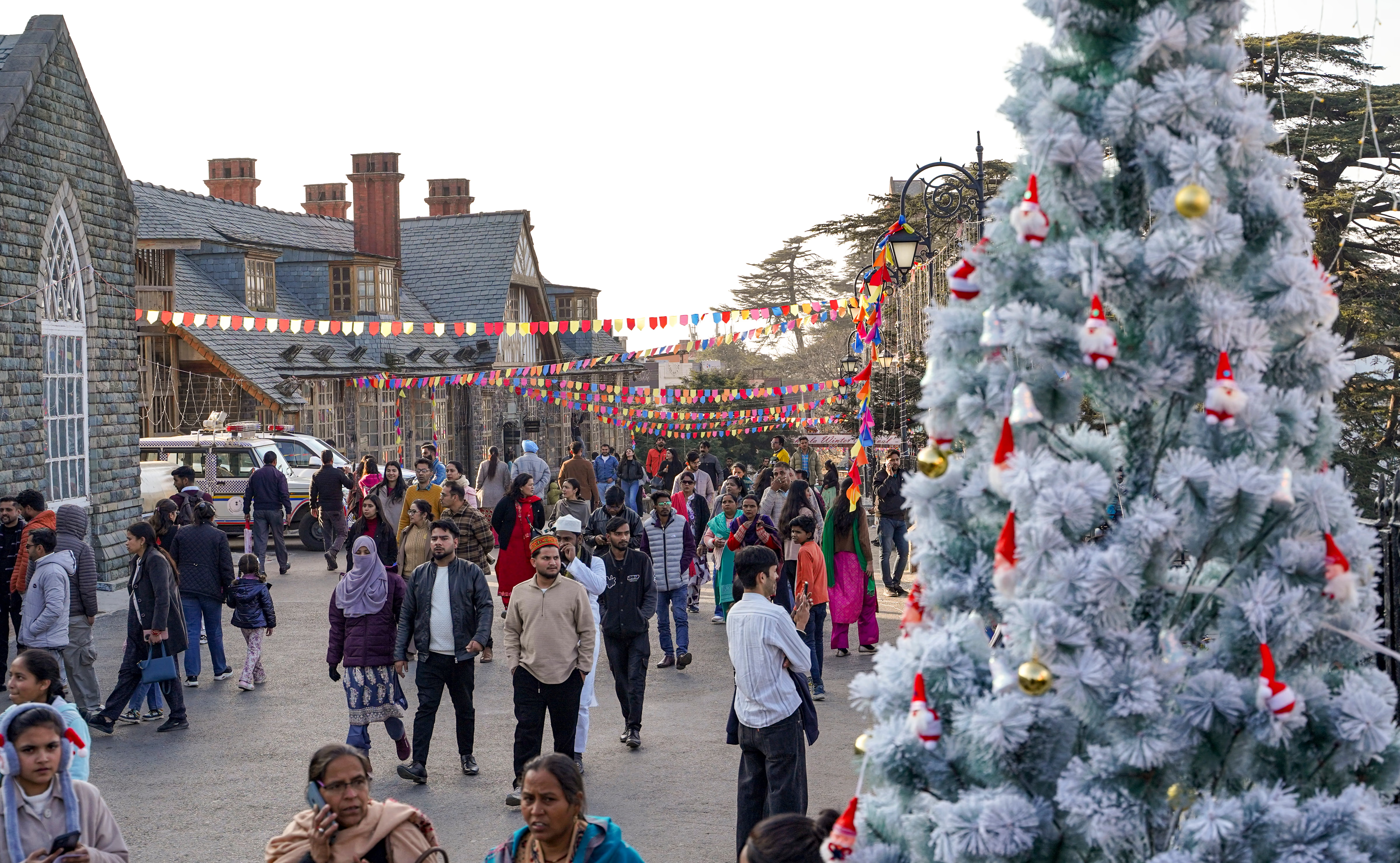
Over the last two decades, Christmas—through market influences—has spread to Indian neighborhoods, gradually gaining recognition even in decorative symbolism. According to Japanese Feng Shui, the Christmas tree is known as the tree of happiness, while in Vastu Shastra, its green color is linked with prosperity and positivity.
Significance of Pine Trees in Hindu Traditions
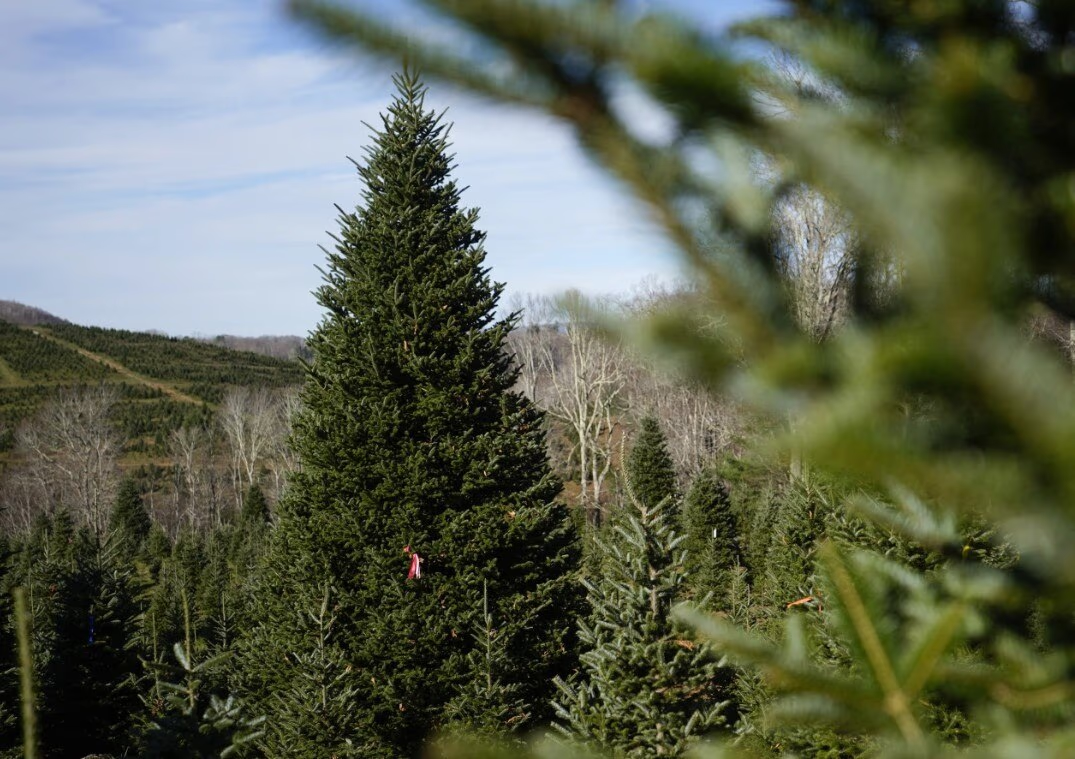
Pine trees, commonly used as Christmas trees, have significance in Hindu tradition as well, being regarded as the trees of gods. In the northern hilly regions of India, they are also seen as the home of forest deities. So, even outside the context of Christmas, pine trees hold a place in our sacred tree traditions.
Source: aajtak
The Bible and the Christmas Tree
A surprising fact about the Christmas tree is its absence in the Bible. Although the Book of Jeremiah mentions carved trees adorned with gold and silver, this description pertains to ancient idol worship rather than Christmas trees.
From Folklore to Market Trends
The Paradise Tree mentioned in the story of Adam and Eve—akin to a fruit-bearing tree—is not a Christmas tree. The modern Christmas tree intertwines religion, folklore, weather, politics, reform movements, and consumerism, with roots stretching back long before Christianity.
European Winters and the Symbolism of Christmas
European winters brought not just cold but also 'darkness and uncertainty'. Long nights and barren fields painted a bleak picture. Evergreen trees, which remain vibrant through winter, symbolized life. They offered hope that life persevered, even if momentarily paused.
This led to evergreen trees being welcomed into homes during pre-Christian pagan celebrations in Europe, meant to ward off evil forces and welcome positivity.
The German Influence to Present Day
The origin of the modern Christmas tree can be traced to 'Central Europe', specifically emerging from Germany and reaching Estonia and Latvia. During the 15th and 16th centuries, Protestant Christian communities popularized this tradition, which spread globally like tree branches reaching into distant lands.
Initially, Christmas trees weren't found in homes but rather in 'Guild Halls'—community buildings of trade organizations. On festival days, children and young people would pluck apples, nuts, sweets, and colorful paper flowers from these trees, representing festivities and community spirit.
A name recurrent in Christmas tree history is 'Martin Luther'. Legends recount a snowy night when Luther saw stars twinkling through the trees, inspiring him to decorate a tree at home with candles, thus giving birth to the tradition of decorating trees with light. With the advent of electricity, candles gave way to 'electric lights'.

Source: aajtak
The 'Paradise Tree': Pre-Christmas Tree Legends
Understanding the Christmas tree's history requires stepping beyond church doors to medieval religious plays and stories. On December 24, celebrated as Adam and Eve's feast day—a precursor to Christmas—'Paradise plays' were held, featuring a particular tree adorned with apples symbolizing the tree of knowledge and original sin. White wafers on the tree signified redemption.
Known as 'Paradise Tree', these plays inspired by religious biblical tales featured the 'tree of knowledge' as a significant element in promotional posters. Over time, the plays faded, but the decorative tree became popular, moving from church stages to markets, and eventually into people's homes, laying the foundation for the modern Christmas tree.
Ancient Traditions and Myths
Before Christianity spread, Europe practiced 'tree worship'. Norse myths spoke of 'Yggdrasil', a giant tree seen as the cornerstone of the universe. In Viking and Saxon cultures, trees weren't just a part of nature—they were a conduit to the gods. The saga of Saint Boniface cutting down Donar's Oak represents this cultural intersection. Later folklore claimed a new evergreen tree grew in its place, its triangular shape symbolizing Christian doctrine. Thus, pagan symbols gradually morphed into Christian meaning.
The Christmas tree wasn't always a private celebration. In Baltic countries, it served as a 'public festival' centerpiece. In the 16th century, merchant associations like the 'Brotherhood of Blackheads' placed Christmas trees in city squares in Tallinn and Riga. People sang, danced, and celebrated around the tree, sometimes ending the festival by burning it, symbolizing the farewell to the old and the welcome of the new.
Source: aajtak
For a long time, Christmas trees were mainly a 'Protestant society' fixture. The Catholic Church focused on nativity scenes or 'Christmas Cribs'. By the 18th and 19th centuries, Christmas trees gradually entered Catholic traditions, culminating in the placement of the first official Christmas tree in the Vatican in 1982.
In the 19th century, the Christmas tree obtained a 'royal touch' as it gained popularity in the imperial courts of Austria, France, Denmark, and Russia. In Denmark, Hans Christian Andersen's story 'The Fir Tree' bestowed an emotional and literary dimension to it.
Typically, Christmas trees are upright with cone-shaped tops, but Poland has its unique tradition. For centuries, a branch of pine or fir tree was hung upside down from the ceiling. Apples, nuts, straw stars, and paper cutouts adorned it, symbolic of prosperity, security, and bountiful harvests.
What's Included in Christmas Tree Decorations?
Every ornament on a Christmas tree holds meaning. 'Star': The Star of Bethlehem 'Angel': Angel Gabriel 'Red Balls': Apples and original sin 'Lights': Light of Christ 'Sweets': Celebration and joy
Today, the Christmas tree has grown beyond a religious symbol, becoming part of 'global culture'. Not only real trees but artificial ones have joined this tradition. LED lights, theme-based decorations, and each year's fresh trends become part of its adornment.