This morning (December 24), a tragic news struck. Turkey announced that a plane crash over its airspace claimed the entire Libyan military leadership. Among the casualties were Libyan Army Chief General Mohammed Ali Ahmad Al-Haddad, Ground Forces Chief Al-Fituri Ghraibal, Military Manufacturing Authority Director Mahmoud Al-Katavi, Al-Haddad's advisor Muhammad Al-Asawi Diab, and military photographer Muhammad Umar Ahmed Mahjoubi.
Just days earlier, Pakistan's Army Chief Asim Munir announced a significant military agreement with Libya. According to Pakistan, it has agreed to supply Libya with $4 billion worth of arms.
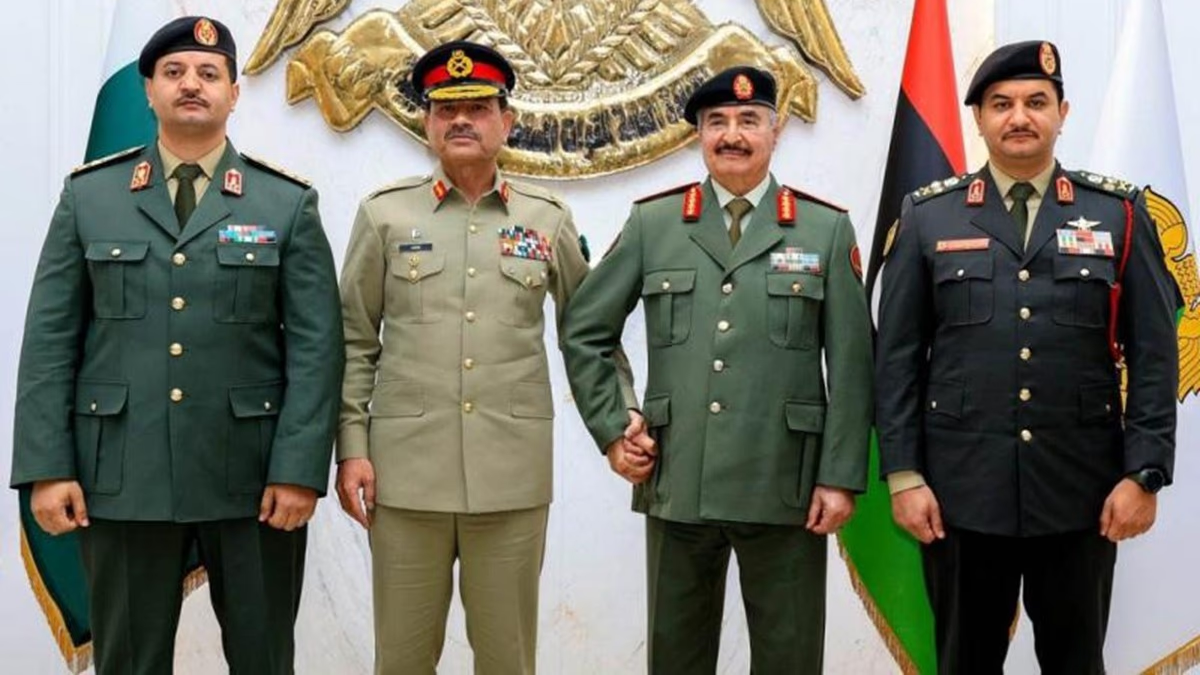
Asim Munir signed the agreement with Khalifa Belqasim Haftar, alleged Libyan army chief. But, the army chief we mentioned earlier killed in the plane crash was General Staff Chief Mohammed Ali Ahmad Al-Haddad.
How can Libya have two army chiefs?
The answer lies in how Pakistan has defied UN and international regulations by selling arms to Libya.
The presence of two army chiefs in Libya indicates a nation split between two leaders. This situation arose after the fall of Muammar Gaddafi in 2011, leading to power struggles between western and eastern factions in Libya.

Source: aajtak
One army chief is under the Tripoli government, the internationally recognized western Libyan government, led by General Mohammad Ali Al-Haddad. This government also enjoys UN support.
Field Marshal Asim Munir visited Libya on December 18, 2025, meeting with LNA leaders under General Khalifa Belqasim Haftar, not officially recognized by the UN.
The UN imposes an arms embargo on Libya, banning weapons and military equipment supplies unless explicitly permitted by the UN Security Council, which applies only to internationally recognized entities within Libya.
But Asim Munir clandestinely negotiated with Haftar's LNA, violating international law with the sale of 16 JF-17 fighter jets and 12 Super Mushak trainer aircraft.
Despite other nations also supplying arms, Munir's deal defies international consensus and legality.
To justify, Pakistani officials argue that other countries like UAE, Egypt, and Russia also trade with Haftar, highlighting the lack of personal sanctions on him.
Israel's perspective labels the Munir-Haftar deal as undermining the UN arms ban, signaling the rise of independent military-industrial channels beyond western oversight.
Amid economic challenges, this deal gives Pakistan vital export opportunities, while offering LNA access to advanced military hardware without diplomatic hurdles from the US or EU.
General Munir portrays this partnership as a Pan-Islamic solidarity gesture over mere transactional intrigue, commending Libya as "land of lions."