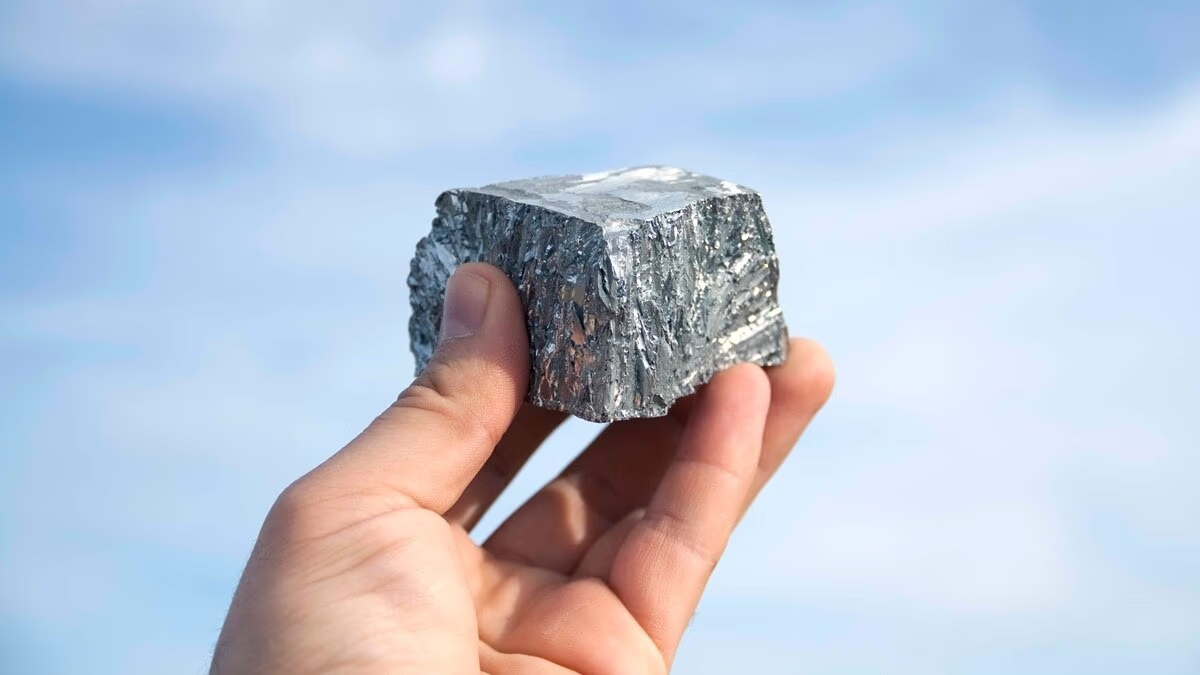
The central government made two pivotal decisions on Wednesday to accelerate the country's industrial and urban development. During a Cabinet meeting, chaired by Prime Minister Narendra Modi, a new plan promoting domestic production of rare earth permanent magnets (REPM) was approved, with a total budget set at ₹7,280 crore.
Information and Broadcasting Minister Ashwini Vaishnaw reported that this scheme includes ₹6,450 crore in performance-based incentives to be provided to industries over the next five years. The government's primary aim is for India to achieve self-reliance in rare earth magnets, as currently, China controls the global supply.
A positive development: Indian companies receive rare earth minerals license from China
According to Vaishnaw, rare earth minerals are found in various coastal regions and ancient geological areas like Gujarat and Rajasthan. The permanent magnets made from these minerals are essential for electric vehicles, defense technology, electronics, space research, and high-tech manufacturing. The government believes this scheme will not only boost investments but also create thousands of jobs and strengthen India's strategic capabilities.
Approval granted for Pune Metro's expansion
The second major decision made in the meeting was the approval of Pune Metro's expansion. The Central Cabinet sanctioned Line-4 (Kharadi-Hadapsar-Swargate-Khadakwasla) and Line-4A (Nal Stop-Verje-Manik Bagh) under Phase-2. The projected cost of this project is ₹9,857.85 crore, with a targeted completion within five years.
US-Australia strike a significant deal on rare earth minerals, a setback for China!
Improved metro connectivity for residential areas
The new metro lines will stretch approximately 31.6 kilometers and feature 28 elevated stations, enhancing connectivity to IT parks, business districts, educational hubs, and densely populated residential areas in east, west, and south Pune. The project costs will be jointly shouldered by the central government, Maharashtra government, and international funding agencies.
The government asserts that this initiative will not only modernize urban transportation but also help reduce traffic congestion, cut pollution, and boost the regional economy.